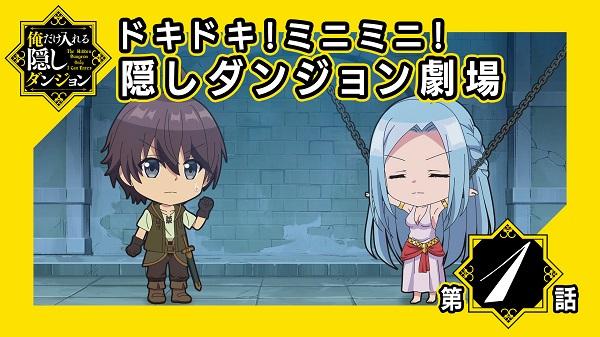
The Hidden Dungeon Only I Can Enter
俺だけ入れる隠しダンジョン (Ore dake Haireru Kakushi Dungeon)
- Action
- Adventure
- Ecchi
- Fantasy
- Harem
- Episodes
- 12
- Duration
- 24 min per ep
- Aired
- Jan 9, 2021 to Mar 27, 2021
- Status
- Finished Airing
Synopsis
Noir Stalgia may carry a noble name, but he’s treated as the lowest of the low by the aristocrats around him. His one advantage is a rare gift: the ability to consult the Great Sage, an all-knowing oracle that can provide answers to any question. After he fails to land a librarian position, Noir sets his sights on enrolling in the Hero Academy—only to realize he’ll need far more strength to get in.
Following the Great Sage’s guidance, Noir ventures into a secret dungeon hidden in the mountains and encounters Olivia Servant, a striking young woman bound within the labyrinth. Their meeting grants Noir an absurdly potent set of skills that can bend reality itself, but every use drains his life points and threatens his survival. To restore his energy, he’s forced to indulge in “worldly pleasures,” including stealing kisses from his childhood friend. Armed with risky power and a growing circle of companions, Noir begins life at the Hero Academy while stepping in to help others through the troubles ahead.
Otaku Consensus
Otaku Consensus: The Hidden Dungeon Only I Can Enter lands as breezy, unapologetically ecchi fantasy comfort food: Kenta Oonishi's direction and Kenta Ihara's series composition keep the 12-episode run moving through compact, episodic academy-and-dungeon scenarios rather than bogging it down in lore. Its strongest reception tends to center on the absurd LP reward loop, the female-harem comedy, and the late Olivia material that viewers singled out as more emotionally effective than expected. The dominant criticism is not confusion but squandered potential: many viewers found a promising dungeon-power premise executed in a highly generic way, reflected in its modest MAL 6.27 and AniList 61/100 scores despite strong popularity.
Why You Should Watch
Watch this if you want a fantasy power trip that treats its RPG mechanics as a dirty joke machine, not a sacred rulebook. The Hidden Dungeon Only I Can Enter is for viewers who enjoy academy ranking, dungeon grinding, harem escalation, and ecchi payoff without the heavier worldbuilding baggage of more serious isekai-adjacent fantasy. It scratches a similar itch to the lighter sides of How Not to Summon a Demon Lord and In Another World With My Smartphone, but with a more overt "pleasure as fuel" gimmick and a surprisingly data-friendly cocktail of magic, guns, swordplay, class resentment, and fanservice. The appeal is in the snackable pacing: 12 episodes, finished airing, mostly episodic problems, and enough Olivia-focused material near the end to give the gag structure a small emotional aftertaste.
Key Characters
- NNoir Stalgia
Noir is memorable less as a standard underdog noble than as a protagonist whose power fantasy is tied to a deliberately shameless cost-benefit system built around life points and sensual indulgence.
- OOlivia Servant
Olivia functions as the show's striking mentor figure, and viewer discussion often points to her late-series background as the point where the anime briefly punches above its usual disposable-fantasy weight.
- EEmma
Emma anchors the harem side of the series by making the fanservice economy feel personal rather than purely mechanical, especially through her role in Noir's life-point recovery dynamic.
- LLuna
Luna represents the series' broader primarily female supporting cast, which AniList users identify as central to the show's identity through its 92% Female Harem and 60% Primarily Female Cast tags.
What Makes It Stand Out
- 1
AniList's tag spread captures the show's unusual genre cocktail: Female Harem at 92%, Magic at 79%, Dungeon at 78%, Guns at 73%, and Feet at 56%. That combination explains why the series feels less like straight fantasy adventure and more like an ecchi RPG parody with weapon-mix novelty.
- 2
The anime is structurally episodic, with AniList marking Episodic at 64%, so the 12-episode run emphasizes short academy, dungeon, and companion-focused incidents over a single long campaign arc. This is a major reason viewers describe it as easy, mildly entertaining viewing even when they criticize its generic execution.
- 3
Okuruto Noboru's TV production puts its emphasis on character-forward comedy and fanservice readability rather than elaborate battle spectacle. The named production spine includes director Kenta Oonishi, character designer Yuuya Uetake, and main animator Takayuki Nakao.
- 4
The late Olivia material has a better reputation than the series' overall score suggests, with viewer commentary specifically calling the ending and Olivia's background the emotional high point. That makes her role a notable exception to the show's otherwise gag-driven rhythm.
- 5
Class tension is not just flavor text: AniList tags Class Struggle at 50%, matching the show's recurring interest in noble status, social ranking, and academy access. It gives the harem-fantasy framework a light social-friction layer without turning the series into political fantasy.
Fun Facts & Trivia
- Fun fact 1
- The anime adapts Meguru Seto's light novel series, with original character designs by Note Takehana. The light novel ran from January 5, 2017 to February 2, 2021, meaning the source concluded while the TV anime was airing.
- Fun fact 2
- The franchise also had a manga run from May 2, 2018 to June 20, 2023, outlasting the anime broadcast by more than two years. That makes the 2021 TV version only one slice of a longer-running light-novel franchise.
- Fun fact 3
- The TV anime aired from January 9, 2021 to March 27, 2021 for a complete 12-episode season. It was produced by Okuruto Noboru, with Kenta Oonishi directing and Kenta Ihara handling series composition.
- Fun fact 4
- Its reception profile is a classic popularity-versus-score split: on MyAnimeList it sits at a modest 6.27/10 and rank #9391, yet its popularity rank is #608 with 226,832 votes. AniList shows a similar lukewarm-but-visible footprint at 61/100 with 1,903 favourites.
- Fun fact 5
- The credited visual staff includes art director Masanobu Nomura, art designer Toshiki Amata, color designer Tomoko Saitou, and director of photography Takao Saitou. Those roles shaped the show's bright fantasy-academy presentation more than any single action set piece.
Studios
- Okuruto Noboru