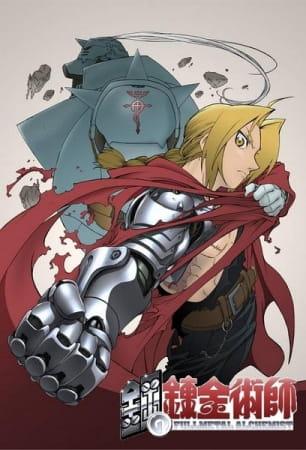
Fullmetal Alchemist: The Movie - Conqueror of Shamballa
劇場版 鋼の錬金術師 シャンバラを征く者 (Fullmetal Alchemist: The Conqueror of Shamballa)
- Action
- Adventure
- Award Winning
- Drama
- Fantasy
- Historical
- Military
- Episodes
- 1
- Duration
- 1 hr 44 min
- Aired
- Jul 23, 2005
- Status
- Finished Airing
Synopsis
After sacrificing everything to save Alphonse, Edward Elric finds himself stranded far from home—in Munich, Germany, in the uneasy aftermath of World War I. Cut off from alchemy and from any clear path back, he tries to survive in a world that feels utterly alien, throwing himself into research for another way across while working alongside people who uncannily resemble those he left behind. As economic hardship deepens and resentment spreads through the city, the tension of a shaken nation begins to ripple beyond its borders.
Back in his own world, Alphonse refuses to accept Edward’s loss. Determined to reunite, he pursues answers through the study of alchemy, following every lead he can in hopes of finding a way to reach his brother again.
Otaku Consensus
Seiji Mizushima’s energetic direction, Bones’s theatrical-scale action, and the film’s unusually serious use of Weimar-era politics give the 2003 anime a visually forceful, historically textured coda. Its reach exceeds its runtime, however: compressed pacing, underused supporting characters, and unresolved logic prevent the promised closure from matching the television series’ patient moral and character development.
Why You Should Watch
If your preferred Fullmetal Alchemist is the darker, anime-original 2003 continuity—and you want its emotional endpoint without committing to another series—Conqueror of Shamballa is essential context. Bones trades television-scale staging for widescreen machinery, aerial combat, firearms, and CG-assisted spectacle, while director Seiji Mizushima treats postwar resentment and occult nationalism as more than decorative period flavor. The result scratches some of the same alternate-history itch as Jin-Roh and Saga of Tanya the Evil, but retains Fullmetal Alchemist’s fixation on sacrifice, identity, and the cost of pursuing an ideal. It is best approached not as a self-contained adventure or a manga adaptation, but as an ambitious final movement whose urgency, historical references, and parallel-world imagery compensate for a noticeably compressed screenplay.
Key Characters
- EEdward Elric(VA: Romi Park)
Edward is written as a more subdued and isolated young adult than his television-series incarnation, giving Romi Park room to temper his familiar volatility with exhaustion and introspection.
- AAlphonse Elric(VA: Rie Kugimiya)
Alphonse preserves the brothers’ emotional center while displaying a firmer independence, with Rie Kugimiya balancing youthful warmth against increasingly decisive conviction.
- AAlfons Heiderich(VA: Shun Oguri)
Alfons turns the franchise’s counterpart motif into a study of resemblance without equivalence, making him more than a simple replacement for someone Edward misses.
- NNoah(VA: Miyuu Sawai)
Noah gives the film’s political history a vulnerable outsider’s perspective, while Miyuu Sawai’s restrained performance distinguishes her from the cast’s more theatrical personalities.
What Makes It Stand Out
- 1
This is the direct feature-length conclusion to Seiji Mizushima’s 2003 Fullmetal Alchemist television continuity, not a sequel to Brotherhood and not an adaptation of Hiromu Arakawa’s manga ending.
- 2
Bones frames the film around a two-world structure, using visual counterparts and repeated character designs to examine how familiar appearances can conceal radically different lives and values.
- 3
The historical backdrop draws on the Weimar Republic, post-Treaty economic resentment, early Nazi agitation, and German occult mythology rather than using interwar Europe as generic scenery.
- 4
Mechanical designer Hitoshi Fukuchi and creature designer Junya Ishigaki support a larger theatrical vocabulary of rockets, aircraft, armor, firearms, and CG-assisted machinery while Yoshiyuki Itou maintains continuity with the television character designs.
- 5
Its action is presented in a 1.85:1 widescreen composition; later 1080p releases were specifically praised for the expansive image and powerful, dynamic audio presentation.
Fun Facts & Trivia
- Fun fact 1
- The film opened in Japan on July 23, 2005, functioning as a single theatrical epilogue to a television story that had already departed substantially from Arakawa’s still-running manga.
- Fun fact 2
- Hiromu Arakawa is credited as the original creator, but director Seiji Mizushima and the anime staff developed this conclusion for the 2003 adaptation’s separate continuity.
- Fun fact 3
- Alfons Heiderich is voiced by Shun Oguri, a prominent live-action actor, rather than by a performer from the Elric brothers’ established voice pairing of Romi Park and Rie Kugimiya.
- Fun fact 4
- The production credits separate art direction from art design: Kazuo Ogura served as art director, while Hideyasu Narita and Naomi Ubukata handled art design, reflecting the film’s need to distinguish its historical and fantastical environments.
- Fun fact 5
- Even the film’s branding received a dedicated specialist credit, with Tsuyoshi Kusano responsible for the title logo design.
Studios
- Bones