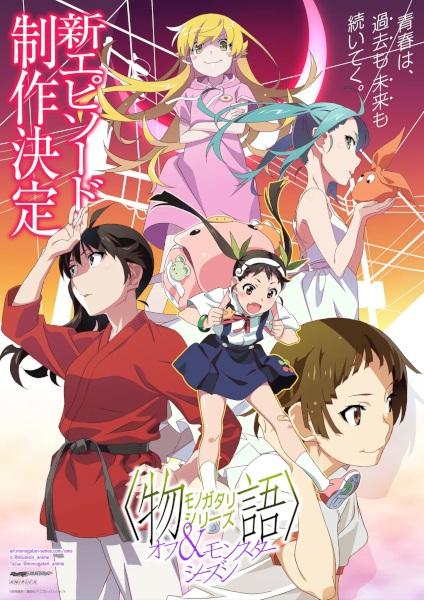
Monogatari Series: Off & Monster Season
〈物語〉シリーズ オフ&モンスターシーズン
- Comedy
- Mystery
- Supernatural
- Vampire
- Episodes
- 14
- Duration
- 25 min per ep
- Aired
- Jul 6, 2024 to Oct 19, 2024
- Status
- Finished Airing
Synopsis
After spending his final year of high school helping local girls untangle strange supernatural afflictions, Koyomi Araragi leaves for university—only for new curses and oddities to keep surfacing back home. In his absence, Yotsugi Ononoki—a former corpse now living as a doll—moves into the Araragi household to watch over his sister Tsukihi, who carries a mysterious secret, and to step into the role of resident occult problem-solver for the town.
Among those drawn back into the paranormal is Nadeko Sengoku, a middle schooler still trying to steady herself after recent encounters with the unknown. Avoiding school, she shuts herself away to focus on her goal of becoming a manga artist, until Yotsugi urges her into a risky shortcut: creating four duplicates of herself, each embodying a different side of her personality. When those copies slip away and begin stirring up trouble around town, Nadeko is left to track them down—confronting the pieces of herself she can no longer ignore.
Otaku Consensus
Monogatari Series: Off & Monster Season lands as a confident late-franchise victory: Shaft’s Shinbou-guided direction, Midori Yoshizawa’s series handling, and the adaptation’s willingness to let side characters carry the philosophical weight keep it from feeling like an afterword. The Nadeko-centered material is the clear critical hook, turning the franchise’s trademark wordplay and self-interrogation into one of its sharpest coming-of-age studies. Its real weakness is also the franchise’s old gate: the achronological structure, dense Japanese-language puns, and post-Final Season continuity make it punishing for newcomers.
Why You Should Watch
Watch this if you want supernatural mystery where the “case” is really a philosophical autopsy of identity, performance, guilt, and growing up. Off & Monster Season scratches the same cerebral itch as The Tatami Galaxy’s verbal velocity and Rascal Does Not Dream’s adolescent paranormal metaphors, but with Monogatari’s harsher editing rhythms, typography, and theatrical staging. It is especially rewarding for viewers who want a female-led continuation that does not reduce its cast to postscript status after Araragi’s high-school story. The appeal is not action escalation; it is watching conversations, visual jokes, urban-fantasy rules, and meta commentary turn into emotional pressure. If you want vampire-adjacent occult fiction without standard exorcist battles or tidy case-of-the-week closure, this is where the series’ later-era confidence pays off.
Key Characters
- KKoyomi Araragi
His reduced presence becomes part of the season’s design, letting the world he used to mediate reveal which problems were never really his to solve.
- YYotsugi Ononoki
Her deadpan doll persona makes her a perfect Monogatari lead: emotionally unreadable on the surface, yet precise enough to expose everyone else’s contradictions.
- NNadeko Sengoku
Fans talk about her here as one of the franchise’s strongest self-examination vehicles, because her arc turns artistic ambition and self-image into supernatural conflict.
- TTsukihi Araragi
Her deceptively ordinary little-sister energy sits on top of one of Monogatari’s strangest identity questions, making her a natural fit for the Off Season focus.
What Makes It Stand Out
- 1
Shaft remains the defining visual author of the anime version, with Akiyuki Shinbou credited as chief director and series composition lead. The season keeps the franchise’s recognizable grammar of abrupt cuts, graphic text, theatrical interiors, and surreal urban spaces rather than chasing a more conventional supernatural-drama style.
- 2
This is not a simple sequel cour to Final Season; it adapts material from the later Off Season and Monster Season phases of NISIOISIN’s light novel structure. That placement lets the anime shift attention away from Araragi as default narrator and toward a primarily female cast.
- 3
The season leans into achronological storytelling, a trait highlighted in AniList’s tags, rather than presenting the franchise’s timeline as a clean forward march. That structure makes the viewing experience closer to assembling a dossier than following a linear occult adventure.
- 4
The Nadeko material stands out because it connects the series’ supernatural logic to manga-making, self-caricature, and the act of drawing yourself into a future. It is one of the clearest examples of Monogatari using a character’s creative work as more than flavor text.
- 5
Its reception is unusually strong for such a continuity-heavy title: MAL lists it at 8.64 from 40,618 votes with a rank of #89, while AniList records an 86/100 score and 1,171 favourites. That gap between high ranking and lower popularity reflects a sequel season embraced intensely by committed viewers rather than casual sampling.
Fun Facts & Trivia
- Fun fact 1
- The broader Monogatari novel/anime framework is organized into six main seasons: First Season, Second Season, Final Season, Off Season, Monster Season, and Family Season. Off & Monster Season therefore adapts material from the fourth and fifth major phases rather than from the original high-school run.
- Fun fact 2
- NISIOISIN is credited as the original creator, with VOFAN as the original character designer and Akio Watanabe handling anime character design. That trio preserves the line from the novels’ illustrated identity to Shaft’s long-running animated interpretation.
- Fun fact 3
- Akiyuki Shinbou has two major credits on this season: chief director and series composition. Series composition is also credited to Fuyashi Tou, keeping the writing structure tied closely to Shaft’s established Monogatari production style.
- Fun fact 4
- The art-side credits are unusually specific in the production data: Hisaharu Iijima is art director, Seiji Oohara is credited for art design on episodes 1-6 and 9-14, and Yasuko Watanabe handles color design. Those roles matter in a franchise where rooms, color blocks, and negative space often carry as much meaning as movement.
- Fun fact 5
- The season finished its 14-episode run from July 6, 2024 to October 19, 2024. Its MAL popularity rank of #2332 sits far below its score rank, which is a useful signal that this is a specialist sequel with a concentrated fanbase rather than a broad entry-point hit.
Studios
- Shaft