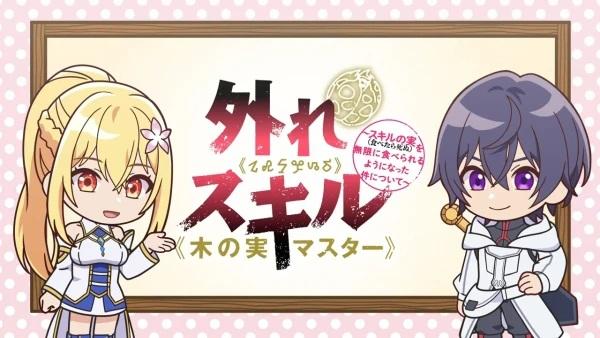
Bogus Skill <<Fruitmaster>>: About That Time I Became Able to Eat Unlimited Numbers of Skill Fruits (That Kill You)
外れスキル《木の実マスター》 ~スキルの実(食べたら死ぬ)を無限に食べられるようになった件について~ (Hazure Skill "Kinomi Master": Skill no Mi (Tabetara Shinu) wo Mugen ni Taberareru You ni Natta Ken ni Tsuite)
- Action
- Adventure
- Fantasy
- Episodes
- 12
- Duration
- 23 min per ep
- Aired
- Jan 7, 2025 to Mar 25, 2025
- Status
- Finished Airing
Synopsis
In a world where abilities are granted by eating rare Skill Fruits, the rule is absolute: a second fruit means instant death. Light Underwood dreams of becoming an adventurer alongside his childhood friend, Lena Floria, but fate deals him an underwhelming draw—Fruitmaster, a skill meant for improving fruit cultivation. Things grow harder when Lena receives a remarkable ability and the two are separated.
Left to start over, Light settles into life as a farmer and takes in a young girl named Ayla Lawrence. A misunderstanding leads to them eating Skill Fruits again—yet Light survives and unexpectedly gains another skill, one better suited to battle, while retaining Fruitmaster. With the seemingly impossible now within reach, Light sets his sights on reuniting with Lena and carving out a name for himself as an adventurer strong enough to make history.
Otaku Consensus
Otaku Consensus: Bogus Skill Fruitmaster lands as a low-scoring but legible comfort-watch for viewers who enjoy rule-breaking ability systems more than intricate fantasy plotting. Ryuuichi Kimura’s direction and Gigaemon Ichikawa’s series composition keep the 12-episode run moving, and the farming/adoption material gives the show a slightly different texture from standard guild-rank power fantasy. The recurring weakness is adaptation thinness: source-context details such as Light’s initial distrust of his new skills were reportedly cut, leaving some character logic flatter than it is on the page.
Why You Should Watch
Watch this if you like skill-tree fantasy that gets to the payoff quickly and does not ask for a grimdark buy-in. Bogus Skill Fruitmaster works best as a compact, game-mechanic adventure: every new ability is a rules question, not just a bigger explosion, and the agricultural angle gives the party-building a softer hook than another guild-grind clone. The AniList tag mix tells you its flavor better than the genre labels do: magic, creature taming, agriculture, adoption, swordplay, fairies, and even necromancy/zombies all share the same 12-episode runway. It scratches a lighter version of the same progression itch as That Time I Got Reincarnated as a Slime or Arifureta, but with less world-politics and a more direct “break the system” pleasure loop.
Key Characters
- LLight Underwood
Light is interesting less as a traditional underdog than as a walking stress test for the world’s Skill Fruit rules, which makes his scenes hinge on loopholes, risk, and system exploitation.
- LLena Floria
Lena functions as the high-achievement contrast point in the cast, giving the adventure a personal benchmark beyond guild rankings and monster fights.
- AAyla Lawrence
Ayla brings the show’s adoption tag into focus, softening the power-progression formula with a found-family dynamic rather than treating every companion as battle utility.
What Makes It Stand Out
- 1
The adaptation is a complete single-cour package: 12 episodes aired from January 7 to March 25, 2025, with web listings noting the season collected in a single Blu-ray release.
- 2
Its genre identity is more specific than the basic Action/Adventure/Fantasy label suggests; AniList’s strongest tags include Magic at 83%, Creature Taming at 60%, Agriculture at 56%, and Adoption at 55%.
- 3
The show’s fantasy toolkit is unusually mixed for a light power-progression anime, pairing swordplay and fairies with darker elements such as necromancy and zombies in the same tag profile.
- 4
The anime version appears to streamline source-material characterization: web discussion notes that Light’s uncertainty about whether skills like Poison Immunity and Sword God are real is cut from the adaptation.
- 5
Asahi Production’s staff list emphasizes a split visual-design pipeline, with Tomoka Ootaki and Risa Miyadani credited for character design, Kumiko Shishido for prop design, and Arisa Taira leading the art direction.
Fun Facts & Trivia
- Fun fact 1
- The original story is credited to Hanyuu, while Yasutaka Isekawa provided the original character designs before the anime’s Tomoka Ootaki and Risa Miyadani adapted them for animation.
- Fun fact 2
- The series composition was handled by Gigaemon Ichikawa, with Ryuuichi Kimura directing the 12-episode TV version.
- Fun fact 3
- Its database reception is notably consistent across platforms: MAL lists it at 5.77/10 from 47,120 votes, while AniList records a 57/100 score and 607 favourites.
- Fun fact 4
- The show’s English web presence is messy: some listings describe it as a 2024 TV series, while the recorded TV airing window runs from January to March 2025.
- Fun fact 5
- Beyond the main visual staff, the background/art side is specifically credited across multiple roles: Emi Toya handled art design, Yukako Ogawa is credited for art board, and Arisa Taira served as art director.
Studios
- Asahi Production