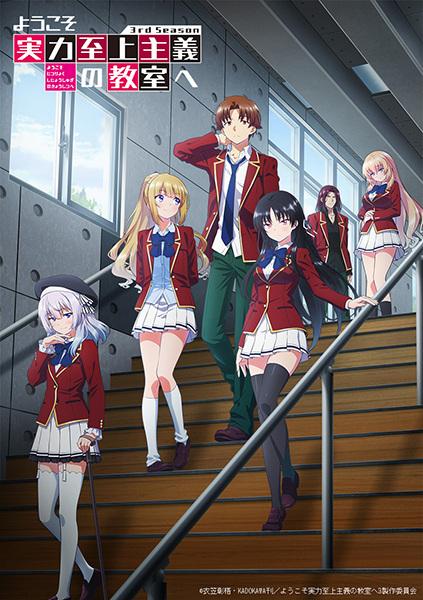
Classroom of the Elite 4th Season: Second Year, First Semester
ようこそ実力至上主義の教室へ 4th Season 2年生編1学期 (Youkoso Jitsuryoku Shijou Shugi no Kyoushitsu e 4th Season: 2-nensei-hen 1 Gakki)
- Drama
- Suspense
- Psychological
- School
- Episodes
- 16
- Duration
- 23 min per ep
- Aired
- Apr 1, 2026 to Jun 24, 2026
- Status
- Finished Airing
Synopsis
Kiyotaka Ayanokouji and Class D begin their second year at Tokyo Metropolitan Advanced Nurturing High School only to be thrown straight into another special test. The challenge pairs every second-year student with a first-year partner for a written exam, and what looks straightforward quickly turns tense: each duo must hit a required score or face severe consequences, making capable students more valuable than ever.
With no time to spare, Class D scrambles to secure the best possible partners. At the same time, Ayanokouji finds himself under renewed pressure as the White Room places another gifted student at the school with the goal of forcing his expulsion—pushing him back into careful, calculated maneuvering while keeping an eye on both familiar rivals and emerging threats.
Otaku Consensus
Classroom of the Elite 4th Season lands as a noticeable course correction for viewers who felt earlier seasons compressed too much, with Noriyuki Nomata’s direction and Kou Shigenobu’s series composition giving the Second Year material a cleaner competitive rhythm across 16 episodes. Fan response is strong for its renewed emphasis on psychological pressure and character advancement, reflected in a 7.88 MAL score, 78 AniList score, and reported 8.4 IMDb average. The main criticism remains adaptation trust: detractors still call the anime weaker than the source material, with complaints that the new first-year conflict can feel like a repeat escalation rather than a fresh reinvention.
Why You Should Watch
Watch this season if you want school drama staged like a controlled social experiment, where status, leverage, and information matter more than speeches about friendship. It scratches the same strategic itch as Tomodachi Game and the cerebral cat-and-mouse side of Death Note, but keeps the battlefield inside an elite boarding-school system rather than relying on supernatural rules or overt violence. The 16-episode length gives the season more breathing room than a standard one-cour return, and the Second Year shift adds a sharper institutional edge: Ayanokouji is no longer just an unreadable prodigy among classmates, but a known variable in a school ecosystem that keeps producing counters to him. If you like anti-hero protagonists whose restraint is more threatening than rage, this is the franchise at its most targeted.
Key Characters
- KKiyotaka Ayanokouji(VA: Shouya Chiba)
Ayanokouji remains the series’ central hook because fans read every pause, deflection, and bland line delivery as a possible move in a larger psychological game.
What Makes It Stand Out
- 1
Lerche returns as the animation studio, keeping the franchise’s cool, controlled visual identity aligned with its surveillance-heavy school setting and emotionally restrained protagonist.
- 2
This season is built as a 16-episode adaptation of the Second Year, First Semester material, giving it more room than a typical 12- or 13-episode seasonal run to track alliances, pressure, and reversals.
- 3
The creative handoff is clearly documented: Noriyuki Nomata directs, Kou Shigenobu handles series composition, and Maki Kouno adapts Shunsaku Tomose’s original character designs for animation.
- 4
Its reception profile is unusually split around adaptation quality: general viewers praised the improved writing and story momentum, while source-conscious critics still labeled the anime a compromised version of the novels.
- 5
The season’s database footprint shows durable franchise interest rather than niche curiosity, with 70,865 MAL votes, a #979 MAL rank, 3,069 AniList favourites, and a reported 8.4/10 IMDb average.
Fun Facts & Trivia
- Fun fact 1
- The season aired from April 1, 2026 to June 24, 2026, closing out as a finished 16-episode spring run rather than a split-cour release.
- Fun fact 2
- Original author Shougo Kinugasa and original character designer Shunsaku Tomose are both credited, preserving the light novel’s core creative identity even as the anime uses a separate adaptation staff.
- Fun fact 3
- The visual production credits separate Art Director Hirofune Hane, Art Design lead Satoru Hirayanagi, Color Designer Mio Takegawa, and Director of Photography Misato Sekiya, showing how much of the show’s sterile elite-school atmosphere is divided across specialized departments.
- Fun fact 4
- Shouya Chiba continues to voice Kiyotaka Ayanokouji, a performance built around understatement rather than theatrical villainy, which is central to how the anime sells Ayanokouji’s unreadability.
- Fun fact 5
- AniList’s tag profile places Boarding School and Survival at 98%, with Battle Royale at 96% and Philosophy at 91%, neatly capturing why the series is discussed less like a normal school anime and more like a rules-based social combat story.
Studios
- Lerche