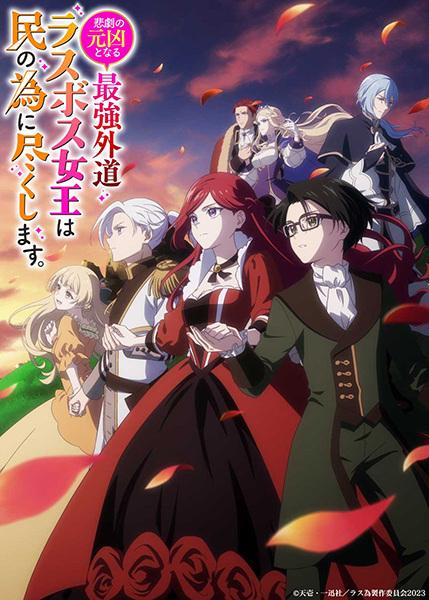
The Most Heretical Last Boss Queen: From Villainess to Savior Season 2
悲劇の元凶となる最強外道ラスボス女王は民の為に尽くします。Season2 (Higeki no Genkyou to Naru Saikyou Gedou Last Boss Joou wa Tami no Tame ni Tsukushimasu. Season 2)
- Fantasy
- Isekai
- Villainess
- Episodes
- 12
- Duration
- 23 min per ep
- Aired
- Apr 7, 2026 to Jun 23, 2026
- Status
- Finished Airing
Synopsis
In the second season of *The Most Heretical Last Boss Queen: From Villainess to Savior*, the journey of the once-maligned queen takes on new challenges as she continues to navigate her dual identity. Embracing her role as both a villainess and a savior, she strives to protect her kingdom while facing the consequences of her past actions.
As the stakes rise, the queen must confront powerful adversaries and complex relationships that test her resolve and commitment to her people. With a blend of fantasy and intrigue, the season delves deeper into themes of redemption, leadership, and the fine line between good and evil, all while maintaining a sense of humor and warmth.
Otaku Consensus
Season 2 lands as a sincere but uneven OLM continuation: Norio Nitta’s direction and Hitomi Mieno’s composition are strongest in the early blue-haired prince arc and in the expanded diplomacy across two new kingdoms, where Pride’s hands-on heroism still has weight. Its MAL 6.91 and AniList 69 reception reflects the split: devoted fans value the heavier emotional bonds, while critics repeatedly point to softer stakes, darker tonal drift, and plot turns that feel engineered rather than earned.
Why You Should Watch
If your favorite villainess stories are less about dating flags and more about a woman using terrifying political and combat leverage responsibly, Season 2 is the rarer follow-up that keeps its heroine active instead of retiring her into romance. It scratches the same itch as My Next Life as a Villainess-style affection-management, but with the royal pressure and moral self-surveillance closer to Tearmoon Empire. The appeal is in watching Pride make leadership feel physical: she fights, negotiates, and absorbs the emotional cost of being adored by people who would have feared another version of her. Choose it if you want courtly family dynamics, a heterosexual otome-game framework, brief bloody swordplay, and a second season that broadens into international relationships rather than resetting to school-comedy comfort.
Key Characters
- PPride Royal Ivy(VA: Fairouz Ai)
Fairouz Ai gives Pride the season’s central tension: an ojou-sama heroine whose frightening competence is filtered through guilt, public duty, and a refusal to let the story’s men take every blow for her.
- SStale Royal Ivy(VA: Kouki Uchiyama)
Kouki Uchiyama’s Stale is the cool Royal Ivy presence who keeps the family-life material from becoming decorative, often functioning as a measure of how much Pride’s choices reshape trust inside the palace.
- TTiara Royal Ivy(VA: Haruka Tomatsu)
Haruka Tomatsu’s Tiara supplies the softer emotional register in the Royal Ivy trio, making the season’s domestic bonds feel as important as its kingdoms and swordplay.
- AArthur Beresford(VA: Junya Enoki)
Junya Enoki’s Arthur gives the male ensemble an earnest counterweight to court etiquette, fitting a season that leans harder into personal loyalty than simple romance flags.
What Makes It Stand Out
- 1
The season’s biggest structural shift is geographical: viewer reviews note that the story moves beyond Freesia and builds bonds with two new kingdoms, giving the sequel a more diplomatic shape than Season 1.
- 2
OLM handled the animation production, and contemporary coverage noted that the art style stays visually close to the first season rather than attempting a redesign between cours.
- 3
The early blue-haired prince arc became the fan-cited highlight, especially among viewers who felt the sequel was otherwise weaker; it is the stretch most often praised for making a new royal character’s devotion to his people emotionally legible.
- 4
The action remains a point of contrast: external reviews described the swordplay as brief and fairly by-the-numbers, but also bloodier than many reincarnation-villainess shows, which helps explain the harsher edge some viewers noticed in Season 2.
- 5
The music credit is unusually crowded for a 12-episode fantasy season, listing Tatsuhiko Saiki, Hanae Nakamura, Kanade Sakuma, Junko Nakajima, and Misaki Tsuchida together rather than a single headline composer.
Fun Facts & Trivia
- Fun fact 1
- Season 2 aired as a 12-episode Spring 2026 run from April 7 to June 23, 2026, and was listed as finished airing before settling around a 6.91 MAL score from 14,752 votes.
- Fun fact 2
- The source credit remains split between Tenichi for the original story and Suzunosuke for the original character designs, while Hitomi Kouno handled the anime character designs for OLM’s version.
- Fun fact 3
- AniList users tagged it more strongly as Heterosexual, Medieval, and Female Protagonist than as Isekai, with Isekai sitting at 53%; that tag spread matches the sequel’s emphasis on courtly relationships over transportation mechanics.
- Fun fact 4
- The series’ database footprint is modest but durable: AniList lists 328 favourites, while MAL places Season 2 at popularity rank #3664 and score rank #5312.
- Fun fact 5
- Pre-release coverage for Season 2 emphasized new cast and character introductions in a trailer, which aligns with the finished season’s reception: even mixed reviews tended to credit the sequel for widening the ensemble.
Studios
- OLM