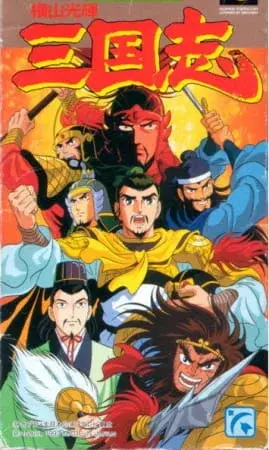
The Legend of the Strongest General: Romance of the Three Kingdoms
最强武将传·三国演义 (Saikyou Bushouden: Sangoku Engi)
- Action
- Drama
- Adventure
- Historical
- Episodes
- 52
- Duration
- 25 min per ep
- Aired
- Apr 4, 2010 to Mar 27, 2011
- Status
- Finished Airing
Synopsis
Set against the tumultuous backdrop of ancient China, The Legend of the Strongest General: Romance of the Three Kingdoms follows the ambitious Liu Bei as he strives to restore peace to his war-torn homeland. Joined by his loyal brothers-in-arms, Zhang Fei and Guan Yu, Liu Bei navigates the treacherous landscape of rival factions and shifting loyalties. Despite commanding a modest force and lacking territory, he cleverly adapts to his circumstances, often playing a subordinate role to more powerful generals to ensure his survival.
As the narrative unfolds, themes of brotherhood, loyalty, and the quest for honor come to the forefront. Liu Bei's resilience in the face of adversity highlights the complexity of leadership in a time fraught with conflict. With each challenge, he seeks not just to defend his life, but to carve out a legacy that will resonate through the ages.
Otaku Consensus
The Legend of the Strongest General: Romance of the Three Kingdoms earns its niche approval as a serious Chinese-Japanese treatment of a literary war epic, with the strongest praise going to its battle-driven adaptation choices and its focus on loyalty, strategy, and character maturation over simple spectacle. Its reception is visibly split across databases, with IMDb’s 7.5/10 enthusiasm sitting far above AniList’s 47/100, and the most common limitation is that its year-long chronicle structure can feel old-fashioned and less immediately propulsive than newer historical action anime.
Why You Should Watch
Watch this if you want the political weight of Kingdom without the same shounen ascent structure, or if you want a more direct animated gateway into Romance of the Three Kingdoms than a game adaptation can provide. Its appeal is not novelty but scale: 52 episodes devoted to commanders, vows, shifting allegiances, battlefield decisions, and the moral language of rulership. The Chinese-Japanese production gives it a different texture from most Japan-only historical anime, and the source material’s reputation for strategy, betrayal, tyranny, and martial legend shows through in the way conflicts are framed. It is best suited to viewers who like war stories where honor codes and survival tactics matter as much as swordplay.
Key Characters
- LLiu Bei
Liu Bei is interesting less as an unstoppable conqueror than as a legitimacy-focused leader whose influence depends on restraint, alliances, and the image of moral authority.
- ZZhang Fei
Zhang Fei functions as the volatile martial counterweight within the sworn-brother dynamic, giving the series a more forceful, instinctive edge beside its political maneuvering.
- GGuan Yu
Guan Yu carries extra cultural weight because Three Kingdoms tradition remembers him as a model of loyalty and martial honor, making his presence resonate beyond the immediate anime cast list.
What Makes It Stand Out
- 1
The series is a Chinese-Japanese adaptation produced by Beijing Huihuang Animation Company and Future Planet, which immediately sets it apart from the more common Japan-only handling of historical anime material.
- 2
Its 52-episode broadcast from April 2010 to March 2011 gives it the structure of a full-year television chronicle rather than a compressed seasonal retelling.
- 3
The anime draws on Romance of the Three Kingdoms, a classic Chinese novel famous for military strategy, betrayal, tyranny, heroic brotherhood, and even poetic insertions associated with writers such as Du Fu and Su Shi.
- 4
Its musical identity includes theme song performances by Isao Sasaki on “Kaze no Kaiwa” and May’n on the ending theme, pairing a veteran anime-song voice with a performer strongly associated with modern anisong fandom.
- 5
AniList tagging emphasizes Historical at 79%, while War, Military, Classic Literature, and Foreign each appear at 20%, reflecting how database users read it more as a literary-historical war adaptation than a standard action title.
Fun Facts & Trivia
- Fun fact 1
- Despite being based on one of East Asia’s most famous war narratives, the anime remains obscure in English-language anime databases: MyAnimeList lists only 455 votes and a popularity rank of #10927.
- Fun fact 2
- The reception profile is unusually uneven across platforms, with MAL at 6.81/10, AniList at 47/100, and IMDb reported at 7.5/10 from 38 ratings.
- Fun fact 3
- Shunji Ooga is credited with supervision, while the theme-song credits highlight Isao Sasaki and May’n rather than a large, widely documented Japanese voice cast.
- Fun fact 4
- The source novel’s cultural footprint extends far beyond animation; Britannica notes its dense mix of battle scenes, strategy, betrayal, supernatural elements, and classical verse.
- Fun fact 5
- The only main character explicitly singled out in the provided database character data is Guan Yu, but the Japanese voice actor is not listed.
Studios
- Beijing Huihuang Animation Company
- Future Planet