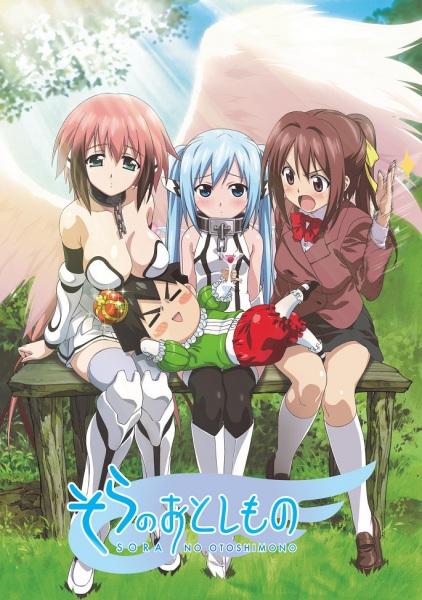
Heaven's Lost Property OVA
そらのおとしもの プロジェクト桃源郷[ピンク] (Sora no Otoshimono: Project Pink)
- Comedy
- Ecchi
- Sci-Fi
- Supernatural
- Harem
- Episodes
- 1
- Duration
- 23 min
- Aired
- Sep 9, 2010
- Status
- Finished Airing
Synopsis
Tomoki and the gang head to an indoor swimming pool looking for a carefree day of play. Predictably, the outing spirals into chaos the moment Tomoki launches into one of his infamous perverted schemes.
At the same time, Nymph struggles with life after losing her former master and briefly considers asking Tomoki to take that role instead. This OVA was never broadcast on television, having been labeled “too dangerous” to air.
Otaku Consensus
Project Pink lands as a well-liked but deliberately niche bonus, reflected by a solid 7.34 MAL average and a cooler 69/100 AniList score rather than broad critical canonization. Hisashi Saitou’s direction and Yuuko Kakihara’s script work best when the OVA weaponizes its “too dangerous for TV” reputation into fast slapstick while still giving Nymph a sharper emotional beat than a throwaway special needs. Its genuine limitation is equally clear: the nudity-heavy harem comedy can crowd out the sci-fi and supernatural texture that gives the main series its stranger identity.
Why You Should Watch
Watch Project Pink if you want a compact, unapologetic dose of late-2000s ecchi comedy without a lore dump or a sequel’s obligation to advance the franchise. It scratches the same itch as To Love-Ru-style chaos, but with Heaven’s Lost Property’s extra flavor of angelic AI weirdness, chibi deformation, and sudden mood swings into character vulnerability. The selling point is contrast: one minute it is pure slapstick humiliation, the next it reminds you that Nymph’s “tsundere” surface is tied to ownership, autonomy, and a damaged sense of belonging. Viewers who like harem specials as exaggerated character stress tests will get more from it than viewers looking for a clean standalone introduction.
Key Characters
- TTomoki
Tomoki functions less like a conventional romantic lead than the franchise’s human disaster engine, built to push every scene from harmless leisure into punishable absurdity.
- NNymph
Nymph is the OVA’s most interesting presence because her tsundere comedy sits beside a post-master identity crisis that gives the fanservice farce an unexpected emotional pressure point.
What Makes It Stand Out
- 1
The OVA was not broadcast on television and is specifically remembered for being labeled “too dangerous” to air, making its format part of its identity rather than just a release footnote.
- 2
AIC ASTA’s production leans into the franchise’s split visual language: angelic sci-fi designs, chibi reactions, and slapstick exaggeration all coexist inside a single short-form special.
- 3
Yuuko Kakihara’s script gives Nymph material tied to dependence and autonomy, which keeps the episode from functioning only as an ecchi side gag collection.
- 4
Kousuke Kawamura is credited as animation director, a key role for an OVA whose comedy depends on rapid shifts between attractive character art, deformity gags, and physical punishment timing.
- 5
The music credits keep it tied to the broader Heaven’s Lost Property identity, with blue drops performing the opening theme and Saori Hayami credited for the ending theme performance.
Fun Facts & Trivia
- Fun fact 1
- Project Pink aired on September 9, 2010 as a single finished OVA rather than as part of a television run.
- Fun fact 2
- The source creator credit goes to Suu Minazuki, anchoring the special directly to the original Heaven’s Lost Property manga lineage.
- Fun fact 3
- The main Japanese production staff listed for the OVA includes director Hisashi Saitou, scriptwriter Yuuko Kakihara, and animation director Kousuke Kawamura.
- Fun fact 4
- AniList’s highest-confidence tags put Angels, Nudity, Female Harem, and Rural all at 79%, while Robots and Artificial Intelligence sit at 70%, neatly capturing the series’ odd mix of erotic comedy and synthetic-angel mythology.
- Fun fact 5
- The English-side production credits include Gen Fukunaga as executive producer and Christopher Bevins as ADR director, linking the OVA to Funimation-era localization talent.
Studios
- AIC ASTA