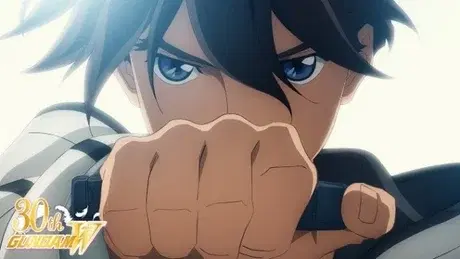
Mobile Suit Gundam Wing: Endless Waltz
新機動戦記ガンダムW Endless Waltz 特別篇 (Shin Kidou Senki Gundam Wing: Endless Waltz Tokubetsu-hen)
- Drama
- Sci-Fi
- Mecha
- Military
- Space
- Episodes
- 1
- Duration
- 1 hr 34 min
- Aired
- Aug 1, 1998
- Status
- Finished Airing
Synopsis
In A.C. 196, a year after the war between Earth and the space colonies ends and the Earth Sphere Unified Nation is established, humanity appears to be moving into a calmer, more unified age. With peace finally within reach, four of the five Gundam pilots choose to lay down their arms for good, preparing to dispose of their mobile suits by sending them into the sun.
That resolve is shaken when a new uprising breaks out under Mariemaia Khushrenada, who presents herself as the child of the late Treize and seeks to carry on his ambition of world conquest. Forced back into battle, Heero Yuy, Trowa Barton, Duo Maxwell, and Quatre Raberba Winner race to reclaim their Gundams and defend the hard-won peace—only to find the fight made even more complicated by Wufei Chang, a former comrade now fighting for Mariemaia’s side.
Otaku Consensus
Endless Waltz is widely valued as Gundam Wing at its most polished: Sunrise's hand-painted missile barrages, Hajime Katoki and Kunio Okawara's upgraded mobile suit work, and Kou Ootani's score give the one-shot epilogue a prestige finish that outclasses much of the TV presentation. Its lean feature format improves the pacing of Wing's usual political sprawl, but the recurring criticism is that it still carries the franchise entry's self-serious melodrama and occasionally convoluted character logic, with a few dated CGI asteroid shots standing out against the traditional animation.
Why You Should Watch
Watch Endless Waltz if you want the romantic excess of 90s Gundam without committing to another long campaign arc. It scratches the same itch as the showpiece battles of Mobile Suit Gundam: Char's Counterattack or the operatic boy-soldier drama of Gundam Wing itself, but in a concentrated single-entry form built around closure, iconography, and mechanical spectacle. The draw is not subtle realism; it is the sight of five famous pilots filtered through cleaner designs, heavier symbolism, and some of Sunrise's most admired late-cel-era action cuts. Viewers who like mecha as choreography, costume, crest, and political ritual will get more from it than those looking for hard-sci-fi procedural detail.
Key Characters
- TTrowa Barton(VA: Shigeru Nakahara)
Trowa remains one of Wing's most enigmatic pilots, and Endless Waltz uses his restraint and performer-like composure as a contrast to the surrounding military pageantry.
- WWufei Chang(VA: Ryuuzou Ishino)
Wufei is the entry's sharpest ideological pressure point, forcing the heroic cast's sense of justice to look less comforting and more absolutist.
- RRelena Darlian(VA: Akiko Yajima)
Relena gives the special its political conscience, carrying Gundam Wing's fascination with pacifism as something more difficult than a slogan.
- DDuo Maxwell(VA: Toshihiko Seki)
Duo supplies the fan-favorite charisma that keeps Wing's theatrical seriousness from becoming completely airless, while still fitting the piece's elegiac tone.
What Makes It Stand Out
- 1
Sunrise's cel-era action is a major part of the film's reputation, especially the hand-painted explosions, missile barrages, and fluid mobile suit movement singled out by reviewers as unusually durable for 1990s Gundam.
- 2
The updated Gundam designs are a marquee attraction, credited to mechanical design veterans Kunio Okawara and Hajime Katoki; fans often discuss Endless Waltz as the version where Wing's mobile suits became most visually iconic.
- 3
Kou Ootani's score gives the special a grander, more ceremonial sound than a typical TV episode, while TWO-MIX's ending-theme presence ties it directly to Gundam Wing's pop identity.
- 4
Its one-episode 1998 format changes the viewing experience: instead of another long factional war narrative, Endless Waltz functions as a compressed epilogue built around finality, symbolism, and large set-piece payoffs.
- 5
The production is not purely pristine cel work; reviewers have noted jarring CGI in asteroid shots, making it an interesting snapshot of anime's late-90s transition period rather than a uniformly traditional showcase.
Fun Facts & Trivia
- Fun fact 1
- Endless Waltz carries both core Gundam authorship labels: Yoshiyuki Tomino is credited as original creator, while Hajime Yatate is listed as producer in the research data.
- Fun fact 2
- The mechanical design credits pair Kunio Okawara, one of Gundam's foundational mecha designers, with Hajime Katoki, whose sharper redesign sensibility strongly defines the Endless Waltz look.
- Fun fact 3
- Yutaka Izubuchi is credited for costume design assistance, adding another major mecha-anime design name to a production usually discussed for its mobile suits first.
- Fun fact 4
- The English-language production lists Michelle Porter as ADR director, a useful credit for viewers comparing the Japanese cast with the widely circulated dubbed release.
- Fun fact 5
- Reception remains solid but not runaway-mainstream: the title holds a 7.78 MAL score from 39,289 votes and a 73/100 AniList score, with its reputation driven more by mecha fandom esteem than broad popularity.
Studios
- Sunrise