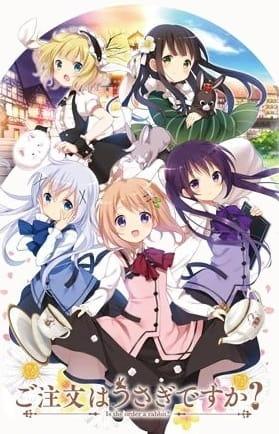
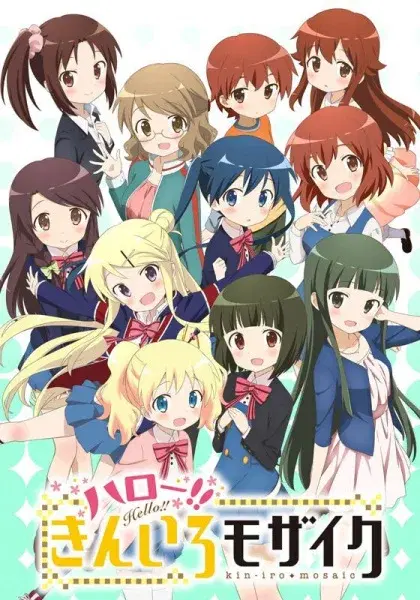
Is the Order a Rabbit??
ご注文はうさぎですか?? (Gochuumon wa Usagi desu ka??)
- Slice of Life
- CGDCT
- Iyashikei
- Workplace
- Episodes
- 12
- Duration
- 23 min per ep
- Aired
- Oct 10, 2015 to Dec 26, 2015
- Status
- Finished Airing
Synopsis
A new year brings fresh everyday moments at the Rabbit House, where Kokoa Hoto has settled into her job as a waitress—despite the café being far different from the rabbit-filled haven she first imagined. Between shifts and downtime, she shares a gentle routine with Chino Kafuu, a soft-spoken middle schooler often seen with her fluffy companion Tippy, and Rize Tedeza, the capable, military-minded girl who tends to be prepared for anything.
Alongside regular visits from neighboring café workers Chiya Ujimatsu and Sharo Kirima, the group drifts from work to play and back again, finding small adventures around town. Their days lead them into quirky encounters and lighthearted surprises, from meeting troubled writers and facing café rivalries to stumbling onto secret treasure and even the odd case of “alcoholic” chocolates.
Otaku Consensus
Hiroyuki Hashimoto’s unhurried direction and Kazuyuki Fudeyasu’s compact episodic pacing make this second season a confident refinement of Koi’s appeal, with sharper ensemble timing and unusually attentive seasonal wardrobe design from the Kinema Citrus and White Fox production. Its soothing consistency is also its chief limitation: viewers seeking character development, thematic depth, or meaningful dramatic progression will find the series deliberately resistant to all three.
Why You Should Watch
Watch this if you want the restorative rhythm of an iyashikei without serialized conflict or dramatic escalation. Is the Order a Rabbit?? scratches the same itch as Kiniro Mosaic and the downtime-heavy side of K-On!, but its café framework gives the comedy a dependable routine: uniforms, customer service, breaks, and neighboring businesses become prompts for compact character bits. Hiroyuki Hashimoto keeps the pace relaxed without letting scenes go inert, while the cast distinguishes familiar moe archetypes through delivery—Ayane Sakura’s exuberance, Inori Minase’s dry restraint, and Risa Taneda’s disciplined intensity are especially complementary. The production also changes outfits and long hairstyles with the seasons rather than leaving everyone in a fixed visual template. It is comfort viewing built around accumulated chemistry, not narrative momentum, and works best in one- or two-episode sittings.
Key Characters
- CCocoa Hoto(VA: Ayane Sakura)
Ayane Sakura makes Cocoa’s relentless enthusiasm funny through speed and vocal elasticity, while her self-appointed big-sister energy gives the ensemble its main source of affectionate chaos.
- CChino Kafuu(VA: Inori Minase)
Chino’s restrained reactions and precise deadpan make her the essential counterweight to louder personalities, with Inori Minase finding humor in minute changes of tone.
- SSharo Kirima(VA: Maaya Uchida)
Sharo turns pride, nervous energy, and tsundere defensiveness into tightly wound comedy, and Maaya Uchida sells each emotional reversal without flattening her into a single gag.
- RRize Tedeza(VA: Risa Taneda)
Rize’s disciplined bearing becomes most entertaining when ordinary social situations undermine it, allowing Risa Taneda to alternate between commanding confidence and flustered vulnerability.
What Makes It Stand Out
- 1
Kinema Citrus and White Fox share studio credit, and the production distinguishes itself through extensive costume changes and hairstyles adjusted to different seasons rather than relying on fixed character models.
- 2
Kazuyuki Fudeyasu’s series composition favors self-contained comic units over a continuous plot, letting workplace routines, personality clashes, and short excursions resolve within individual episodes.
- 3
Hiroyuki Hashimoto directs at an iyashikei tempo but preserves comic momentum through reaction shots and contrasts between energetic, deadpan, tsundere, and military-minded personalities.
- 4
Ruka Kawada’s music supports the series’ low-pressure atmosphere instead of forcing dramatic stakes, keeping the soundtrack aligned with its intimate, restorative tone.
- 5
The second season deliberately expands a proven formula rather than restructuring it, a choice praised by returning viewers for consistency and criticized by detractors as evidence of limited development.
Fun Facts & Trivia
- Fun fact 1
- The original work is credited to Koi, while the doubled question mark in Gochuumon wa Usagi desu ka?? identifies this as the second television season.
- Fun fact 2
- Yousuke Okuda handled both character design and chief animation direction, sharing the latter responsibility with Takahiro Sasaki; that overlap helped keep the cast recognizable across numerous outfit and hairstyle changes.
- Fun fact 3
- Ayane Sakura performs the opening theme and also receives theme-song performance credit for episode 12, in addition to voicing Cocoa.
- Fun fact 4
- Rie Murakawa and Chimame-Tai are credited for the first ending theme, reinforcing the franchise’s practice of tying its music closely to its voice cast.
- Fun fact 5
- The season holds a 7.77 average from 64,351 MyAnimeList votes and a 76/100 AniList score, with 531 AniList users listing it among their favourites.
Studios
- Kinema Citrus
- White Fox