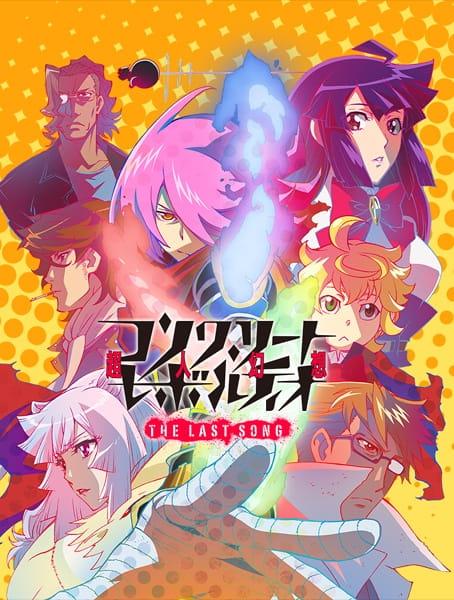
Concrete Revolutio
コンクリート・レボルティオ~超人幻想~ (Concrete Revolutio: Choujin Gensou)
- Action
- Fantasy
- Mystery
- Sci-Fi
- Mythology
- Super Power
- Urban Fantasy
- Episodes
- 13
- Duration
- 24 min per ep
- Aired
- Oct 4, 2015 to Dec 27, 2015
- Status
- Finished Airing
Synopsis
In July of Shinka Era year 41, government agent Jirou Hitoyoshi is assigned to secretly monitor a clandestine meeting between a leading state scientist and an industrial spy. The operation quickly unravels when Jirou’s identity is exposed and the spy reveals an alien disguise. Caught in the turmoil, he turns to Kikko Hoshino—a café waitress who is also a magical girl—and one of the many “superhumans” living unnoticed among ordinary citizens while defending them from extraterrestrial threats. Working for the Super Population Research Laboratory, Jirou’s job is as complicated as it is dangerous: safeguard helpful superhumans, and eliminate those judged too hazardous. After proving her strength in the encounter, Kikko is recruited into the organization.
Five years later, Tokyo has grown wary of superhumans, with suspicion and resentment becoming part of daily life. As corruption spreads and competing ideas of justice clash over the rights and role of this supernatural minority, the city feels increasingly unstable. Then, under unclear circumstances, Jirou turns against his own agency and disappears—only to find himself hunted through Shinjuku’s rain-soaked alleys by the very superhumans he once brought into the fold.
Otaku Consensus
Concrete Revolutio is a divisive Bones original whose best qualities are also its gatekeeping devices: Seiji Mizushima’s pop-art direction, Shou Aikawa’s politically charged superhero writing, and the deliberately achronological structure give it far more texture than a routine superpower show. The consensus fault line is execution, especially early pacing and time skips that can read as incoherence until the viewer learns its rhythm; for the right audience, repeated viewing turns that confusion into design.
Why You Should Watch
Watch Concrete Revolutio if you want superhero anime treated as cultural argument rather than power fantasy. It scratches the same nonlinear ensemble itch as Baccano! or Durarara!!, but filters it through tokusatsu, kaiju cinema, magical girls, urban fantasy, and postwar-style political anxiety. The appeal is not clean catharsis; it is watching an original anime use every pop-hero archetype it can grab to ask who gets protected, who gets controlled, and who gets written out of public memory. Viewers who need chronological handholding will bounce off the first episodes, but anyone who enjoys assembling a timeline, tracking ideological shifts, and rewatching scenes for new context will find one of Bones’ stranger, denser 2010s projects.
Key Characters
- JJirou Hitoyoshi(VA: Kaito Ishikawa)
Jirou is compelling because he functions less like a straightforward lead hero and more like the series’ moral pressure point, forcing every debate about superhuman justice through his changing loyalties.
- KKikko Hoshino(VA: Sumire Uesaka)
Kikko brings magical-girl iconography into a world of state agencies and ideological conflict, making her brightness feel deliberately out of place rather than merely cute.
- EEmi Kino(VA: Aki Toyosaki)
Emi is one of the show’s key supporting presences, often discussed alongside Kikko as part of the emotional counterweight to Jirou’s increasingly unstable worldview.
What Makes It Stand Out
- 1
The series is an original anime from Bones rather than a manga or light novel adaptation, which gives Shou Aikawa and Seiji Mizushima room to build a dense superhero setting around theme-first storytelling instead of source-material coverage.
- 2
Its achronological structure is not a gimmick: AniList tags it at 86% for non-linear order, and the show repeatedly asks viewers to connect cause and consequence across separated Shinka Era time periods.
- 3
Concrete Revolutio mixes tokusatsu, kaiju, magical-girl, youkai, alien, and superhero grammar in the same political framework, making its genre collage part of the argument rather than mere fan-service referencing.
- 4
The visual identity comes from a layered design chain: original character designs are credited to Hekiru Hikawa and Noizi Itou, while Yoshiyuki Itou handled animation character design for the series.
- 5
Kakeru Ishihama’s music supports the show’s pop-mythic tone, sitting beside bright Bones visuals and sudden tonal shifts rather than smoothing them into a conventional action-score template.
Fun Facts & Trivia
- Fun fact 1
- Shou Aikawa is credited twice on the project, as original creator and series composition writer, which helps explain why the show feels unusually authored for a TV original.
- Fun fact 2
- Seiji Mizushima directed the series with Tomoyuki Kurokawa as assistant director, while Hiroki Matsumoto served as art director and Akiko Kikuchi as assistant art director.
- Fun fact 3
- The first season aired as a 13-episode TV anime from October 4, 2015 to December 27, 2015, placing it in the Fall 2015 season before later critical reassessments by viewers who initially found it too fragmented.
- Fun fact 4
- Reception data reflects its cult status more than broad popularity: it sits at a 6.64 MAL score from 28,504 votes and an AniList score of 64/100, yet still has 207 AniList favourites.
- Fun fact 5
- Fan commentary frequently frames the show as one that improves with age or rewatching, with one 10/10 user review explicitly describing an initial teenage dismissal followed by a much stronger appreciation nine years later.
Studios
- Bones