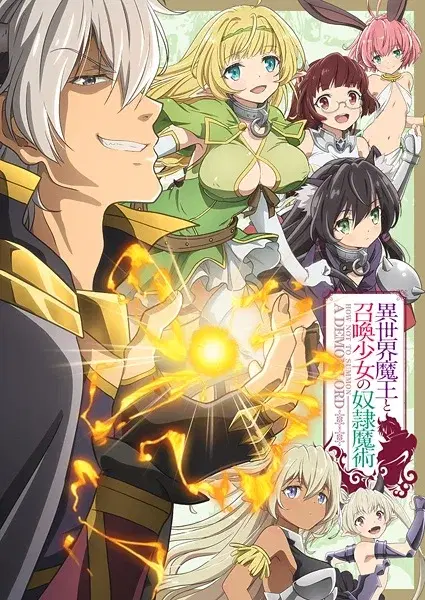
Death March to the Parallel World Rhapsody
デスマーチからはじまる異世界狂想曲 (Death March kara Hajimaru Isekai Kyousoukyoku)
- Adventure
- Fantasy
- Isekai
- Harem
- Episodes
- 12
- Duration
- 23 min per ep
- Aired
- Jan 11, 2018 to Mar 29, 2018
- Status
- Finished Airing
Synopsis
Ichirou Suzuki, a programmer nearing thirty, is pushed to the brink by relentless deadlines. When he finally drifts off, he wakes to find himself inside a fantasy RPG world that feels eerily familiar—stitched together from the games he was debugging. Even his identity has shifted: he’s younger, and he’s now known as Satou, the beta-test nickname he once used.
Before Satou can make sense of the change, he’s attacked by a lizardman army and responds with an overwhelming spell that annihilates them. The aftermath leaves him at level 310 with maxed-out stats and an arsenal of abilities—yet no clear path back home. With power far beyond an ordinary adventurer, Satou begins traveling through the new world, taking in its magic and mysteries as he searches for what comes next.
Otaku Consensus
Death March to the Parallel World Rhapsody lands exactly where its 6.43 MAL score and 61/100 AniList score suggest: a watchable, comfort-food isekai whose relaxed character interactions carry more weight than its fantasy danger. Shin Oonuma’s direction and the Connect/SILVER LINK. production keep the adaptation clean and easy to follow, with the city-and-labyrinth stretch functioning better as RPG tourism than as high-stakes adventure. The recurring criticism is that the anime sands down the calmer appeal of Hiro Ainana’s source into something too unremarkable: limited world expansion, modest visual impact, and a harem setup that many viewers found less charming than intended.
Why You Should Watch
Watch Death March to the Parallel World Rhapsody if you want isekai as low-pressure RPG sightseeing rather than panic, punishment, or survival horror. It scratches a neighboring itch to In Another World With My Smartphone: an overpowered lead, game-interface logic, travelogue pacing, beast-girl and elf-adjacent fantasy flavor, and conflicts that rarely feel built to traumatize the viewer. The appeal is not tactical suspense; it is the rhythm of leveling systems, local customs, party banter, and a protagonist who treats impossible power like a convenience tool instead of a throne. Viewers who bounced off harsher isekai such as Re:Zero but still like menus, magic, demi-human companions, and gentle wish-fulfillment will understand why it remained highly visible despite middling critical scores.
Key Characters
- SSatou
Satou is discussed less as a battle shonen hero than as an ultra-polite RPG tourist, which gives the series its oddly calm tone even when the setting keeps handing him absurd advantages.
- IIchirou Suzuki
Ichirou’s programmer background is the show’s most distinctive character hook, turning familiar isekai mechanics into the perspective of someone who recognizes systems, bugs, and beta-test logic rather than treating magic as pure wonder.
What Makes It Stand Out
- 1
The TV anime was co-produced by Connect and SILVER LINK., a pairing that gives the show the clean, light-novel-adaptation polish associated with late-2010s seasonal fantasy rather than a grittier adventure texture.
- 2
Shin Oonuma directed the series, with Kento Shimoyama handling series composition; the result favors digestible episodic progression and party-building over the aggressive escalation expected from darker isekai.
- 3
The adaptation is structurally more localized than its title suggests: contemporary reviews specifically criticized it for feeling confined to a small city-and-labyrinth slice instead of delivering a broad parallel-world expedition.
- 4
Its music branding ties it strongly to idol-anime crossover culture: Run Girls, Run! performed the opening theme, while Wake Up, Girls! performed the ending theme.
- 5
Episode 10 features insert-song performances credited to Hiyori Kouno, Aoi Yuuki, and Kaya Okuno, giving the season one of its more production-specific musical moments beyond the standard OP/ED package.
Fun Facts & Trivia
- Fun fact 1
- Despite a low MAL rank of #8363, the series sits at MAL popularity #449 with more than 315,000 votes, showing a major gap between broad exposure and critical enthusiasm.
- Fun fact 2
- AniList’s tag distribution captures the show’s identity unusually clearly: Isekai at 97%, Video Games at 81%, Female Harem at 72%, Slavery at 71%, and CGI at 55%.
- Fun fact 3
- The anime adapts Hiro Ainana’s original story, with shri credited for the original character designs and Shouko Takimoto translating those designs for animation.
- Fun fact 4
- The web-review pattern is unusually consistent: even positive-leaning comments praise the show as calming or character-focused, while negative reviews target its lack of standout isekai identity and underwhelming harem chemistry.
- Fun fact 5
- Its episode-title style repeatedly uses the phrase “That Started with a Death March,” turning the source title into a running structural motif across entries such as the catastrophe, city-tour, romance, and labyrinth episodes.
Studios
- Connect
- SILVER LINK.