Boruto: Naruto Next Generations
BORUTO -NARUTO NEXT GENERATIONS-
- Action
- Adventure
- Fantasy
- Martial Arts
- Episodes
- 293
- Duration
- 23 min per ep
- Aired
- Apr 5, 2017 to Mar 26, 2023
- Status
- Finished Airing
Synopsis
In the years after the Fourth Shinobi World War, Konohagakure enters an era of calm, prosperity, and rapid technological progress. Guided by the Allied Shinobi Forces and the Seventh Hokage, Naruto Uzumaki, the village has grown into something closer to a modern city—changing daily life and redefining what it means to be a shinobi. As Naruto and his longtime allies keep watch, a new generation steps forward to train in the ninja arts.
At the center is Boruto Uzumaki, the Seventh Hokage’s son. Gifted and confident, he shows remarkable talent with the support of friends and family, but that success also feeds his arrogance and a fierce drive to outdo Naruto. With Naruto’s responsibilities often keeping him away, the distance between father and son widens—just as an ominous presence begins to stir within the village, threatening Boruto’s once-easy days.
Otaku Consensus
Boruto: Naruto Next Generations is most convincing when judged as a long-form expansion of the Naruto world rather than a lean manga adaptation: its anime-canon material gives the child cast, especially Team 7 and Kawaki, more room than the faster manga structure. Studio Pierrot’s weekly output and the series’ 293-episode scale produce visible inconsistency, and the dominant criticism remains that too many episodes stall the central momentum with uneven animation and low-stakes detours.
Why You Should Watch
Watch Boruto if you want the Naruto universe as an extended sandbox rather than a straight sprint through major battles. It is built for viewers who enjoy team missions, academy-era banter, inherited techniques, and side-character breathing room, without needing every episode to push a single endgame. The appeal is closest to early Naruto’s genin rhythm with a more modern, tech-anachronistic village texture; it also scratches the Black Clover itch for young rivals learning through squad dynamics, though with more episodic stops. The strongest selling point is scale: 293 finished episodes let Studio Pierrot turn what could have been a compressed sequel into a generational handoff, with Yasuharu Takanashi’s music helping tie the new cast back to the franchise’s martial-arts melodrama.
Key Characters
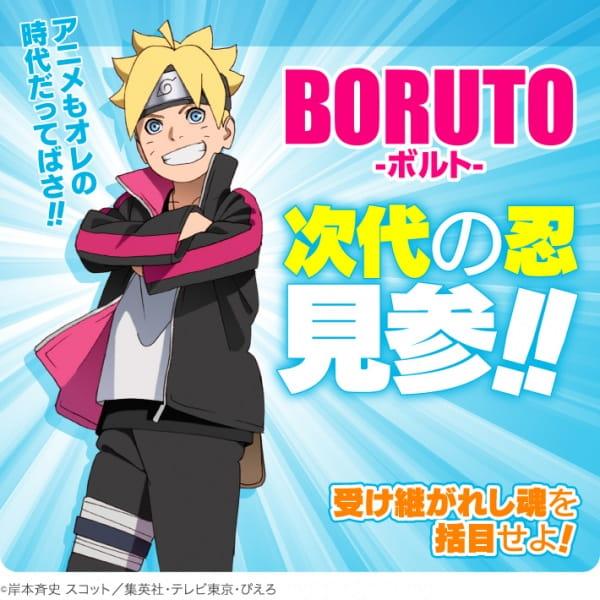
- BBoruto Uzumaki(VA: Yuuko Sanpei)
Sanpei’s Boruto works best as a deliberately abrasive prodigy: fans who stick with him get a lead designed to be challenged rather than instantly admired.
- SSarada Uchiha(VA: Kokoro Kikuchi)
Sarada is the franchise’s sharpest answer to inherited legend, combining Uchiha expectations with a practical leadership streak that gives Team 7 a tactical center.
- MMitsuki(VA: Ryuuichi Kijima)
Mitsuki’s calm presence and outsider-like curiosity make him a quiet wildcard, especially in episodes that slow down enough to examine loyalty and identity.
- KKawaki(VA: Yuuma Uchida)
Kawaki brings a harder edge to the main cast, and his arrival is widely treated by viewers as the point where the sequel’s dramatic identity becomes more focused.
What Makes It Stand Out
- 1
The anime is a completed 293-episode Studio Pierrot production that aired continuously from April 2017 to March 2023, making it one of the largest post-Naruto TV projects rather than a short sequel cour.
- 2
Its adaptation strategy is deliberately expansive: web discussion often credits the anime-canon material with giving supporting characters development, while the same structure is also the main reason detractors call the pacing bloated.
- 3
Yasuharu Takanashi is credited for the music, giving the series a direct sonic link to the high-impact percussion, strings, and battle-drama style associated with modern Naruto anime scoring.
- 4
The direction has clear production phases: Noriyuki Abe served as chief director through episode 104, Hiroyuki Yamashita directed episodes 1–66, Toshirou Fujii handled 67–104, and Masayuki Kouda became the longest-running director across episodes 105–281 and 287 onward.
- 5
AniList’s tag profile captures the show’s unusual genre mixture: alongside Shounen, Ninja, Super Power, Swordplay, and Martial Arts, it also carries Anachronism, Episodic, School, and even Table Tennis tags.
Fun Facts & Trivia
- Fun fact 1
- The page credits Ukyou Kodachi with the original story and Mikio Ikemoto with the original character designs, marking the anime as part of the post-Naruto creative handoff rather than a simple one-person continuation.
- Fun fact 2
- Character design duties were split among Hirofumi Suzuki and Tetsuya Nishio, with Kouji Yabuno credited for sub character design, reflecting the large design workload required by a long-running ensemble sequel.
- Fun fact 3
- The reception numbers show a sharp split between visibility and approval: it sits at MAL popularity #217 with 480,447 votes, while its MAL score is 5.97 and its rank is #11036.
- Fun fact 4
- AniList lists the series at 57/100 with 4,697 favourites, closely matching the broader pattern of a highly watched but heavily contested legacy sequel.
- Fun fact 5
- The web consensus around the anime versus the manga is unusually divided: one recurring pro-anime argument is that the TV version develops more characters, while the recurring anti-anime argument is that there is too much anime-canon content.
Studios
- Studio Pierrot