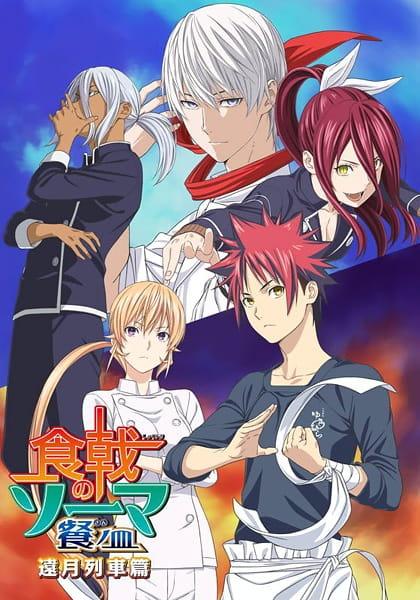
Food Wars! The Third Plate
食戟のソーマ 餐ノ皿 (Shokugeki no Souma: San no Sara)
- Ecchi
- Gourmet
- School
- Episodes
- 12
- Duration
- 24 min per ep
- Aired
- Oct 4, 2017 to Dec 20, 2017
- Status
- Finished Airing
Synopsis
Tōtsuki Academy’s annual Moon Festival turns the campus into a bustling food fair, pitting students against one another as they sell their signature dishes and vie for the highest profits. For Sōma Yukihira, the event carries even more weight: it’s his first real chance to take on the Elite Ten, the academy’s ruling council.
Yet the festival is only the opening move. As Sōma’s confrontation with the Elite Ten begins in earnest, a shadowy scheme starts to unfold—offering the kind of challenge he craves while threatening to unsettle Tōtsuki itself.
Otaku Consensus
Food Wars! The Third Plate is widely received as a rebound season: Yoshitomo Yonetani’s direction and Shougo Yasukawa’s compact 12-episode structure restore the first season’s blend of competitive momentum, outrageous humor, and appetite-triggering food imagery. The Moon Festival material is the standout, turning cooking into a measurable school-wide power game rather than a simple duel format, while the most common criticism is that the broader conspiracy-heavy direction signals the story-quality drop some viewers associate with later Food Wars.
Why You Should Watch
Watch The Third Plate if you want battle-shounen escalation without fistfights: recipes function like special moves, judges read plates like tactical breakdowns, and school rank matters as much as flavor. It scratches the competitive itch of Haikyuu!! or Kuroko’s Basketball, but replaces athletic form with menu engineering, service logistics, and profit strategy. This is also the season to try if you liked early Food Wars for its comedy and food spectacle but wanted the hierarchy at Tōtsuki to feel more consequential. The ecchi element is still part of the texture, so it is not for viewers who want a restrained culinary drama; for those who can accept that excess, J.C.Staff’s glossy plating shots, Tatsuya Katou’s energetic score, and the Moon Festival’s scoreboard pressure make it one of the franchise’s most watchable stretches.
Key Characters
- SSōma Yukihira
Sōma remains compelling because his confidence is not presented as genius mystique; fans respond to how he treats every kitchen setback as another recipe test.
- EErina Nakiri
Erina is the franchise’s sharpest status character, turning taste, pedigree, and pride into a constant source of tension even before she enters a kitchen.
- MMegumi Tadokoro
Megumi gives the series its emotional ballast, contrasting Tōtsuki’s ruthless ranking culture with a gentler style of cooking rooted in hospitality.
- EEishi Tsukasa
Eishi stands out as an Elite Ten figure because his presence makes technical perfection feel intimidating rather than merely impressive.
What Makes It Stand Out
- 1
J.C.Staff keeps the franchise’s house style intact under director Yoshitomo Yonetani, emphasizing reaction shots, glossy close-ups, and heightened comedic timing over naturalistic cooking realism.
- 2
The Moon Festival arc changes the competitive grammar of the series by making sales, placement, and crowd appeal part of the contest, so culinary skill is tested through business strategy as well as taste.
- 3
Tatsuya Katou’s music gives the season its battle-anime pulse, using energetic cues to make plating, judging, and menu reveals feel like combat turns rather than static demonstrations.
- 4
The season’s AniList tag spread is unusually revealing: Food at 99%, Educational at 65%, and Nudity at 58% captures exactly why it attracts both culinary-anime fans and viewers wary of its ecchi excess.
- 5
At 12 episodes, The Third Plate is more compressed than a two-cour school saga, which helps the Moon Festival momentum but also makes the tonal pivot into institutional conflict feel sharper.
Fun Facts & Trivia
- Fun fact 1
- The anime adapts a manga credited to Yuuto Tsukuda for the original story, Shun Saeki for the original character design, and Yuki Morisaki for original work assistance, reflecting the franchise’s split between shounen plotting, visual sensuality, and culinary input.
- Fun fact 2
- This season aired from October 4 to December 20, 2017, placing its entire run inside the Fall 2017 anime season and delivering a clean 12-episode broadcast.
- Fun fact 3
- The production credits pair director Yoshitomo Yonetani with assistant director Mitsutoshi Satou and series composer Shougo Yasukawa, giving the season continuity in both visual escalation and serialized structure.
- Fun fact 4
- Its reception footprint is larger than its rank alone suggests: it holds a MAL score of 7.97 from 633,377 votes and a MAL popularity rank of #179, alongside 3,059 AniList favourites.
- Fun fact 5
- Reviewer reactions in the supplied coverage repeatedly single out the same appeal points: the season made viewers hungry, revived the charm associated with early Food Wars, and remained recommendable even for critics who felt the franchise’s later story direction weakened.
Studios
- J.C.Staff