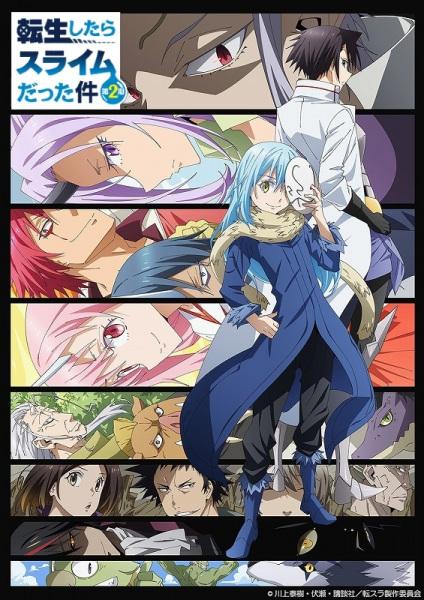
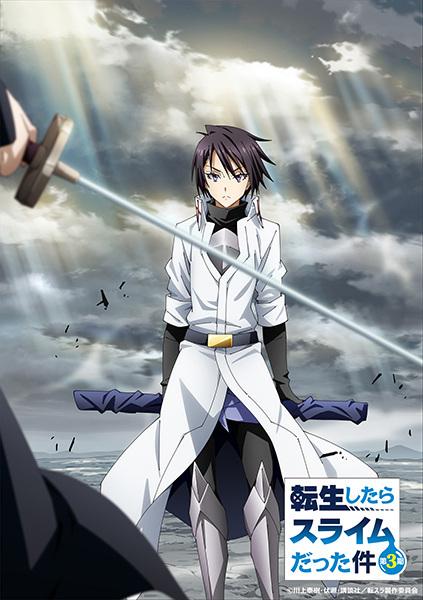
That Time I Got Reincarnated as a Slime Season 2 Part 2
転生したらスライムだった件 (Tensei shitara Slime Datta Ken 2nd Season Part 2)
- Action
- Comedy
- Fantasy
- Isekai
- Reincarnation
- Episodes
- 12
- Duration
- 23 min per ep
- Aired
- Jul 6, 2021 to Sep 21, 2021
- Status
- Finished Airing
Synopsis
Tempest celebrates after repelling the sudden assault by the Falmuth Army and the Western Holy Church, but the relief doesn’t last long. As leaders gather with allied nations to discuss what comes next for the burgeoning Nation of Monsters, new concerns crowd in: the fallout from Falmuth’s invasion, Milim Nava’s unsettling actions, and the unexplained disappearance of Demon Lord Carrion.
Having awakened as a True Demon Lord, Rimuru Tempest shifts from defense to decisive action, setting his sights on Clayman. With the fully restored Storm Dragon Veldora, the Ultimate Skill Raphael, and a formidable circle of companions at his side, Rimuru moves to dismantle his foes step by step—closing in on the one orchestrating events from the shadows.
Otaku Consensus
Otaku Consensus: Season 2 Part 2 earns its 8.29 MAL score by committing to the series’ strongest identity: Atsushi Nakayama’s direction and Kazuyuki Fudeyasu’s structure treat kingdom management, alliance-building, and demon-lord politics as the main event rather than filler between fights. Fans and reviewers consistently praise the heavier stakes, side-character attention, and character development, with the post-Falmuth fallout giving the cour a more consequential shape than early Slime. The recurring criticism is equally clear: viewers looking for constant travel or spectacle may find the season too concentrated in Tempest’s council rooms, where the world expands through meetings more than through new locations.
Why You Should Watch
Watch this cour if you want isekai power fantasy that cares as much about policy, diplomacy, and chain-of-command as it does about magical domination. It scratches a similar itch to Log Horizon’s civic-minded fantasy and Overlord’s factional chess, but with a warmer comedic core and less nihilism. The appeal is not just seeing Rimuru overpower threats; it is watching a monster nation professionalize itself through alliances, intelligence-gathering, military planning, and image control. If you like the idea of a fantasy cast debating consequences before unleashing superpowers, this is one of Slime’s most rewarding stretches. If you need nonstop movement, dungeon-crawling, or weekly boss fights, the meeting-heavy rhythm will test you.
Key Characters
- RRimuru Tempest(VA: Miho Okasaki)
Rimuru is compelling here because the series shifts him from charming accidental founder to deliberate head of state, making his kindness and pragmatism feel like political tools rather than simple personality traits.
- VVeldora
Veldora’s restored presence changes the texture of Tempest’s power balance, giving the season a source of comic excess and strategic intimidation without turning every scene into a fight.
- MMilim Nava
Milim stands out because her unpredictable behavior forces the cast to treat raw strength as a diplomatic crisis, not merely a battle statistic.
- CClayman
Clayman functions as the cour’s political pressure point, the kind of antagonist fans discuss less for brute force and more for how he manipulates the demon-lord ecosystem around him.
What Makes It Stand Out
- 1
The cour’s AniList tag profile is unusually revealing: Kingdom Management sits at 100%, above Isekai at 96% and Reincarnation at 94%, which matches how the season prioritizes administration, alliances, and political aftermath over the standard portal-fantasy checklist.
- 2
8bit’s adaptation leans into split-cour pacing: these 12 episodes, airing from July 6 to September 21, 2021, are structured as a follow-through cour rather than a reset, letting consequences and planning occupy more screen time than a typical action-fantasy sequel.
- 3
The staff lineup pairs director Atsushi Nakayama with series composition writer Kazuyuki Fudeyasu, a combination that helps explain the season’s confidence in long-form council scenes, faction briefings, and side-character participation.
- 4
The visual identity is credited through a layered design chain: Mitz Vah provides the original character design foundation, while Ryouma Ebata handles anime character design, keeping the cast readable across comedy, diplomacy, and large-scale fantasy confrontations.
- 5
Its reception numbers show broad approval beyond niche fandom: MAL lists it at 8.29 from 536,091 votes with Rank #346 and Popularity #223, while AniList records an 82/100 score and 8,166 favourites.
Fun Facts & Trivia
- Fun fact 1
- The key staff credits list Fuse and Taiki Kawakami under original story, reflecting how the anime’s production identity is tied not only to the light novel origin but also to the manga-side creative lineage recognized in the data.
- Fun fact 2
- Art direction is credited to Ayumi Satou, with Tomoyasu Fujise and Masahiro Satou on art design and Maki Saitou on color design, giving this cour a clearly segmented visual-production pipeline rather than a single catch-all art credit.
- Fun fact 3
- One reviewer from TakaCode Reviews explicitly described Slime as the series that broke his dislike of isekai and led him toward titles such as Villainess, Bookworm, Mushoku Tensei, Re:Zero, and KonoSuba, a useful snapshot of the franchise’s gateway-anime reputation.
- Fun fact 4
- A recurring positive note from reviewer coverage is the increased side-character screentime in Season 2, which aligns with Part 2’s emphasis on Tempest as a functioning nation rather than Rimuru as a solo problem-solver.
- Fun fact 5
- The most pointed fan criticism in the research is not about production quality but spatial repetition: one review notes that the story can feel stuck in one city or even one room, a complaint that directly reflects the season’s meeting-driven political structure.
Studios
- 8bit