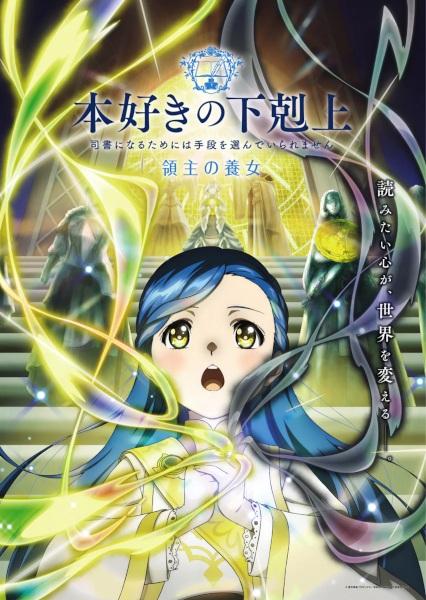
Ascendance of a Bookworm Season 3
本好きの下剋上 ~司書になるためには手段を選んでいられません~ 第3期 (Honzuki no Gekokujou: Shisho ni Naru Tame ni wa Shudan wo Erandeiraremasen 3rd Season)
- Fantasy
- Isekai
- Reincarnation
- Episodes
- 10
- Duration
- 23 min per ep
- Aired
- Apr 12, 2022 to Jun 14, 2022
- Status
- Finished Airing
Synopsis
With winter closing in, Myne—now serving as an apprentice priestess—has to settle into life at the temple while readying herself for the coming Dedication Ceremony. Her modern knowledge and unusually vast mana, however, make her a target, drawing the interest of influential and dangerous figures determined to claim her for themselves.
To protect her, the Head Priest arranges a guard and urges her to accept adoption into a noble household—an option that would separate her from the family she treasures. Myne resists, prompting a strict ultimatum: she may remain with her loved ones until she turns ten, but if she’s judged too unstable, decisive action will be taken immediately.
Caught between duty, safety, and the bonds she refuses to abandon, Myne faces an uncertain path ahead. Whatever comes, she’s prepared to fight for the people she cares about, even if it forces painful compromises with the future she’s been chasing.
Otaku Consensus
Season 3 is a decisive, emotionally sharper continuation that preserves Ascendance of a Bookworm’s unusual appeal: isekai driven by labor, literacy, class systems, and institutional power rather than combat escalation. Mitsuru Hongou’s direction and Mariko Kunisawa’s series composition land the season’s late conflicts with real force, but the 10-episode format makes the middle feel compressed, with several reviewers noting that developments arrive before scenes have time to breathe.
Why You Should Watch
Watch Season 3 if you want an isekai about leverage, bureaucracy, and social mobility without a power-fantasy protagonist steamrolling the setting. It scratches the same process-oriented itch as Spice and Wolf, where economics and negotiation matter, while keeping the reincarnation angle more grounded than most post-SAO fantasy series. The appeal is in watching modern knowledge collide with a medieval hierarchy that has rules, gatekeepers, and consequences. This season leans harder into church obligations, noble politics, and the cost of belonging to multiple families and institutions at once. Viewers who value slow-burn world systems, frail protagonists with non-combat strengths, and conflicts where paperwork can be as dangerous as magic will get the most from it.
Key Characters
- MMyne(VA: Yuka Iguchi)
Myne remains compelling because her greatest advantage is not strength but obsessive literacy, practical memory, and a refusal to treat books as luxuries reserved for the powerful.
- FFerdinand(VA: Show Hayami)
Ferdinand fascinates fans as a controlled, intimidating mentor figure whose protection of Myne often looks less like comfort and more like political risk management.
What Makes It Stand Out
- 1
Ajia-do’s adaptation keeps the franchise visually modest and character-focused, prioritizing expressions, ritual spaces, and object handling over spectacle-heavy fantasy action.
- 2
The season is structurally tighter than the first two, running only 10 episodes from April 12 to June 14, 2022; that brevity gives the finale momentum but also fuels the common criticism that the middle moves too quickly.
- 3
Its genre identity is unusually specific for isekai: AniList users tag it heavily for Class Struggle, Work, Economics, Religion, and Politics, making the appeal closer to institutional fantasy than adventure fantasy.
- 4
Season 3 places more weight on adaptation compression, with critics and fans broadly agreeing that it keeps the source’s essence while losing some nuance in transition.
- 5
The late-season conflict is the most discussed strength in user reactions, with several viewers singling out the climax and sadder emotional turn as the payoff for earlier setup.
Fun Facts & Trivia
- Fun fact 1
- The season was produced by Ajia-do with Mitsuru Hongou directing and Mariko Kunisawa handling series composition, continuing the anime’s emphasis on clear story logistics over flashy reinvention.
- Fun fact 2
- Miya Kazuki is credited for the original story, while You Shiina provided the original character designs; the anime adaptation lists Yoshiaki Yanagida, Toshihisa Kaiya, and Haruka Matsunae for character design.
- Fun fact 3
- The production credits separate prop design and art design, with Ryou Hirata on prop design and Toshiki Amata on art design, a fitting detail for a series where tools, materials, and social spaces carry narrative weight.
- Fun fact 4
- Reception is strong but not runaway mainstream: it holds an 8.06 MAL score from 101,281 votes, while AniList lists it at 79/100 with 1,259 favourites.
- Fun fact 5
- User reviews show a clear divide over adaptation pacing: positive reviewers praise the unique non-OP isekai structure and finale, while mixed reactions complain that the continuation feels like a rapid chain of events rather than a fully lingering expansion of the world.
Studios
- Ajia-do