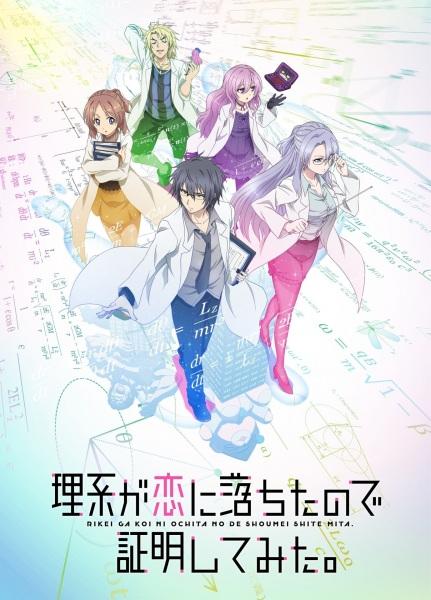
Science Fell in Love, So I Tried to Prove It r=1-sinθ
理系が恋に落ちたので証明してみた。r=1-sinθ(ハート) (Rikei ga Koi ni Ochita no de Shoumei shitemita. Heart)
- Comedy
- Romance
- Adult Cast
- Episodes
- 12
- Duration
- 23 min per ep
- Aired
- Apr 2, 2022 to Jun 18, 2022
- Status
- Finished Airing
Synopsis
After returning from their Okinawa trip, Saitama University grad students Shinya Yukimura and Ayame Himuro still can’t produce the decisive data needed to validate their love through science. Since recreating the trip’s exact conditions proves impossible, the two uncompromising researchers turn to help elsewhere on campus—specifically, the Biological Sciences department.
With support from fellow graduate students and established couple Chris Floret and Suiu Fujiwara, Yukimura and Himuro set out to quantify their emotions by tracking oxytocin levels across a range of romantic scenarios. The results only deepen their doubts, especially when compared to the steadier bond of a more mature relationship. When Chris challenges them to consider what it would mean if their “affection” doesn’t meet the definition of love, Yukimura becomes determined to find an explanation—and stake everything on proving their feelings are real.
Otaku Consensus
RikeKoi Heart lands as a warmly liked but more niche sequel, reflected in its 7.3 MAL score and 71/100 AniList score: Tooru Kitahata’s direction and Rintarou Ikeda’s composition keep the lab-room comedy brisk while the oxytocin material gives the season a sharper romantic test than the first. Its best asset remains the adult university cast bouncing absurd methodology off recognizable relationship anxiety, but the most common criticism is built into that same formula: the joke rhythm works better in weekly doses than in a binge, where the experiment-driven structure can feel repetitive.
Why You Should Watch
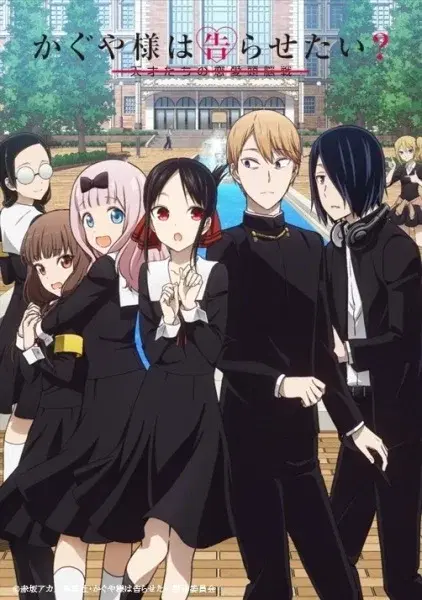
Watch RikeKoi Heart if you want a rom-com that treats flirtation like a peer-reviewed disaster without retreating into high-school confession clichés. It scratches some of the tactical-romance itch of Kaguya-sama: Love Is War, but trades student-council warfare for grad-student overanalysis, lab banter, and quantified affection. Viewers who liked Wotakoi’s adult-cast energy but want more academic ridiculousness will get the most out of it, especially because the second season leans harder into biological data, comparison couples, and meta jokes about measuring the unmeasurable. It is also easy to sample: 12 episodes, a finished Spring 2022 run, and a comedy rhythm reviewers specifically found funnier when watched one episode at a time.
Key Characters
- SShinya Yukimura
Yukimura is funniest when his confidence as a researcher becomes emotional tunnel vision, turning every romantic uncertainty into something he believes can be solved with enough variables.
- AAyame Himuro
Himuro balances the series’ cold academic surface with visible romantic impatience, making her the character who most often exposes the gap between data and desire.
- CChris Floret
Chris stands out in Heart as the outside benchmark for a more practiced relationship, pushing the central pair beyond cute hypotheticals and into uncomfortable definitions.
- SSuiu Fujiwara
Suiu gives the sequel’s relationship comparisons weight because her bond with Chris is framed as steadier and less performative than Yukimura and Himuro’s experiments.
What Makes It Stand Out
- 1
The season’s full title, r=1-sinθ, references a polar equation associated with a heart-shaped curve, matching the show’s habit of turning romance into a visualized mathematical object.
- 2
Zero-G produced the 12-episode season, which aired from April 2 to June 18, 2022, giving it a compact Spring 2022 broadcast run rather than a split-cour or long-form format.
- 3
The sequel shifts its scientific framework toward biological measurement, especially oxytocin, rather than relying only on behavioral observation; that gives Heart a more specific experimental texture than a standard workplace rom-com.
- 4
AniList’s tag distribution captures how unusually adult and academic the series is for TV anime romance: Primarily Adult Cast at 92%, College at 90%, Educational at 85%, and Meta at 62%.
- 5
Its international release was notably accessible, with listed audio options in Japanese, English, Latin American Spanish, and Brazilian Portuguese, plus subtitles in languages including English, German, French, Italian, Russian, and Arabic.
Fun Facts & Trivia
- Fun fact 1
- The anime adapts Arihred Yamamoto’s original work, credited in the production materials under the RikeKoi Project copyright with COMIC METEOR.
- Fun fact 2
- Director Tooru Kitahata returned with a staff lineup that included Rintarou Ikeda on series composition, Yuusuke Isouchi on character design, and Yuuichi Imaizumi as sound director.
- Fun fact 3
- On MyAnimeList, the season sits at 7.3/10 from 60,395 votes, with a rank of #3128 and popularity position of #1606, placing it in the solidly watched middle tier rather than cult obscurity.
- Fun fact 4
- AniList records 691 favourites for the season, a useful contrast to its broader 71/100 score because it suggests a smaller but committed fanbase for the sequel’s specific brand of academic romance comedy.
- Fun fact 5
- The streaming listing’s content advisory includes suggestive dialogue, sexualized imagery, and violence, which is a reminder that the show’s clean scientific framing still sits inside an adult-cast comedy register.
Studios
- Zero-G