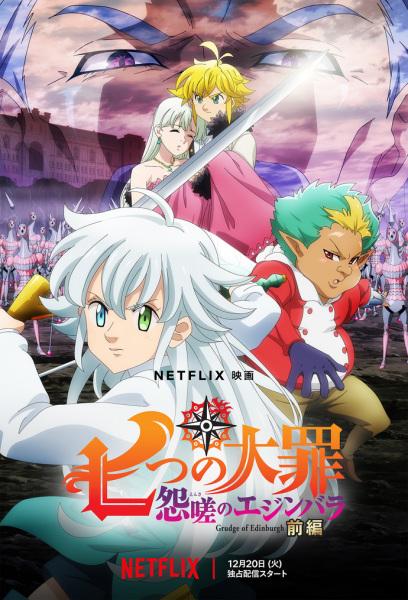
The Seven Deadly Sins: Grudge of Edinburgh Part 2
七つの大罪 怨嗟のエジンバラ 後編 (Nanatsu no Taizai: Ensa no Edinburgh Part 2)
- Action
- Adventure
- Fantasy
- Super Power
- Episodes
- 1
- Duration
- 54 min
- Aired
- Aug 8, 2023
- Status
- Finished Airing
Synopsis
In the thrilling continuation of *The Seven Deadly Sins: Grudge of Edinburgh*, the epic journey unfolds as the remnants of the notorious group confront their past and the challenges that lie ahead. With the fate of their world hanging in the balance, familiar faces return while new threats emerge, testing their bonds and resolve.
As the heroes navigate a landscape filled with powerful foes and lingering grudges, the stakes rise, and alliances are put to the ultimate test. The adventure blends intense action with rich fantasy elements, inviting viewers to immerse themselves in a tale of redemption, loyalty, and the pursuit of justice.
Otaku Consensus
Grudge of Edinburgh Part 2 is received as a compact, more purposeful franchise coda than its middling MAL score of 6.56 and AniList score of 65 suggest, with Bob Shirohata and chief director Noriyuki Abe keeping the one-episode format brisk and Hiroyuki Sawano and Kouta Yamamoto giving the action a larger-than-TV scale. The sticking point remains the Marvy Jack and Alfred Imageworks full-CGI presentation: its clean swordplay and fantasy spectacle are easy to read, but the character animation is the most common barrier for viewers attached to the 2D identity of The Seven Deadly Sins.
Why You Should Watch
Watch this if you want The Seven Deadly Sins mythology in a concentrated, action-first format without committing to another long TV arc. Its appeal is less “newcomer gateway” and more franchise aftertaste: a chance to see the series’ medieval fantasy vocabulary filtered through full CGI, with fairies, swordplay, and super-powered clashes pushed to the front. It scratches the same battle-shonen itch as Fairy Tail or Black Clover when those shows lean into party chemistry and magical weapons, but its single-film structure trims out training detours and comedy padding. The strongest hook is the sound of it: Hiroyuki Sawano and Kouta Yamamoto bring a muscular, cinematic score, and Sawano’s theme-song involvement gives the finale a recognizable prestige-anime pulse.
Key Characters
- TTristan Liones
Tristan is compelling as a next-generation lead because he carries franchise legacy on-screen rather than functioning as a simple replacement for the original Sins.
- LLancelot
Lancelot gives the film its sharper edge, standing out as the cooler, more controlled counterpart to Tristan’s more emotionally exposed heroism.
- DDeathpierce
Deathpierce is memorable because his role draws on the series’ older political and racial resentments instead of introducing a disposable movie-only threat.
What Makes It Stand Out
- 1
The film is a full-CGI production by Marvy Jack and Alfred Imageworks, a notable shift for a franchise most viewers first encountered through traditional TV anime production. That makes the action staging cleaner and more spatially legible, while also explaining why the visuals remain the most divisive part of its reception.
- 2
Noriyuki Abe serves as chief director while Bob Shirohata directs, pairing a veteran anime action hand with a filmmaker known for handling ensemble fantasy material. The result is a sequel entry built around momentum rather than the decompressed rhythm of a weekly shonen arc.
- 3
Hiroyuki Sawano and Kouta Yamamoto share the music credit, a pairing associated with high-impact orchestral-electronic scoring. Sawano also appears in the theme-song performance credit alongside XAI, giving the soundtrack a stronger identity than many franchise side films receive.
- 4
AniList’s highest-weighted tags are Fairy, Swordplay, and Medieval at 79% each, which accurately signals the film’s priorities better than a broad fantasy label. Its identity is built from weapon combat, non-human lineage, and chivalric-fantasy iconography rather than school, tournament, or isekai conventions.
- 5
Its one-episode finished-airing format makes it a deliberately contained continuation rather than a new cour. That structure benefits viewers who want franchise closure and spectacle, but it also limits the room for side-character texture.
Fun Facts & Trivia
- Fun fact 1
- Original creator Nakaba Suzuki is credited on the project, tying the film directly to the authorial source of The Seven Deadly Sins rather than positioning it as an unrelated spin-off experiment.
- Fun fact 2
- The script is credited to Rintarou Ikeda, whose role is especially important here because a single-episode sequel has to compress franchise callbacks, character handoffs, and action escalation into one continuous structure.
- Fun fact 3
- The localization footprint is visible in the staff data: Leonardo Santhos is credited as Brazilian Portuguese ADR director, while Stefan Gawłowski is credited for Polish ADR editing. That points to a release planned with multiple international audio markets in mind.
- Fun fact 4
- Despite being a sequel entry in a major shonen-fantasy brand, its database footprint is modest: MAL lists it at 6.56 from 8,763 votes, with a popularity rank of #5392, while AniList records 109 favourites.
- Fun fact 5
- The dual studio credit of Marvy Jack and Alfred Imageworks matters because Alfred Imageworks is strongly associated with CGI production, matching AniList’s Full CGI tag at 73% and CGI tag at 60%.
Studios
- Alfred Imageworks
- Marvy Jack