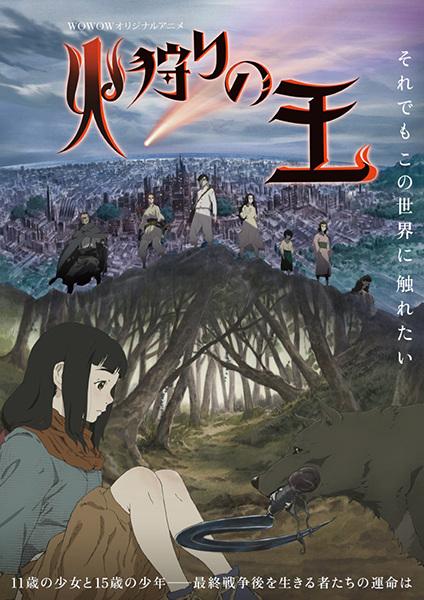
The Fire Hunter Season 2
火狩りの王 第2シーズン (Hikari no Ou 2nd Season)
- Adventure
- Drama
- Fantasy
- Episodes
- 10
- Status
- Finished Airing
Synopsis
In a city engulfed by chaos and besieged by the formidable Spiders, Touko finds herself grappling with the aftermath of a harrowing encounter. Determined to honor the legacy of Haijuu, a fallen fire hunter who bravely protected her, she embarks on a quest to return his belongings. Accompanied by Haijuu's loyal dog, Kanata, and Akira, a steadfast fire hunter who has been her protector, Touko navigates the turmoil that surrounds her. However, as Akira is called away on a critical mission, she is thrust into the heart of the conflict, setting the stage for her own path of discovery.
Meanwhile, Koushi, Haijuu's son, fights valiantly to safeguard the city amidst the chaos. While he may not possess remarkable physical strength, Koushi's ingenuity shines through as he crafts an impressive array of weapons, including a powerful cannon that harnesses lightning to strike down the invading forces. Yet, this display of might draws the ire of the deity Hibari, who aims to thwart his efforts. As the threads of their fates intertwine, both Touko and Koushi must navigate the treacherous schemes of gods and humans alike, striving to survive in a world on the brink of destruction.
Otaku Consensus
The Fire Hunter Season 2 remains one of the stranger post-apocalyptic fantasy projects of its era: its Oshii-led series composition, dense class-and-gods mythology, and Koushi’s father-centered mini-arc give it a texture few seasonal anime attempt. The verdict is sharply mixed because the same density often becomes disorientation, with viewers repeatedly citing confusing plotting, rough storyboarding, and underpowered animation as the season’s genuine barriers. Best watched in a short binge rather than week to week, it rewards patience more than it delivers polish.
Why You Should Watch
Watch The Fire Hunter Season 2 if you want fantasy that treats civilization, technology, animals, gods, and social hierarchy as one broken ecosystem rather than as background lore. It scratches the same itch as Shinsekai Yori or the harsher side of Nausicaä: a world where the rules feel old, half-understood, and politically loaded, without the clean exposition or triumphant battle grammar of standard adventure anime. The appeal is not sakuga spectacle; it is the accumulation of strange systems, ceremonial violence, improvised machinery, divine interference, and morally exhausted survivors. Viewers who enjoy Mamoru Oshii’s taste for institutional conspiracy and philosophical friction will find more to chew on than the low score suggests, especially if they can tolerate a production that looks idiosyncratic rather than smooth.
Key Characters
- TTouko
Her appeal lies in the slow shift from protected rural outsider to self-directed survivor, a trajectory critics identified as one of the show’s strongest character ideas even when the execution divided them.
- KKoushi
Fans who defend the series often single out his emotionally tangled connection to Haijuu as the most effective small-scale drama inside the larger mythology.
- AAkira
Akira functions as the professional counterweight to Touko, grounding the setting’s fire-hunter culture in discipline, duty, and the cost of competence.
- KKanata
Kanata gives the series’ animal motif unusual weight, serving less as mascot relief than as a living link between memory, labor, and survival.
What Makes It Stand Out
- 1
Mamoru Oshii handled series composition, which helps explain the season’s emphasis on systems, institutions, gods, and conspiracy over conventional adventure momentum.
- 2
Signal.MD’s production keeps the franchise’s divisive visual identity intact: viewers praised its unusual art direction and world texture, while detractors focused on limited character animation and uneven storyboarding.
- 3
The season runs only 10 episodes, making it structurally tighter than many fantasy cours but also leaving little room for viewers who need gradual reorientation into its terminology and factions.
- 4
The design pipeline is unusually specialized, with Akihiro Yamada credited for original character design, Takuya Saitou for anime character design, Kaoru Kamigiku for mechanical design, Gouichi Iwahata for props, and Tomohiro Matsubara for creatures.
- 5
Forum reception specifically noted that the story plays better when watched faster than weekly, because gaps between episodes intensify the confusion caused by its dense plotting and rough transitions.
Fun Facts & Trivia
- Fun fact 1
- The anime is based on Rieko Hinata’s original story, with Akihiro Yamada credited for the original character designs, giving the project a literary-fantasy foundation rather than a manga-first identity.
- Fun fact 2
- Director Junji Nishimura returned with assistant director Yukiko Kanno, while Mamoru Oshii’s role as series composer remained one of the production’s biggest auteur signals.
- Fun fact 3
- Its reception numbers reflect a cult-object profile rather than mainstream traction: MAL lists it at 5.9 from 4,831 votes, while AniList records a 58/100 score and only 46 favorites.
- Fun fact 4
- One Anime-Planet forum comment argued that the show benefits from a rewatch or binge pace, an unusually practical criticism that matches the common complaint that weekly viewing made the narrative harder to parse.
- Fun fact 5
- A notably harsh independent review rated Season 2 at 3.5/10 after giving Season 1 a 5/10, showing how the sequel’s execution alienated even viewers who saw promise in the first season.
Studios
- Signal.MD