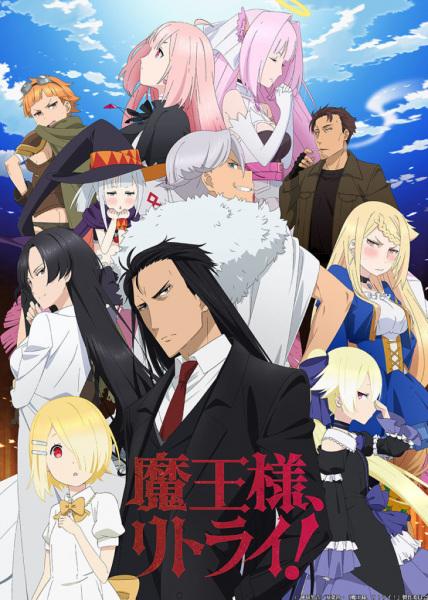
Demon Lord, Retry! R
魔王様、リトライ! R (Maou-sama, Retry! R)
- Action
- Adventure
- Fantasy
- Isekai
- Episodes
- 12
- Duration
- 23 min per ep
- Aired
- Oct 5, 2024 to Dec 21, 2024
- Status
- Finished Airing
Synopsis
With Rabbi Village flourishing under the steady direction of Isami Tahara and Yuu Kirino, Hakuto Kunai is free to set out again, continuing his hunt for items capable of resisting magic. His trail leads to Rookie Town’s Prison Labyrinth, where a hidden research facility buried deep in the dungeon reveals technology far beyond—and far more perilous than—anything known elsewhere in the world.
Back in Rabbi Village, that sudden growth draws the gaze of foreign powers. The newly established Queendom of Xenobia moves to stir conflict between the Holy Kingdom of Light and the State of Right, placing the village in the middle of a larger political game. With the help of his newly summoned aide, Akane Fujisaki, Kunai is better positioned to push back against plans that don’t unfold as Xenobia expects.
Otaku Consensus
Demon Lord, Retry! R lands as a niche sequel for viewers already tuned to its offbeat blend of isekai power fantasy, village economics, guns, and dungeon science, with Kazuomi Koga’s direction and Katsuhiko Takayama’s series composition giving the 12-episode run a clearer adventure-management rhythm than its premise suggests. Its strongest material is the contrast between the Rookie Town Prison Labyrinth’s anachronistic technology and Rabbi Village’s political fallout, but the muted MAL score of 5.91 and AniList score of 57 reflect the main criticism: it rarely breaks out of specialist isekai appeal or converts skeptics of the franchise.
Why You Should Watch
Watch Demon Lord, Retry! R if you want an isekai that treats domination as administration: resource control, diplomatic pressure, hired hands, and the practical value of anti-magic tools matter as much as combat swagger. It scratches part of the Overlord itch with its anti-hero male lead and subordinates, but it is less grandiose and more interested in frontier infrastructure, dungeon oddities, and political nuisance-making. Viewers who like Tsukimichi: Moonlit Fantasy for its settlement-building angle may find a rougher, pulpier companion here, especially if they prefer guns, swordplay, kemonomimi side characters, and magic systems colliding in the same package. It is not the pick for prestige animation seekers; it is for isekai fans who enjoy competent power fantasy with a surprisingly business-minded spine.
Key Characters
- HHakuto Kunai
Kunai remains the franchise’s main draw: a controlled anti-hero presence whose appeal comes from treating fantasy-world threats like operational problems rather than heroic destinies.
- IIsami Tahara
Isami functions as part of Rabbi Village’s stabilizing brain trust, giving the series a grounded administrative counterweight to its dungeon and battle material.
- YYuu Kirino
Yuu is interesting less as a conventional side character than as evidence of the show’s fixation on logistics, social order, and what happens after an isekai protagonist starts building institutions.
- AAkane Fujisaki
Akane’s introduction expands Kunai’s tactical toolkit, and her presence sharpens the season’s emphasis on summoned aides as strategic assets rather than simple fan-service companions.
What Makes It Stand Out
- 1
Studio Gekkou handles this 12-episode season, which aired as a compact fall 2024 run from October 5 to December 21 rather than a split-cour or long-form adaptation.
- 2
The season’s genre mix is unusually explicit: AniList tags it with Isekai, Reincarnation, Magic, Guns, Martial Arts, Swordplay, Economics, and Anti-Hero, which accurately signals a show more hybridized than a standard sword-and-spell power fantasy.
- 3
Katsuhiko Takayama’s series composition gives the season a two-front structure, alternating dungeon-side escalation with the consequences of Rabbi Village’s growth and foreign political pressure.
- 4
The Rookie Town Prison Labyrinth material stands out because it injects buried research-facility technology into a fantasy setting, making the season’s threats feel less medieval and more unstable.
- 5
The music credits split attention between recognizable anisong names: ASCA performs the opening theme, while Yuuho Kitazawa and MIMiNARI are credited on ending theme performance.
Fun Facts & Trivia
- Fun fact 1
- The production credits separate Amaru Minotake as Original Creator, Kurone Kanzaki as Original Story, and Kouji Ogata as Original Character Design, reflecting the franchise’s layered source-material lineage rather than a single-credit origin.
- Fun fact 2
- Minori Homura is credited for the anime’s character designs, translating Kouji Ogata’s original design work into the visual framework used by Studio Gekkou’s adaptation.
- Fun fact 3
- Kazuomi Koga directs the season, while Katsuhiko Takayama handles series composition, a pairing that gives the anime distinct credits for episode-level staging and overall narrative organization.
- Fun fact 4
- The English-language production lists Zachary Bolton as ADR Producer, confirming that the series received a coordinated English dub production track rather than only subtitled distribution.
- Fun fact 5
- Despite finishing outside MAL’s upper ranks at #11282, the series still drew substantial database activity, with 21,813 MAL votes and 330 AniList favourites recorded in the provided data.
Studios
- Gekkou