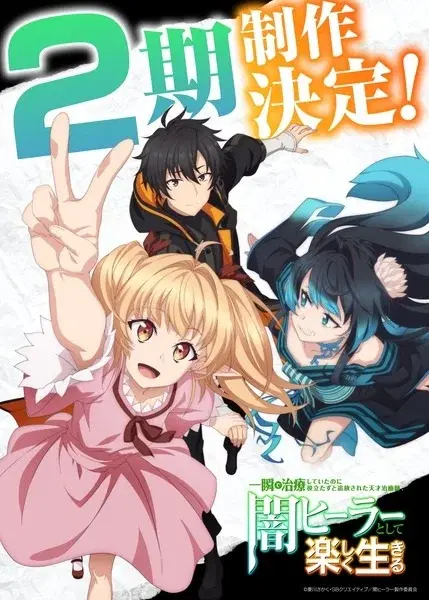
The Brilliant Healer's New Life in the Shadows
一瞬で治療していたのに役立たずと追放された天才治癒師、闇ヒーラーとして楽しく生きる (Isshun de Chiryou shiteita noni Yakutatazu to Tsuihou sareta Tensai Chiyushi, Yami Healer toshite Tanoshiku Ikiru)
- Fantasy
- Medical
- Episodes
- 12
- Duration
- 24 min per ep
- Aired
- Apr 3, 2025 to Jun 19, 2025
- Status
- Finished Airing
Synopsis
In the Kingdom of Herzeth, healing is a respected profession—one that typically demands a hard-won license and years of formal training. Zenos, raised in poverty and guided by practicality, learns the craft on his own and proves so gifted that an adventurer party takes him in. Even so, he’s later cast out, and a chance encounter with an elf slave named Lily gives his life a new direction: building a discreet clinic for people the system overlooks.
With Lily at his side, Zenos begins treating patients in the shadows, only to be swept into rising tensions among lizardmen, werewolves, and orcs. His skill at mending bodies helps settle the conflict and bring the groups together—but word of his deeds reaches the royal knights, who don’t welcome an unlicensed healer operating beyond their control. To keep helping those in need, Zenos has to protect his underground work without betraying the values that led him there.
Otaku Consensus
With MAL at 6.82 and AniList at 68, The Brilliant Healer's New Life in the Shadows landed as a modestly liked 2025 fantasy rather than a breakout; its strongest material is the compact tribal-conflict stretch involving lizardmen, werewolves, and orcs, where Joe Yoshizaki's direct, unfussy pacing gives the 12-episode run a clear middle spine. Viewers responded best to its medicine-and-magic angle, class-system friction, and Makaria's clean character-forward presentation, while the most persistent limitation is how often its harem and monster-girl framework softens the sharper social material into familiar light-novel comfort food. The broader web footprint is notably thin and noncommittal, so the audience scores tell the story: watchable, specific in its niche, but not widely treated as essential fantasy.
Why You Should Watch
Watch this if you want fantasy healing treated less like a support spell and more like a black-market profession shaped by licensing, poverty, and status. It scratches a neighboring itch to Banished from the Hero's Party or The Saint's Magic Power Is Omnipotent, but with more emphasis on back-alley medicine, beastfolk factions, and the politics of who gets care. The appeal is not high-stakes spectacle; it is the satisfaction of a competent specialist solving bodily and social damage in a world that would rather regulate him out of existence. Viewers who like monster-girl ensembles, elves, kemonomimi designs, and a mostly female supporting cast will find the AniList tag profile very accurate. If you want class-struggle fantasy without grimdark revenge, this is calibrated for that lane.
Key Characters
- ZZenos
Zenos is built around a rare fantasy-anime competency hook: the pleasure is watching him diagnose, improvise, and outmaneuver credentialed gatekeepers rather than chase conventional hero status.
- LLily
Lily functions as the emotional counterweight to the show's institutional critique, giving the clinic scenes a steadier domestic rhythm amid the primarily female fantasy-species ensemble.
What Makes It Stand Out
- 1
The series' tag profile is unusually concentrated around Medicine at 90% and Magic at 88%, making healing practice the central fantasy mechanism rather than a background support class gimmick.
- 2
Its social angle is baked into the metadata as well as the story world: AniList tags include Class Struggle, Slavery, and Dystopian, while MAL lists no formal theme category, creating an interesting mismatch between database classification and what the show actually foregrounds.
- 3
Makaria produced the anime as a single-cour, 12-episode adaptation that aired from April 3 to June 19, 2025, giving it a tight seasonal footprint rather than a split-cour sprawl.
- 4
The creature-community material is not incidental window dressing: AniList specifically flags Monster Girl, Nekomimi, Kemonomimi, Werewolf, Elf, and Ghost, signaling a fantasy cast built around species variety as much as profession or party roles.
- 5
Music is credited to Harumi Fuuki, while Hiroto Morishita handled sound direction, giving the production a clearly separated music-and-audio leadership structure rather than folding those responsibilities into a single department credit.
Fun Facts & Trivia
- Fun fact 1
- The anime's full Japanese title, Isshun de Chiryou shiteita noni Yakutatazu to Tsuihou sareta Tensai Chiyushi, Yami Healer toshite Tanoshiku Ikiru, is far more explanatory than the English title and preserves the light-novel tradition of turning the hook into the name itself.
- Fun fact 2
- Sakaku Hishikawa is credited with the original story, while Ryuu Dabu provided the original character designs; the anime adaptation lists Yoshihiro Sawada and denpuougi for character design, indicating a separate translation of the source visuals for animation.
- Fun fact 3
- The production's visual pipeline credits include Hiroshi Gouroku as art director, Moe Kawada as color designer, and Kouhei Tanada as director of photography, three roles that shape the look beyond character art alone.
- Fun fact 4
- Despite its middle-of-the-pack MAL rank of #5813, the show had substantial visibility for a niche fantasy title, with 83,299 MAL votes and a popularity placement of #1619 in the supplied data.
- Fun fact 5
- AniList records 1,392 favourites for the series, which is a useful counterweight to its merely moderate 68/100 score: the show did not dominate consensus, but it did carve out a committed fan pocket.
Studios
- Makaria