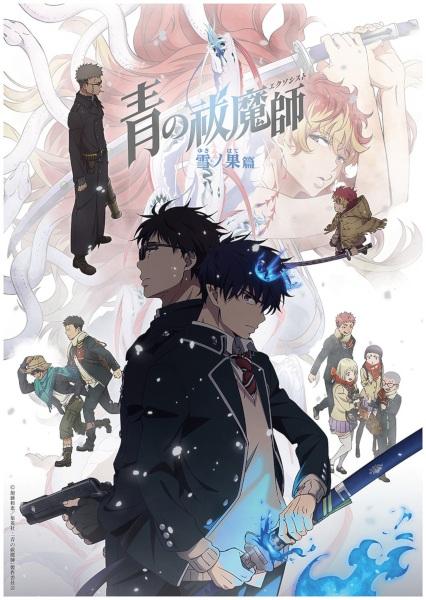
Blue Exorcist: The Blue Night Saga
青の祓魔師 終夜篇 (Ao no Exorcist: Yosuga-hen)
- Action
- Supernatural
- Mythology
- School
- Episodes
- 12
- Duration
- 23 min per ep
- Aired
- Jan 5, 2025 to Mar 23, 2025
- Status
- Finished Airing
Synopsis
Rin Okumura has never been eager to dig into the mysteries of his birth the way his twin brother, Yukio, has. That changes when Mephisto Pheles, the self-proclaimed master of time, hands Rin a key that sends him 40 years into the past—back to when his late mother, Yuri Frederick Egin, was still a child. Under Mephisto’s direction, Rin moves through pivotal moments of Yuri’s youth and her later days as an exorcist-in-training.
Along the way, Yuri crosses paths with Shirou Fujimoto, the man who will one day raise Rin and Yukio. Watching their lives unfold, Rin also sees the earliest signs of Satan’s influence and the grim reality hidden within the True Cross Order’s Section 13. As Yuri’s unusual bond with Satan comes into focus, Rin is drawn toward the truth behind the Blue Night—the darkest tragedy in exorcist history and the night he and Yukio were born.
Otaku Consensus
Blue Exorcist: The Blue Night Saga earns its strong 7.99 MAL score by treating the Blue Night material as a focused historical reckoning rather than a routine supernatural-school continuation, with Daisuke Yoshida’s direction and Toshiya Oono’s series composition giving the season a cleaner throughline than the franchise’s more episodic stretches. Critics and episode reviewers singled out the season’s early-to-middle run and the closing three episodes as especially rewarding, while the main reservation is that its lore-heavy structure can feel less immediately playful than the first season’s mix of comedy, school life, and exorcist action.
Why You Should Watch
Watch The Blue Night Saga if you want shounen occult drama that digs into institutional secrets instead of simply escalating fights. It scratches a similar itch to Jujutsu Kaisen’s exorcist bureaucracy and Fullmetal Alchemist’s suspicion of official power, but with Blue Exorcist’s specific blend of demon mythology, religious imagery, and twin-family tension. The season is especially appealing if Mephisto’s manipulations, Yukio’s anxiety, and the True Cross Order’s darker corners are the parts of the franchise that stayed with you. Studio VOLN gives the 12-episode run a compact shape, while Hiroyuki Sawano and Kouta Yamamoto’s music pushes the material toward tragic grandeur rather than nostalgic comfort.
Key Characters
- RRin Okumura
Rin is compelling here because the season uses his usual impulsive sincerity as a pressure test for the franchise’s most uncomfortable family and institutional truths.
- YYukio Okumura
Yukio remains the series’ most tightly wound counterpoint to Rin, and fan discussion often centers on how his hunger for answers turns brotherhood into a source of tension rather than simple loyalty.
- YYuri Frederick Egin
Yuri gives the saga its emotional gravity by turning long-discussed Blue Exorcist mythology into a character-driven tragedy rather than background lore.
- MMephisto Pheles
Mephisto’s appeal is his unnerving mix of school-director theatrics and cosmic manipulation, the kind of character viewers cite when they talk about Blue Exorcist’s enduring mysteries.
What Makes It Stand Out
- 1
The season’s structure is a deliberate pivot away from the franchise’s school-mission rhythm: AniList still tags the series with School at 20%, but Time Manipulation sits at 79%, reflecting how strongly this arc prioritizes historical investigation over classroom dynamics.
- 2
Studio VOLN produced this 12-episode cour under director Daisuke Yoshida, with Toshiya Oono on series composition, giving the Blue Night material a contained January-to-March 2025 television run rather than a sprawling adaptation.
- 3
The music team pairs Hiroyuki Sawano with Kouta Yamamoto, a combination that suits the season’s movement between occult action and generational tragedy; Kazuhiro Wakabayashi’s role as sound director further emphasizes atmosphere over gag-driven timing.
- 4
amazarashi performs the opening theme, a fitting match for a season built around grief, memory, and moral corrosion rather than straightforward heroic momentum.
- 5
Its reception profile is strong but not mainstream-saturated: MAL lists it at 7.99 from 32,676 votes with a #757 rank and #2588 popularity, while AniList records an 80/100 score and 515 favourites.
Fun Facts & Trivia
- Fun fact 1
- The Japanese title is Ao no Exorcist: Yosuga-hen, while the English-facing title emphasizes the Blue Night, making the season’s branding unusually direct about the franchise mystery it addresses.
- Fun fact 2
- AniList’s highest-weighted tags are Demons and Exorcism at 95% each, followed by Urban Fantasy, Shounen, and Time Manipulation at 79%, which neatly maps the season’s identity as occult shounen filtered through a memory-and-history framework.
- Fun fact 3
- Jonathan Clements’ episodic coverage noted the value of catching up with Yukio, the Exwires, and the wider sense that the world is destabilizing, highlighting that the season is not only backward-looking despite its historical focus.
- Fun fact 4
- One review of episodes 10 to 12 praised the final stretch while still calling the early and middle parts of the season its favorites, a useful snapshot of the season’s reception: admired overall, but with its strongest momentum perceived before the finale.
- Fun fact 5
- Kazue Katou remains credited as the original creator, while the anime’s visual identity is shaped by art director Tomoyuki Shimizu, color designer Yoshinori Horikawa, and editor Yumi Jinguuji.
Studios
- Studio VOLN