This Monster Wants to Eat Me
私を喰べたい、ひとでなし (Watashi wo Tabetai, Hitodenashi)
- Drama
- Girls Love
- Supernatural
- Mythology
- Episodes
- 13
- Duration
- 23 min per ep
- Aired
- Oct 2, 2025 to Dec 25, 2025
- Status
- Finished Airing
Synopsis
After losing her family to a tragic accident at sea, Hinako Yaotose can’t shake the pull of the ocean—or the thought of disappearing beneath it. She keeps up a fragile, almost cheerful front with her only friend, Miko Yashiro, but when Miko isn’t nearby, Hinako’s despair resurfaces. One summer day, a mysterious girl with clear, sea-deep eyes catches Hinako’s attention and stirs something she hasn’t felt in a long time.
Searching for her again, Hinako is dragged underwater by a monstrous deep-sea creature, only to wake and find the girl—Shiori Oumi—standing over her after transforming into something inhuman to destroy the attacker. Shiori’s rescue comes with a chilling truth: like the other creatures of the deep, she intends to eat Hinako.
By morning, Shiori appears in Hinako’s classroom as a new transfer student. Instead of fear, Hinako finds herself smiling—faced at last with someone who might grant the quiet death she’s been yearning for.
Otaku Consensus
This Monster Wants to Eat Me landed as a strong niche success rather than a broad breakout, with MAL’s 7.44 and AniList’s 74 reflecting admiration for how Studio Lings frames Girls’ Love horror as a grief-driven supernatural drama. The Kuzuya/Suzuki direction works best in its tonal discipline: suicide ideation, mermaid mythology, gore, rural coastal atmosphere, and school intimacy are treated as one unstable emotional ecosystem. Its clearest limitation is the same thing that defines it: the slow, interior pacing and dark yuri premise make it less accessible than its monster-girl hook suggests.
Why You Should Watch
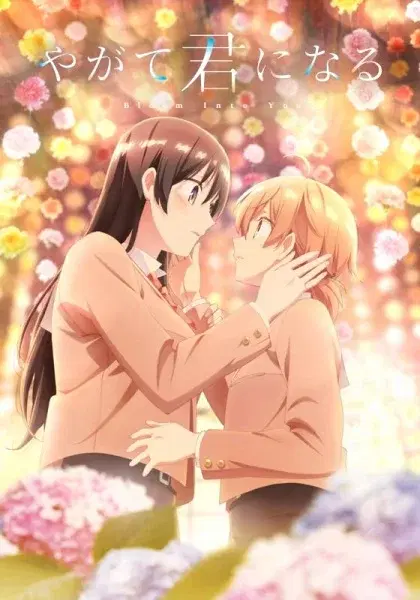
Watch this if you want yuri that feels dangerous, mournful, and mythic rather than cute or comfort-coded. It scratches the same itch as Bloom Into You for emotional restraint, but filters that longing through the appetite-and-devotion horror of Mermaid Forest. The appeal is not monster spectacle alone; it is the way the series lets attraction, grief, self-erasure, and folklore occupy the same room without softening the discomfort. Viewers drawn to female-led supernatural drama, coastal settings, and relationships with an explicitly predatory edge will get the most from it. If you want Girls’ Love without slice-of-life safety rails, and horror that uses gore as emotional punctuation rather than weekly shock value, this is squarely in your lane.
Key Characters
- HHinako Yaotose
Hinako is compelling because the series treats her cheerfulness as a social performance, making every quiet pause around her feel more revealing than a confession.
- SShiori Oumi
Shiori gives the anime its central tension: fans discuss her less as a simple monster girl and more as a figure whose hunger blurs protection, intimacy, and threat.
- MMiko Yashiro
Miko anchors the human side of the cast, functioning as the emotional counterweight to the series’ supernatural pull and its fascination with disappearance.
What Makes It Stand Out
- 1
Studio Lings handles the adaptation as a complete 13-episode single-cour drama, airing from October 2 to December 25, 2025, which gives the series a contained seasonal shape rather than a long-running supernatural format.
- 2
The production uses a split leadership structure, with Naoyuki Kuzuya credited as Chief Director and Yuusuke Suzuki as Director, a notable arrangement for a mood-heavy series where tone control matters as much as incident.
- 3
AniList’s tag profile is unusually concentrated: Suicide at 94%, Monster Girl at 92%, Female Protagonist at 92%, Mermaid at 85%, Yuri at 80%, and Gore at 73%, signaling a show that commits to its discomfort rather than sanding it down.
- 4
The anime’s genre listing pairs Drama, Girls Love, and Supernatural with the Mythology theme, placing it closer to folk-horror melodrama than to conventional school romance or monster-of-the-week fantasy.
- 5
The setting identity is part of the appeal: AniList tags it as Coastal at 82% and Rural at 78%, so the series’ sense of isolation is built into its environment rather than treated as background decoration.
Fun Facts & Trivia
- Fun fact 1
- Sai Naekawa is credited as the original creator, while Mitsutaka Hirota handles series composition, placing the adaptation’s structural spine in the hands of a dedicated script coordinator rather than dispersing it across episode writers alone.
- Fun fact 2
- Nozomi Ikuyama is credited for character design, with Shinichi Inami separately credited for prop design, indicating a production pipeline that distinguishes the cast’s visual identity from the objects and details around them.
- Fun fact 3
- The visual world is divided across multiple specialized credits: Yoshitaka Kudou as Art Director, Hosoi for Art Design, and Taeko Mizuno for Color Design.
- Fun fact 4
- Tetsurou Shouji receives a dedicated Title Logo Design credit, a small but telling production detail for a series whose Japanese title, Watashi wo Tabetai, Hitodenashi, carries much of its unsettling identity.
- Fun fact 5
- Despite its niche combination of Girls’ Love, suicide themes, mermaid mythology, and gore, it accumulated 26,729 MAL votes, with a MAL rank of #2453 and popularity position of #2726.
Studios
- Studio Lings