Maria†Holic Alive
まりあ†ほりっく あらいぶ
- Comedy
- Girls Love
- Crossdressing
- Parody
- School
- Episodes
- 12
- Duration
- 23 min per ep
- Aired
- Apr 8, 2011 to Jun 24, 2011
- Status
- Finished Airing
Synopsis
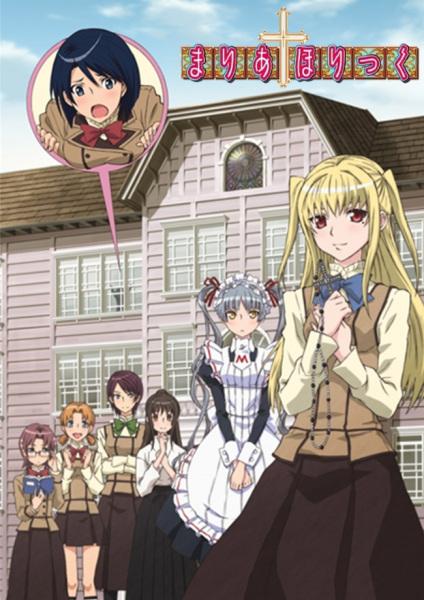
Kanako Miyamae transfers to an all-girls school convinced she’ll finally meet her destined sweetheart. On day one she’s captivated by the elegant, seemingly perfect Mariya Shidou—until she learns Mariya’s secret: he’s actually a boy in disguise. Worse, Kanako ends up sharing a room with him, turning her school life into a steady stream of bad luck and frustration.
Maria†Holic Alive picks up with Kanako still trapped in close quarters with Mariya, trying to keep her romantic hopes alive while navigating everyday high school chaos. Her search for “true love” is continually complicated by Mariya’s sadistic interference and the biting commentary of his maid, Matsurika Shinouji.
Otaku Consensus
Maria†Holic Alive lands as a sharper-than-average sequel for viewers already tuned to Shaft’s anti-romance wavelength: Akiyuki Shinbou and Tomokazu Tokoro keep the comedy visually restless, meta, and deliberately abrasive rather than letting it become routine school hijinks. Its strongest appeal is the dense parody of yuri boarding-school fantasies through crossdressing, maids, religious imagery, and deadpan cruelty; its most common limitation is that the sadistic gag rhythm can feel repetitive or exhausting once the first season’s shock value is gone.
Why You Should Watch
Watch Maria†Holic Alive if you want girls’ school romance tropes attacked with a mallet instead of indulged with sincerity. This is for fans who enjoy Shaft’s rapid-fire visual comedy, theatrical cutaways, and meta asides, especially the same nervous energy that powers Sayonara Zetsubou Sensei, but filtered through yuri parody, crossdressing farce, and boarding-school iconography. It is not a soft comfort comedy or a clean romantic payoff machine; the pleasure is in watching every elegant genre expectation get punctured by timing, cruelty, and absurd escalation. Viewers who like their school comedies meaner, denser, and more self-aware than the average clubroom gag series will get the most out of it.
Key Characters
- KKanako Miyamae
Kanako is memorable less as a conventional romantic lead than as a walking disaster engine whose fantasies give the series a target for its yuri-parody punchlines.
- MMariya Shidou
Mariya’s appeal comes from the gap between flawless feminine presentation and a gleefully vicious personality, making him the show’s main weapon against idealized school-romance fantasy.
- MMatsurika Shinouji
Matsurika functions like a precision comedy instrument: cold, observant, and usually more devastating in one line than the broader chaos around her.
What Makes It Stand Out
- 1
Shaft produced the season, with Akiyuki Shinbou and Tomokazu Tokoro directing, giving the comedy a recognizably stylized presentation built around abrupt visual shifts and punchline-driven staging rather than naturalistic school life.
- 2
AniList’s top tags place Parody at 96%, Yuri at 92%, and Crossdressing at 80%, which accurately frames the series as a genre takedown first and a romantic school comedy second.
- 3
The 12-episode spring 2011 run keeps the sequel compact, leaning into episodic gag density instead of building the season around a long dramatic arc.
- 4
Masahiro Yokotani handled series composition, while Hideyuki Morioka provided character design, pairing structured sketch-comedy pacing with designs that can sell both elegant Catholic-school imagery and cartoonish humiliation.
- 5
Toshiki Kameyama served as sound director with music by Tatsuya Nishiwaki, an important fit for a series where pauses, sudden tonal flips, and deadpan line delivery carry as much comedy weight as the dialogue itself.
Fun Facts & Trivia
- Fun fact 1
- Maria†Holic Alive aired from April 8 to June 24, 2011, making it a complete 12-episode Spring 2011 television sequel rather than an OVA or short-form follow-up.
- Fun fact 2
- The anime adapts Minari Endou’s original work and was produced by Shaft, placing it in the studio’s lineage of visually self-conscious comedies rather than straightforward school adaptations.
- Fun fact 3
- Its database reception is notably consistent across platforms: MAL lists a 6.96 score from 31,367 votes, while AniList records 68/100 and 86 favourites.
- Fun fact 4
- The AniList tag spread goes beyond the obvious yuri and crossdressing labels, also highlighting Maids, Boarding School, Meta, Kuudere, Nekomimi, Religion, Tomboy, and Female Protagonist as recurring identity markers.
- Fun fact 5
- The creative staff includes dedicated roles for art direction by Hisaharu Iijima, color design by Izumi Takizawa, and editing by Rie Matsubara, reflecting how much of the show’s comedy depends on controlled visual rhythm.
Studios
- Shaft