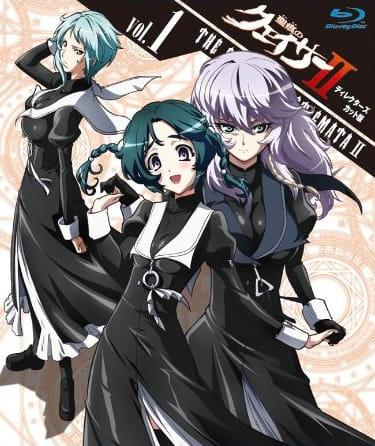
The Qwaser of Stigmata II
聖痕のクェイサー II (Seikon no Qwaser II)
- Action
- Ecchi
- Fantasy
- Harem
- School
- Urban Fantasy
- Episodes
- 12
- Duration
- 24 min per ep
- Aired
- Apr 12, 2011 to Jun 28, 2011
- Status
- Finished Airing
Synopsis
Sasha teams up with Hana, who becomes his new Maria, and the pair set their sights on an all-girls academy. To move unnoticed while investigating a Qwaser-related artifact known as the Magdalena of Thunder, Sasha is pushed into disguising himself as a student.
With the artifact believed to have manifested within one of the girls, their covert search quickly turns complicated—others are after the Magdalena of Thunder as well, turning the academy into a battleground of rival ambitions.
Otaku Consensus
The Qwaser of Stigmata II earns its cult audience by leaning harder into Hiraku Kaneko’s lurid exploitation instincts, with gender-bending school infiltration, psychosexual power mechanics, and Hoods Entertainment’s unapologetic ecchi framing giving it a trashy identity few 2011 TV anime pushed this far. The same extremity that makes it memorable also exposes the season’s weakest craft: reviews repeatedly cite repetitive plotting, poor pacing, and too little narrative payoff across its 12 episodes, which helps explain its modest 6.29 MAL score and 57/100 AniList score.
Why You Should Watch
Watch The Qwaser of Stigmata II if you want supernatural battle anime with the brakes cut: more transgressive than High School DxD, less romantic-comedy-minded than To Love-Ru, and much more committed to making its fanservice part of the show’s bizarre power-system identity. This is for viewers who enjoy early-2010s ecchi when it felt like studios were testing broadcast limits, not for anyone looking for elegant pacing or restrained characterization. The appeal is the collision of urban-fantasy combat, harem-school absurdity, nun-and-ojou-sama iconography, and gender-bending disguise comedy under a director comfortable with provocation. If you can treat it as lurid exploitation anime rather than polished adventure storytelling, Season II has the shameless specificity that makes cult ecchi memorable.
Key Characters
- AAlexander Nikolaevich Hell(VA: Yuuko Sanpei)
Sasha remains the franchise’s deadpan center of gravity, a kuudere-style male lead whose severity makes the season’s gender-bending school setup play even more perversely against type.
- HHana Katsuragi(VA: Youko Hikasa)
Hana’s promotion to a central partner role gives Season II one of its clearest character hooks, with her reactions often functioning as the audience’s barometer for the show’s escalating absurdity.
- EEkaterina Kurae(VA: Aya Hirano)
Ekaterina stands out as the series’ ojou-sama-flavored power player, and Aya Hirano’s casting adds extra otaku-recognition value to her theatrical presence.
- MMafuyu Oribe(VA: Ayumi Fujimura)
Mafuyu carries continuity weight from the broader Qwaser cast, grounding the second season’s more outrageous detour in the relationships and tensions established earlier.
What Makes It Stand Out
- 1
Season II is a compact 12-episode follow-up to the longer first season, making the pacing controversy more noticeable: critics complained that even with half the length, the show still felt repetitive and drawn out.
- 2
Hoods Entertainment keeps the franchise’s identity tied to extreme ecchi spectacle rather than treating nudity as incidental; AniList’s 96% Nudity and 79% Psychosexual tags accurately signal how central that material is to the viewing experience.
- 3
The gender-bending element is not a throwaway gag in the season’s marketing profile; AniList tags it at 79%, placing it alongside Magic as one of the sequel’s defining genre signals.
- 4
The staff combination is unusually genre-specific: director Hiraku Kaneko, series composer Makoto Uezu, and sound director Jin Aketagawa frame a battle-school fantasy that is as invested in shock rhythms and reaction timing as in action escalation.
- 5
Tatsuya Katou’s score and theme-song performances by Faylan and Shoujo Byou give the season a recognizably early-2010s anisong edge, contrasting polished music production with the show’s intentionally sleazy fantasy material.
Fun Facts & Trivia
- Fun fact 1
- The Qwaser of Stigmata II aired in Japan from April 12 to June 28, 2011, arriving as a 12-episode second season after the franchise had already built a reputation for unusually aggressive ecchi content.
- Fun fact 2
- The anime is based on material credited to original creator Hiroyuki Yoshino, with original character designs by Kenetsu Satou; the TV production was handled by Hoods Entertainment.
- Fun fact 3
- Chris Beveridge reviewed Qwaser of Stigmata II as a complete collection for The Fandom Post in 2013, two years after its Japanese broadcast, reflecting the title’s later life as a home-video cult object.
- Fun fact 4
- The broader anime package discussed by reviewers spans 37 episodes when counting the 24-episode first season, the 12-episode second season, and the OVA, which helps explain why Season II is often judged as part of a larger endurance test rather than a standalone curiosity.
- Fun fact 5
- Despite low critical enthusiasm, the sequel still has measurable niche loyalty: AniList lists 186 favourites, while MAL records over 66,000 votes and a popularity rank of #1837.
Studios
- Hoods Entertainment