Glassy Ocean
クジラの跳躍 (Kujira no Chouyaku)
- Award Winning
- Drama
- Fantasy
- Iyashikei
- Visual Arts
- Episodes
- 1
- Duration
- 22 min
- Aired
- Nov 14, 1998
- Status
- Finished Airing
Synopsis
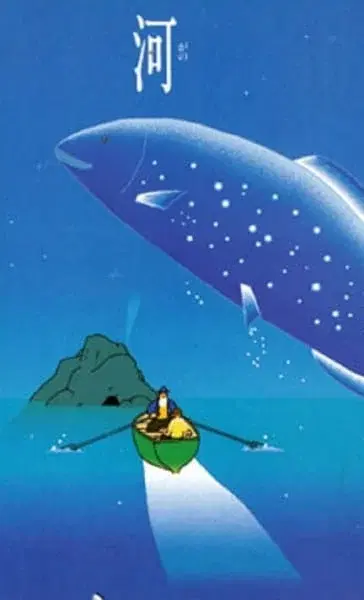
In a world where time has frozen, a magnificent whale emerges from a crystalline ocean, gliding effortlessly through the sky. This stunning visual journey captivates the audience with its unique artistic approach: while the tranquil ocean and towering glaciers are rendered in intricate 3D graphics, the characters—including the whale and the ships—are brought to life with delicate hand-drawn animation. This striking contrast immerses viewers in a mesmerizing realm that blurs the lines between reality and fantasy.
Glassy Ocean serves as a visual poem, inviting the audience to explore themes of wonder and stillness through its breathtaking imagery. The ambitious project showcases the beauty of animation as a medium, delivering a captivating experience that lingers long after the final frame.
Otaku Consensus
Glassy Ocean is best understood as a compact experimental film rather than a conventional drama: Shigeru Tamura’s unified direction, illustration, and script give it the coherence of a single artist’s moving canvas, while Project Team Sarah’s split between intricate CGI environments and hand-drawn figures remains its defining achievement. Its modest MAL and AniList scores reflect the main complaint: the film’s meditative pacing and minimal narrative reward viewers attuned to mood and form more than those seeking character-driven catharsis.
Why You Should Watch
Watch Glassy Ocean if you want anime that behaves more like a gallery installation than a story machine: one concentrated episode built around stillness, time distortion, and the tactile contrast between CGI space and drawn animation. It scratches a similar itch to Angel’s Egg in its refusal to over-explain, and to the gentler side of Mushishi in the way it asks you to sit with atmosphere rather than chase plot turns. The key appeal is authorship: Shigeru Tamura directs, writes, and illustrates, so the film feels unusually unified in visual logic. If you want experimental fantasy without franchise baggage, battle mechanics, or sentimental over-scoring, this is a concise 1998 artifact worth treating as animation criticism in motion.
Key Characters
- EElderly Protagonist
The elderly protagonist gives the film its human scale, functioning less as a dialogue-led hero than as a contemplative witness to an impossible suspension of time.
- WWhale
The whale is the film’s central icon, remembered by viewers as the image that turns the short from technical experiment into dreamlike myth.
What Makes It Stand Out
- 1
Project Team Sarah’s production uses a deliberately visible contrast between 3D-rendered oceanic and glacial spaces and hand-drawn animated figures, making the medium clash part of the viewing experience rather than hiding it.
- 2
Shigeru Tamura is credited across direction, illustration, and script, giving Glassy Ocean the feel of an auteur short rather than a committee-shaped studio product.
- 3
The film’s AniList tagging emphasizes Time Manipulation at 84% and Achronological Order at 64%, which points to structure and perception as core attractions rather than conventional incident.
- 4
Utollo Teshikai’s music and Kazutaka Someya’s sound design are key to the film’s identity, because the short relies on audiovisual rhythm to carry meaning where dialogue and plot density are minimal.
- 5
Its single-episode format makes it unusually easy to approach as a self-contained experimental object, especially compared with longer fantasy anime that require investment in lore or serial character arcs.
Fun Facts & Trivia
- Fun fact 1
- Glassy Ocean aired on November 14, 1998, placing it in a late-1990s moment when anime studios were actively testing how CGI could coexist with traditional drawing.
- Fun fact 2
- Shigeru Tamura holds three major creative credits on the project: director, illustrator, and scriptwriter.
- Fun fact 3
- Shinya Katou is credited as CG Visual Director, a role that matters heavily here because the film’s computer-generated spaces are not background decoration but one of its signature formal ideas.
- Fun fact 4
- Akemi Ueda served as animation producer, while the sound side was split between Utollo Teshikai for music and Kazutaka Someya for sound design.
- Fun fact 5
- Its reception is niche rather than mainstream: MAL lists it at 6.59 from 4,287 votes with a popularity rank of #6978, while AniList records a 63/100 score and 62 favourites.
Studios
- Project Team Sarah