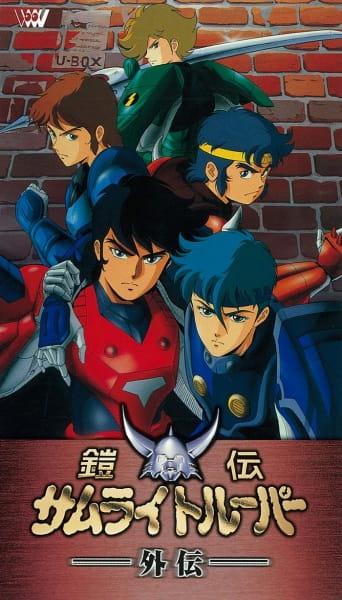
Samurai Troopers
鎧伝サムライトルーパー (Yoroiden Samurai Troopers)
- Adventure
- Sci-Fi
- Samurai
- Episodes
- 39
- Duration
- 23 min per ep
- Aired
- Apr 30, 1988 to Mar 4, 1989
- Status
- Finished Airing
Synopsis
In a distant past, the malevolent emperor Talpa sought to dominate the Earth but was ultimately vanquished and exiled to the Nether Realm, his formidable armor fragmented into nine distinct suits. Now, Talpa has resurfaced, intent on reclaiming his power by reassembling four of these legendary suits. The fate of the world hangs in the balance as he plots his return to domination.
Standing against this impending darkness are the Ronin Warriors, a group of brave fighters entrusted with the remaining five suits. Each warrior possesses unique abilities and a fierce determination to protect the Earth from Talpa’s malevolence. As they prepare for the inevitable confrontation, their journey unfolds, filled with challenges that test their strength, resolve, and camaraderie.
Otaku Consensus
Sunrise’s series earned cult-classic status through snappy armor-assisted action, vivid late-1980s color design, catchy period themes, and a supernatural-samurai format whose visual details can reward revisiting individual episodes. Koujin Ochi and early-series director Masashi Ikeda deliver energetic confrontations, but the 39-episode narrative is frequently judged rambling and disjointed, with uneven animation and limited character development; the English Ronin Warriors adaptation further compounds its coherence problems. It remains spirited and memorable cult television rather than consistently polished storytelling.
Why You Should Watch
Watch Samurai Troopers if you want the five-man transformation rhythm of a sentai show filtered through supernatural sword-and-armor iconography, without the tournament structure that dominates many battle anime. It scratches the same ensemble itch as Saint Seiya, while its late-1980s Sunrise look offers the broadcast-era texture familiar to viewers who discovered Gundam Wing and Sailor Moon on Toonami. The appeal is tactile rather than immaculate: bold color blocks, weapon-specific choreography, emphatic villain cues, and Osamu Totsuka’s period score turn individual confrontations into miniature rituals. Its urban-fantasy framework also lets archery, blades, ghosts, and sci-fi armor coexist with cheerful anachronism. Come for sincere team chemistry and armor-equip spectacle; stay if production roughness, repetitive musical signaling, and a loose serial narrative feel like cult-TV character rather than defects.
Key Characters
- AArago(VA: Shigezou Sasaoka)
Shigezou Sasaoka gives Arago the broad theatrical menace suited to a series famous for announcing its villains with unmistakably ominous musical cues.
- SSeiji Date(VA: Daiki Nakamura)
Seiji is the blade-centered Trooper whose disciplined swordplay provides the ensemble’s clearest straight-samurai counterweight to its sci-fi transformations.
- TTouma Hashiba(VA: Hiroshi Takemura)
Touma’s specialization in archery breaks up the close-range choreography and gives the team a distinctive long-distance combat silhouette.
- SShin Mouri(VA: Nozomu Sasaki)
Shin’s water-aligned armor and polearm-oriented fighting style broaden the action vocabulary beyond the katana duels suggested by the title.
What Makes It Stand Out
- 1
Sunrise built the show around a hybrid of urban fantasy, super-powered henshin, swordplay, archery, ghosts, and deliberately anachronistic samurai imagery rather than treating it as a conventional historical action series.
- 2
Norio Shioyama served as both character designer and chief animation director, placing the angular heroes, ornate armor, and overall visual supervision under the same key artist.
- 3
The directing credits have an unusual layered structure: Koujin Ochi is credited as director, while Masashi Ikeda directed episodes 1 through 19, covering nearly the entire first half of the 39-episode run.
- 4
Osamu Totsuka composed the score, whose emphatic villain motifs and unmistakably 1980s sound became both a source of nostalgia and one of the production’s most frequently mocked excesses.
- 5
Episode 11 carries both storyboard and episode-director credits for Shinji Takamatsu, an example of a single creator controlling the episode’s visual planning and final direction.
Fun Facts & Trivia
- Fun fact 1
- Samurai Troopers aired in Japan from April 30, 1988, to March 4, 1989, completing 39 television episodes during Sunrise’s prolific late-1980s period.
- Fun fact 2
- The series reached American television in 1995 as Ronin Warriors and later gained lasting recognition through syndication and Cartoon Network’s Toonami block, where it aired in the same broader programming era as Dragon Ball Z, Gundam Wing, and Sailor Moon.
- Fun fact 3
- A licensing retrospective reports that the Japanese title was initially considered for overseas use, but Ronin Warriors avoided confusion with Saban-era names such as Superhuman Samurai Syber-Squad and VR Troopers.
- Fun fact 4
- The second opening and second ending were both performed by Hiroko Moriguchi, giving the latter portion of the broadcast a shared vocal identity across its two principal theme slots.
- Fun fact 5
- Hajime Yatate receives the original-creator credit, while reception remains distinctly cult-sized: the supplied figures place it at 7.11 from 10,172 MyAnimeList votes versus 66 out of 100 and 85 favorites on AniList.
Studios
- Sunrise