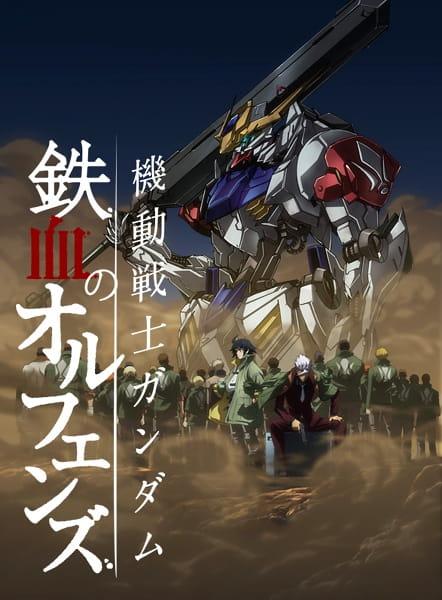
Mobile Suit Gundam: Iron-Blooded Orphans
機動戦士ガンダム 鉄血のオルフェンズ (Kidou Senshi Gundam: Tekketsu no Orphans)
- Drama
- Sci-Fi
- Mecha
- Space
- Episodes
- 25
- Duration
- 24 min per ep
- Aired
- Oct 4, 2015 to Mar 27, 2016
- Status
- Finished Airing
Synopsis
More than three centuries after the Calamity War reshaped relations between Earth and its space colonies, power on Earth is divided among four economic blocs, with Gjallarhorn enforcing order. Mars remains economically dependent on Earth, and many of its people endure harsh conditions under that imbalance.
Kudelia Aina Bernstein, a young aristocrat from the Chryse Autonomous Region, throws her support behind Mars’ push for independence and sets out for Earth to negotiate better terms. She contracts Chryse Guard Security to escort her, placing her protection in the hands of CGS’s Third Army Division—child soldiers including Mikazuki Augus and Orga Itsuka. When Gjallarhorn strikes the CGS facilities in an attempt to eliminate Kudelia, the attack forces Orga and the others into a fight for survival that begins to shape the course of their own future.
Otaku Consensus
Tatsuyuki Nagai’s direction and Mari Okada’s series composition give Iron-Blooded Orphans a hard, unusually character-driven shape for a modern Gundam: critics and fans respond most to its brisk watchability, political clarity, and the first season’s Episode 25, “Tekkadan,” as an emotional payoff. As an original Sunrise entry rather than an adaptation, it is judged on franchise reinvention and pacing, and its main weakness is the one repeated across viewer reactions: the animation can look merely average outside its clean, smooth combat cuts, especially compared with more colorful Gundam entries like 00 and Build.
Why You Should Watch
Watch Iron-Blooded Orphans if you want Gundam politics without needing Universal Century homework, and if you prefer metal-on-metal desperation over flashy beam spectacle. It scratches the same military-SF itch as Gundam 00, but with a rougher social texture: child soldiers, economic blocs, private security, and institutional power are treated as systems people survive inside, not just lore terms. The appeal is not “who has the strongest robot,” but how a found family builds identity under pressure and how quickly liberation rhetoric can collide with business, war, and revenge. Viewers who like ensemble casts, anti-heroes, and coming-of-age stories with consequences will get more from it than viewers looking for a bright tournament-style mecha show.
Key Characters
- MMikazuki Augus(VA: Kengo Kawanishi)
Mikazuki became a fan talking point because his quiet, kuudere-like affect makes him feel less like a traditional heroic pilot and more like a weaponized survivor learning what loyalty means.
- OOrga Itsuka(VA: Yoshimasa Hosoya)
Orga stands out as the series’ pressure-cooker leader figure, carrying the found-family fantasy and the anti-hero edge in the same set of decisions.
- KKudelia Aina Bernstein(VA: Yuka Terasaki)
Kudelia is compelling because the show uses her aristocratic idealism as a political stress test rather than treating her as a simple symbol of innocence.
What Makes It Stand Out
- 1
Iron-Blooded Orphans is a standalone Sunrise Gundam television entry, so its political vocabulary and factional history are built for new viewers rather than dependent on Universal Century continuity.
- 2
The staff pairing is distinctive: Tatsuyuki Nagai directs with Mari Okada on series composition, a combination that pushes the mecha framework toward interpersonal tension, found-family bonds, and emotionally loaded group dynamics.
- 3
Its tag profile is unusually hybridized for Gundam: AniList marks it as Real Robot at 90% while also giving it Super Robot at 65% and Swordplay at 79%, reflecting combat that feels grounded but often resolves through close-quarters impact rather than distant beam exchanges.
- 4
The first season runs a tight 25-episode broadcast block from October 2015 to March 2016, giving it the structure of a self-contained television cour pair rather than a long, lore-sprawling franchise commitment.
- 5
Viewer commentary repeatedly singles out the fights as smooth and the artwork as clean, while also noting a more muted visual palette than Gundam 00 or the Build series.
Fun Facts & Trivia
- Fun fact 1
- The official creator credits still go to Hajime Yatate and Yoshiyuki Tomino, the standard Gundam franchise attribution, even though this particular entry is shaped by a younger creative team led by Nagai and Okada.
- Fun fact 2
- Character design passed through two credited hands: Yuu Itou supplied the original character designs, while Michinori Chiba handled the animation character designs for the TV production.
- Fun fact 3
- The mechanical design bench is unusually deep, with Kanetake Ebikawa, Kenji Teraoka, Naohiro Washio, and Ippei Gyoubu all credited, matching the show’s emphasis on varied mobile suit silhouettes and weapon identities.
- Fun fact 4
- Reception data shows a strong but not untouchable modern-Gundam reputation: MyAnimeList lists it at 8.07 from 136,670 votes, while AniList records a 78/100 score and 2,076 favourites.
- Fun fact 5
- Its AniList tag spread is almost a compact critical map of the series: Orphan at 100%, Military at 96%, Dystopian at 88%, Politics at 84%, Found Family at 80%, and Anti-Hero at 79%.
Studios
- Sunrise