Marmalade Boy
ママレード・ボーイ
- Comedy
- Drama
- Romance
- Love Polygon
- School
- Workplace
- Episodes
- 76
- Duration
- 24 min per ep
- Aired
- Mar 13, 1994 to Sep 3, 1995
- Status
- Finished Airing
Synopsis
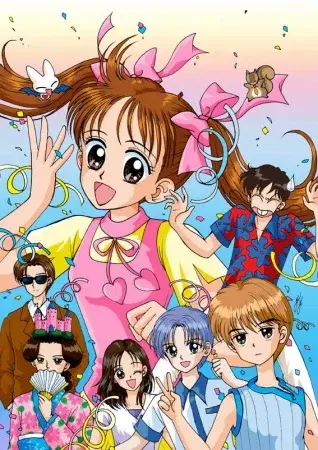
Miki Koishikawa is expecting a normal homecoming when her parents return from Hawaii—until they cheerfully announce they’re divorcing. The surprise doesn’t stop there: they intend to trade partners with another couple they met on the trip, and the two families will live together. Still reeling, Miki goes to meet the other pair and their son, the notably charming Yuu Matsuura.
Settling into a newly blended household, Miki tries to adapt to the upheaval while sorting through her growing feelings for Yuu. As the new school year begins, she leans on her best friend Meiko Akizuki, who is keeping a complicated romance of her own under wraps. With lingering secrets, past hurts, and other would-be romances circling both Miki and Yuu, everyday life quickly becomes a delicate balancing act between comedy, drama, and first love.
Otaku Consensus
Critical and fan response converges on Marmalade Boy’s sharp comic timing, memorable ensemble, expressive voice work, Keiichi Oku soundtrack, and Yoshihiko Umakoshi designs, which preserve the appeal of Wataru Yoshizumi’s artwork despite Toei Animation’s visibly limited production resources. Its early-to-middle stretch is widely regarded as the strongest, when romantic complications still feel cumulative rather than cyclical. The prevailing criticism is that the 76-episode format overstays its welcome: the third season draws complaints about repetition, contrived angst, geographical errors, and a late twist that expends drama without delivering a satisfying payoff.
Why You Should Watch
Watch this if you want a 1990s shoujo romance that behaves like a weekly soap opera rather than a tidy cour-long fantasy. Marmalade Boy supplies 76 episodes of shifting loyalties, comic flare-ups, and emotional reversals, scratching the romantic-churn itch of Boys Over Flowers and the family-friction side of Fruits Basket without relying on supernatural metaphor. Its advantage is accumulation: recurring characters have enough screen time for minor misunderstandings to become social chain reactions, while slapstick regularly punctures the solemnity. School, tennis, workplace, and domestic storylines also give the love polygon more arenas than the average classroom romance. Keiichi Oku’s music and a well-liked voice cast lend personality even to inexpensive-looking episodes. It best suits viewers comfortable with heightened melodrama, an impulsive heroine, age-gap material, and intentionally prolonged romantic tension.
Key Characters
- MMiki Koishikawa(VA: Mariko Kouda)
Miki’s emotional impulsiveness makes her both the engine of the comedy and the series’ most polarizing figure, with viewers split between finding her reactions painfully human and needlessly frustrating.
- YYuu Matsuura(VA: Ryoutarou Okiayu)
Yuu’s easy charm makes him an effective romantic center and a comparatively composed counterweight to Miki’s volatility.
What Makes It Stand Out
- 1
The 76-episode structure turns the central romance into sustained serial melodrama, allowing its love polygon to migrate through family life, school, tennis, and workplace settings rather than relying on one repeating backdrop.
- 2
Toei Animation uses economical television animation throughout, but Yoshihiko Umakoshi’s character designs were praised for translating Wataru Yoshizumi’s manga artwork faithfully; the visual appeal lies more in faces and design consistency than fluid motion.
- 3
Keiichi Oku’s score is one of the production’s most consistently praised elements, helping the series pivot between slapstick, sweetness, jealousy, and heavier emotional confrontations.
- 4
Comedy is not merely downtime between romantic crises: slapstick and reactive character humor form a parallel engine for the show, a balance that critics identified as central to keeping its soap-opera excess entertaining.
- 5
The adaptation’s scale is also its fault line. Viewers frequently praise the opening 20 to 30 episodes, while the anime’s third-season material is repeatedly singled out for weaker pacing, recycled tension, and questionable geographical details.
Fun Facts & Trivia
- Fun fact 1
- Marmalade Boy was created by Wataru Yoshizumi, who later created Ultra Maniac, another shoujo work that received an anime adaptation.
- Fun fact 2
- Takahiro Kagami contributed both animation direction and key animation, while Mitsuru Aoyama served as animation director on nine specified episodes: 5, 11, 34, 39, 45, 51, 56, 63, and 71.
- Fun fact 3
- The Italian version had notable localization-specific staff: Cristina D’Avena performed its theme song, while Ryan Carrassi and Aldo Stella were credited for the Italian scripts.
- Fun fact 4
- Carlos Ross of THEM Anime Reviews awarded the anime four out of five stars, praising its cast, voice acting, music, and faithful designs while criticizing its budget animation and third season; Anime News Network’s Jason Sondhi separately graded the English manga release B+.
- Fun fact 5
- The series aired from March 13, 1994, to September 3, 1995. Its recorded reception sits at 7.43 from 23,639 MyAnimeList votes and 70 out of 100 on AniList, where it has 218 favourites.
Studios
- Toei Animation