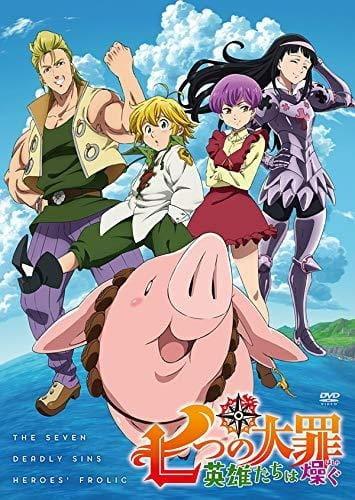
The Seven Deadly Sins: Revival of the Commandments
七つの大罪 戒めの復活 (Nanatsu no Taizai: Imashime no Fukkatsu)
- Action
- Adventure
- Fantasy
- Super Power
- Episodes
- 24
- Duration
- 24 min per ep
- Aired
- Jan 13, 2018 to Jun 30, 2018
- Status
- Finished Airing
Synopsis
The clash between Meliodas, captain of the Seven Deadly Sins, and Great Holy Knight Hendrickson leaves fallout far beyond the battlefield. With the fragments needed to awaken the Demon Clan in his grasp, Hendrickson shatters the seal and unleashes the Ten Commandments—elite warriors who serve directly under the Demon King. Meliodas recognizes them at once through an unexplained connection, and the Commandments appear to sense him in return.
As the demons carve devastation across Britannia, the Seven Deadly Sins race to contain the threat before the Demon Clan’s return plunges the land into terror and bloodshed.
Otaku Consensus
Revival of the Commandments is widely treated as a confident continuation: A-1 Pictures’ action staging, Jouji Furuta’s brisk sequel direction, and the introduction of antagonists scaled to the heroes give the season more momentum than a simple victory-lap follow-up. The most persistent criticism is uneven pacing when the enlarged ensemble and franchise fanservice compete with the power-escalation arcs, but the consensus remains that this is the Seven Deadly Sins season fans point to when defending the anime’s appeal.
Why You Should Watch
Watch Revival of the Commandments if you want shounen escalation with mythic scale, loud personalities, and fights that feel built around clashing power systems rather than tournament brackets. It scratches the same itch as Fairy Tail’s found-family swagger and Bleach’s captain-class confrontations, but with a more medieval-fantasy texture: taverns, Holy Knights, demons, fairies, swords, spears, archery, and magic all sharing the same battlefield. The season is best for viewers who already care about the cast and want a sequel that raises the ceiling without abandoning the comedy and romantic teasing that define the series. If you want restrained strategy or minimal fanservice, this is not the cleanest fit; if you want theatrical entrances, overpowered reveals, and emotionally charged rivalries, it delivers.
Key Characters
- MMeliodas
Meliodas is compelling here because his usual carefree captain persona is placed beside a far darker reputation, making his jokes and bursts of strength feel less like simple shounen confidence.
- HHendrickson
Hendrickson remains important because the season uses him as a living consequence of the previous conflict rather than letting him disappear after serving as an earlier antagonist.
- EEscanor
Escanor is the character fans most often cite when discussing this season’s appeal, because his presence turns power-scaling into spectacle and gives the heroes a new kind of dramatic imbalance.
What Makes It Stand Out
- 1
A-1 Pictures handles this 24-episode sequel during the Winter-to-Spring 2018 broadcast window, giving the season the longer runway needed for multiple factions, matchups, and character spotlights rather than compressing the conflict into a cour.
- 2
The music department is unusually stacked for a TV fantasy-action sequel: Hiroyuki Sawano is credited alongside Takafumi Wada and Kouta Yamamoto, which helps explain the season’s emphasis on large, arena-sized emotional cues.
- 3
Critic and fan commentary repeatedly points to the antagonist design as a major improvement: the season creates enemies at several threat levels, so the heroes are not only steamrolling minor opponents between boss fights.
- 4
The show’s AniList tag profile is unusually concentrated for a battle shounen: Demons at 94%, Shounen at 91%, Magic at 84%, Super Power at 80%, and Gods/Fairy both at 79%, signaling how heavily this season leans into cosmology rather than grounded knight drama.
- 5
Its action vocabulary is broader than swordplay alone, with AniList identifying Archery, Swordplay, and Spearplay all at 79%, a useful marker for why the ensemble fights rarely feel limited to one combat style.
Fun Facts & Trivia
- Fun fact 1
- Netflix numbering caused lasting confusion: viewers referring to Netflix’s “Season 3” are often talking about Revival of the Commandments, which is treated elsewhere as the second full TV season after the original series.
- Fun fact 2
- The season is directly tied to Nakaba Suzuki’s manga through his Original Creator credit, while Takao Yoshioka handled series composition for the anime adaptation.
- Fun fact 3
- Despite a more mixed reputation in later franchise discussions, this entry remains heavily watched: it holds a MAL popularity rank of #138 with 754,826 votes and a 7.53 score in the supplied data.
- Fun fact 4
- AniList lists 4,116 favourites and a 73/100 score for the season, placing it in the territory of a broadly liked sequel rather than a niche-only continuation.
- Fun fact 5
- The production credits include Keigo Sasaki on character design, Hiromichi Itou as art director, Masahiro Gotou on editing, and Kazuhiro Wakabayashi as sound director, a staff spread that reflects how much of the season’s identity comes from action readability and audio impact.
Studios
- A-1 Pictures