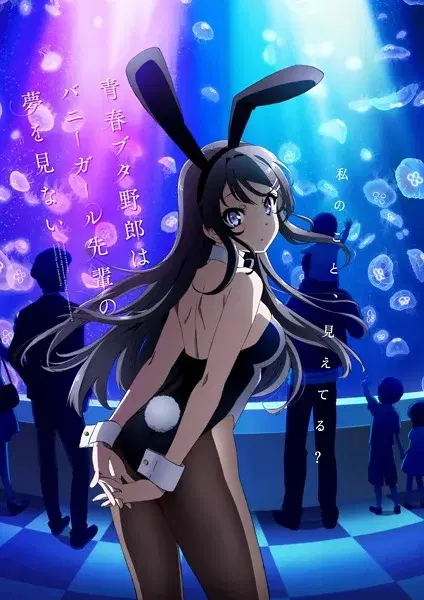
Rascal Does Not Dream of a Dreaming Girl
青春ブタ野郎はゆめみる少女の夢を見ない (Seishun Buta Yarou wa Yumemiru Shoujo no Yume wo Minai)
- Drama
- Romance
- Supernatural
- School
- Episodes
- 1
- Duration
- 1 hr 30 min
- Aired
- Jun 15, 2019
- Status
- Finished Airing
Synopsis
Six months after meeting a girl in a bunny suit at the library, Sakuta Azusagawa has settled into a calm, happy relationship with Mai Sakurajima. That stability is shaken when Shouko Makinohara—his enigmatic first crush, now an adult—unexpectedly returns, complicating what Sakuta and Mai have built together.
Soon after, Sakuta encounters another Shouko: a middle schooler hospitalized with a serious illness. As her strange circumstances begin to intertwine with his own life, his old scars start to ache whenever she’s nearby. Caught between his feelings and the unsettling mystery surrounding Shouko, Sakuta is forced to face choices that may determine a girl’s fate.
Otaku Consensus
Dreaming Girl is widely received as the emotional payoff to Bunny Girl Senpai rather than a disposable side film, with Souichi Masui's controlled direction and CloverWorks' continuity of character acting keeping the romance, school drama, and urban-fantasy logic tightly focused. Critics and fans consistently single out Shouko Makinohara's Puberty Syndrome arc as the film's strongest material, while the recurring complaint is that its final stretch leans on a solution that can feel too convenient for viewers who prefer harder supernatural rules.
Why You Should Watch
Watch Dreaming Girl if you want romance anime that treats emotional accountability as seriously as confession scenes, and if you prefer supernatural devices that expose character flaws rather than escalate into action spectacle. It scratches a similar itch to the quieter, relationship-driven parts of Monogatari and the time-bent melancholy of Your Name., but with Bunny Girl Senpai's sharper conversational rhythm and less ornamental direction. The film is especially rewarding for viewers who liked Sakuta and Mai because it tests their dynamic without reducing either of them to romantic decoration. At a single feature-length entry, it also avoids the padded middle that can weaken school-drama sequels, concentrating its drama around one of the franchise's most-discussed arcs.
Key Characters
- SSakuta Azusagawa(VA: Kaito Ishikawa)
Sakuta's appeal comes from how his blunt, deadpan honesty cuts through supernatural confusion without making him emotionally invulnerable.
- MMai Sakurajima(VA: Asami Seto)
Mai remains a fan-favorite romantic lead because her calm confidence and adult-level boundaries make her more than a reward for the protagonist.
- SShouko Makinohara(VA: Inori Minase)
Shouko is the film's emotional and conceptual center, with reviewers often pointing to her Puberty Syndrome material as its most compelling character work.
What Makes It Stand Out
- 1
CloverWorks produced the film as a direct theatrical continuation of the 2018 Bunny Girl Senpai anime, not as a recap or alternate retelling, which lets it spend its runtime on payoff rather than reintroduction.
- 2
The movie keeps key visual continuity through Satomi Tamura's character designs based on Keiji Mizoguchi's original designs, preserving the restrained facial acting that defines the series' conversational drama.
- 3
Its tag profile is unusually hybrid for a school romance: AniList classifies it strongly as Coming of Age, Urban Fantasy, Age Regression, Love Triangle, and Amnesia, reflecting how the film folds genre mechanics into adolescent identity drama.
- 4
Shouko Makinohara's arc is the film's critical calling card; even mixed responses tend to identify her specific Puberty Syndrome conflict as the section where the sequel most justifies its feature format.
- 5
The reception numbers show unusually durable fan approval for a franchise film: MAL lists it at 8.59 from over 524,000 votes, while AniList records an 84/100 score and more than 10,000 favourites.
Fun Facts & Trivia
- Fun fact 1
- The film's creative spine comes from Hajime Kamoshida's original story and Keiji Mizoguchi's original character designs, with Satomi Tamura translating those designs for animation.
- Fun fact 2
- The production credits separate art direction between Satoru Hirayanagi and Hisayo Usui, with Kazushi Fujii on art design and Asuka Yokota on color design, showing how granular the film's visual pipeline was despite its grounded school setting.
- Fun fact 3
- A notable English-language review framed the movie's overseas release as 'Better Late Than Never,' criticizing Aniplex's limited and expensive US Blu-ray availability as a major barrier for UK fans after the TV anime's popularity.
- Fun fact 4
- Akira Takata is credited specifically for prop design and Kouhei Masuno for title logo design, small production roles that help explain the series' preference for clean, understated visual presentation over spectacle.
- Fun fact 5
- The film was released on June 15, 2019 as a single finished entry, making it one of the rare anime sequel films whose reputation rests on narrative closure rather than franchise expansion.
Studios
- CloverWorks