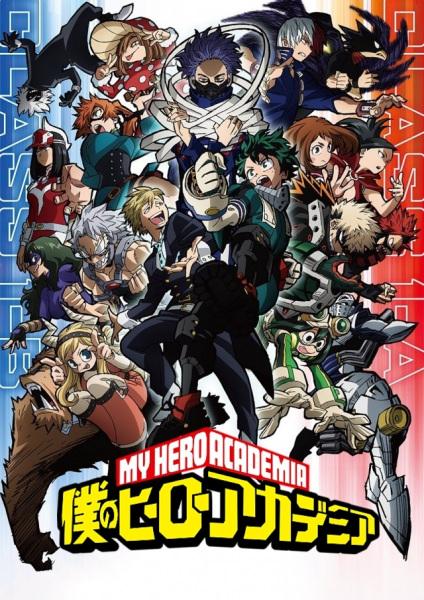
My Hero Academia Season 4
僕のヒーローアカデミア (Boku no Hero Academia 4th Season)
- Action
- School
- Super Power
- Episodes
- 25
- Duration
- 24 min per ep
- Aired
- Oct 12, 2019 to Apr 4, 2020
- Status
- Finished Airing
Synopsis
With his Provisional Hero License in hand, Izuku “Deku” Midoriya sets his sights on a work-study internship at a pro hero agency. On All Might’s recommendation, he joins the office of Sir Nighteye—All Might’s former sidekick—where Deku is pushed to grow under the guidance of a hero renowned in his own right. Meanwhile, Class 1-A spreads out across various internships, sharpening their skills in the field.
In the criminal underworld, Kai Chisaki—feared as Overhaul—moves to expand his influence, drawing unwanted attention from the League of Villains and its leader, Tomura Shigaraki. During his time with Nighteye, Deku uncovers Chisaki’s organization and the villain’s fraught connection to a mysterious young girl named Eri. Determined to protect her, Deku teams up with upperclassman Mirio Toogata to confront Overhaul and bring his violent ambitions to a halt.
Otaku Consensus
My Hero Academia Season 4 widens the series’ scope with a grittier crime-and-yakuza storyline, sharper emotional stakes, and several crowd-pleasing set pieces that remind viewers why Bones’ action direction is a franchise pillar. Fans and critics frequently single out its high points—character-focused heroism, a vulnerable new catalyst in Eri, and a handful of “all-in” battles—as some of the show’s most memorable moments. The most common knock is uneven pacing and tonal whiplash, with detractors arguing the season’s connective tissue can feel formulaic or undercut by familiar shounen rhythms despite the darker premise.
Why You Should Watch
Season 4 is My Hero Academia at its most “pro hero” in feel: less classroom sparring, more real-world consequences, and a villain conflict rooted in organized crime. If you watch shounen for big emotional payoffs, this season leans hard into responsibility—internships, mentorship under pressure, and the idea that saving someone can be as important as winning a fight. Bones delivers the kind of clean, readable action that makes superpowers feel tactical rather than noisy, while the arc structure gives multiple characters room to prove what heroism looks like outside U.A.’s safety net. Ideal for viewers who want superhero spectacle with a heavier moral center and a more grounded underworld edge.
Key Characters
- MMidoriya, Izuku(VA: Yamashita, Daiki)
Now holding a Provisional Hero License, Deku steps into a tougher work-study environment where idealism meets professional standards—and he has to grow fast to keep up.
What Makes It Stand Out
- 1
A notable shift from school-centric training to fieldwork, using the work-study framework to test what “hero” means when civilians, agencies, and real stakes enter the equation.
- 2
A crime-driven antagonist structure: Overhaul’s underworld rise and the League of Villains’ competing ambitions add a sharper edge to the series’ superhero world-building.
- 3
Bones’ action staging emphasizes clarity and impact—big moments land because the choreography remains legible even when quirks get visually dense.
- 4
Character-design consistency from Yoshihiko Umakoshi and Hitomi Odashima keeps the expanding cast readable, while the art and color teams support the season’s darker, more urban atmosphere.
- 5
A more emotionally direct season profile: multiple reviews and critic write-ups highlight its heightened drama and “memorable moments,” even when pacing between peaks divides viewers.
Fun Facts & Trivia
- Fun fact 1
- Season 4 ran for 25 episodes and aired from October 12, 2019 to April 4, 2020, maintaining the franchise’s long-cour seasonal format.
- Fun fact 2
- It’s one of the most-watched entries in the My Hero Academia catalog on MyAnimeList by popularity (#53) and has a large voting base (over 1.18 million votes) alongside a 7.86/10 score—evidence of both mainstream reach and polarized discussion.
- Fun fact 3
- The season’s leadership reflects a handoff in day-to-day direction: Kenji Nagasaki is credited as Chief Director, with Masahiro Mukai directing, while Yousuke Kuroda continues as series composer—helping preserve continuity in tone and structure across seasons.
- Fun fact 4
- Studio Bones returned for production, continuing the studio’s long-running association with the franchise and its reputation for high-energy action animation.
- Fun fact 5
- On AniList, the season sits at a 78/100 with 8,317 favourites, reinforcing its status as a heavily followed shounen even among viewers who consider it uneven.
Studios
- Bones