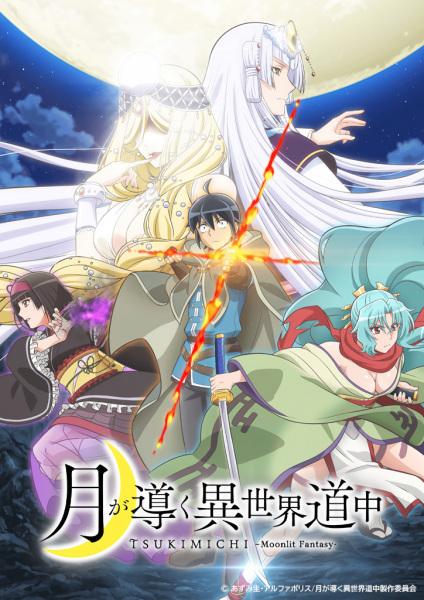
Tsukimichi -Moonlit Fantasy- Season 2
月が導く異世界道中 第二幕 (Tsuki ga Michibiku Isekai Douchuu 2nd Season)
- Action
- Adventure
- Comedy
- Fantasy
- Isekai
- Mythology
- School
- Episodes
- 25
- Duration
- 23 min per ep
- Aired
- Jan 8, 2024 to Jun 24, 2024
- Status
- Finished Airing
Synopsis
Makoto Misumi’s second life finally starts to steady after its rocky beginning, helped along by new demihuman allies who acknowledge him and gather under his growing influence. Now leading an expanding demihuman settlement, he sets out to improve how humans view them by launching a business that highlights their talents and opens doors that prejudice keeps shut.
To broaden both his magical knowledge and his commercial reach, Makoto enrolls at Rotsgard Academy, where new connections and opportunities await. Elsewhere, the goddess who summoned—and discarded—him has already called two more people into the world, elevating them as heroes for different nations; as their stories move forward, their eventual meeting with Makoto threatens to shift the balance of the world.
Otaku Consensus
Tsukimichi -Moonlit Fantasy- Season 2 lands as the rare isekai sequel that broadens its world without sanding down its oddball personality, with Shinji Ishihira’s direction and Kenta Ihara’s series composition giving the Rotsgard Academy and business-focused material more shape than Season 1’s looser adventure rhythm. Critics and fans responded especially well to the stronger villains, denser character writing, and banter-driven ensemble energy, while the most persistent complaint is that its character-heavy structure can let momentum sprawl across the 25-episode run.
Why You Should Watch
Watch Season 2 if you want isekai power fantasy filtered through logistics, education, monster diplomacy, and social friction rather than just boss fights. It scratches the same itch as That Time I Got Reincarnated as a Slime when that show leans into settlement-building and nonhuman politics, but Tsukimichi keeps a sharper comic edge and a more abrasive relationship with divine authority. The appeal is in the texture: language barriers matter, demihuman society has practical labor value, magic is treated as something to study, and Makoto’s influence expands through commerce as much as combat. Viewers who like fantasy casts arguing, negotiating, and testing each other’s limits will get more out of it than viewers looking for a straight heroic campaign.
Key Characters
- MMakoto Misumi
Makoto remains compelling because the season frames his overwhelming ability less as wish fulfillment and more as a leadership problem involving demihumans, commerce, education, and reputation.
- GGoddess
The goddess functions as one of the series’ most distinctive pressure points: a divine authority whose earlier rejection of Makoto continues to shape the world’s political and moral imbalance.
What Makes It Stand Out
- 1
J.C.Staff handled the 25-episode second season, giving the anime a full two-cour runway from January 8 to June 24, 2024 rather than compressing its academy, business, and war-adjacent material into a shorter sequel format.
- 2
The season’s most distinctive genre mix is visible in its AniList tags: Isekai at 93%, Magic at 92%, Economics at 70%, Teacher at 70%, and Language Barrier at 77%, a combination that explains why the show often prioritizes systems, instruction, and negotiation over simple dungeon progression.
- 3
Series composition by Kenta Ihara helps organize a broader narrative field than Season 1, with web commentary singling out the sequel’s improved storytelling, deeper character development, and more engaging villains.
- 4
Yasuharu Takanashi’s music is part of the show’s genre identity, supporting rapid tonal shifts between fantasy action, comedy, and larger-scale dramatic beats rather than locking the series into one mood.
- 5
The season is openly character-heavy, a trait noted by reviewers as both its strength and its limiter: the banter and interpersonal friction are central to the experience, but they also make the pacing feel less direct than battle-first isekai.
Fun Facts & Trivia
- Fun fact 1
- The anime adapts Kei Azumi’s original story, with Mitsuaki Matsumoto credited for the original character designs and Yukie Suzuki handling the anime character designs.
- Fun fact 2
- Shinji Ishihira directed the season, while the core production credits also include Teruhiko Niita as art director, Fuuka Aoyagi as director of photography, Masahiro Gotou as editor, and Shouji Hata as sound director.
- Fun fact 3
- On MyAnimeList, the season held a 7.84 score from 162,607 votes, with a rank of #1073 and popularity placement of #834, indicating a sequel with both a sizable audience and above-average approval.
- Fun fact 4
- AniList reception was closely aligned with MAL: the season carried a 78/100 score and 3,380 favourites, reinforcing that its audience response was not confined to one database.
- Fun fact 5
- The show’s tag profile highlights details that distinguish it from more conventional isekai: Creature Taming at 79%, Monster Girl at 75%, Gods at 70%, Demons at 70%, Dragons at 68%, and Assassins at 60%.
Studios
- J.C.Staff