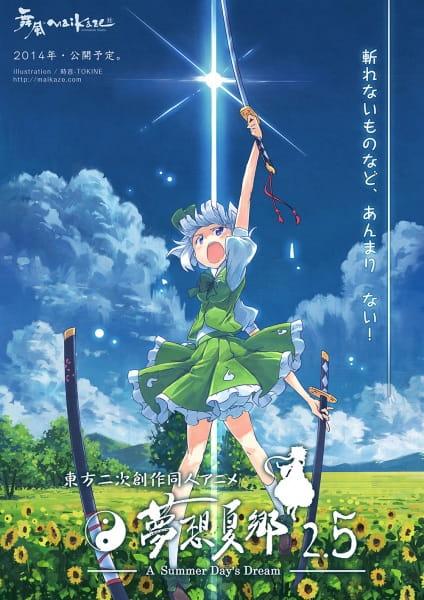
Touhou Niji Sousaku Doujin Anime: Musou Kakyou
東方二次創作同人アニメ 夢想夏郷
- Fantasy
- Vampire
- Duration
- 22 min
- Aired
- Dec 29, 2008 to ?
- Status
- Currently Airing
Synopsis
In the secluded, magical realm of Gensokyo, shrine maiden Reimu Hakurei works to keep the disturbances caused by youkai and other supernatural beings to a minimum. True to Hakurei Shrine tradition, she prepares an annual summer banquet that welcomes an eclectic mix of attendees—humans alongside even the most formidable youkai.
But on the morning of the gathering, Reimu’s donation box vanishes without a single sign of a break-in. Teaming up with her friend Marisa Kirisame and the reporter Aya Shameimaru, she begins to look into the disappearance, only to find the problem isn’t isolated: other residents have also discovered missing belongings. As the trio follows the trail, it becomes clear they’re dealing with something far larger than ordinary theft—an incident on the scale of the major upheavals Gensokyo has faced before.
Otaku Consensus
Musou Kakyou earns its 7.31 MAL score by understanding Touhou as a fandom language first and a conventional anime narrative second: Maikaze’s doujin direction favors recognizable character chemistry, Gensokyo atmosphere, and incident-style pacing over onboarding newcomers. Its biggest strength is adaptation texture rather than polish, while the clearest drawback is the release model itself: a “currently airing” OVA that began in 2008 inevitably feels fragmented and inaccessible to viewers expecting a normal seasonal anime.
Why You Should Watch
Watch Musou Kakyou if you want Touhou’s folklore-fantasy sandbox translated into anime without the flattening that often comes with official franchise adaptations. It is best for viewers who already like ensemble worlds where gods, youkai, magicians, tengu, and vampires share the same social space, and who enjoy recognizing personality dynamics more than being guided through lore from zero. It scratches a lighter version of the youkai-community appeal of Natsume’s Book of Friends, but with the fan-service density and cast-crossover energy of a game-derived OVA. The appeal is not a clean television arc; it is seeing Maikaze treat Gensokyo like a living doujin stage, where familiar faces, shrine comedy, and supernatural etiquette matter as much as the incident itself.
Key Characters
- RReimu Hakurei
Reimu is compelling because Touhou fans read her as both the realm’s spiritual authority and its most hilariously underfunded public servant, giving every supernatural crisis a dry, practical edge.
- MMarisa Kirisame
Marisa brings the series its most recognizable human mischief: a hard-working magician whose casual attitude toward “borrowing” makes her a perfect partner and suspect in any Gensokyo incident.
- AAya Shameimaru
Aya stands out as a tengu journalist because her investigative energy is inseparable from sensationalism, turning exposition into gossip, pressure, and fandom-familiar media chaos.
What Makes It Stand Out
- 1
Maikaze’s production is explicitly a doujin anime rather than a standard TV adaptation, which makes its priorities different from most game-to-anime projects: it assumes affection for Touhou culture instead of pausing to explain it.
- 2
The anime has an unusually long release footprint, listed as airing from December 29, 2008 with no end date, making it closer to an irregular fan OVA project than a seasonal fantasy series.
- 3
Its fantasy identity is rooted in Touhou’s mixed supernatural ecology: shrine maidens, youkai, tengu reporters, magicians, and vampire-associated characters coexist as social equals rather than as a simple hero-versus-monster hierarchy.
- 4
The show’s MAL profile reflects a niche but durable fanbase: a 7.31 score from 12,684 votes, with popularity ranked #3975, points to a title more sustained by dedicated Touhou viewers than mainstream anime traffic.
Fun Facts & Trivia
- Fun fact 1
- The full title includes “Niji Sousaku Doujin Anime,” which directly frames the work as a secondary-creation doujin anime rather than an official mainstream adaptation.
- Fun fact 2
- Its first listed air date, December 29, 2008, places it in the late-2000s era when Touhou fan works were already a major force in doujin culture.
- Fun fact 3
- Maikaze is the credited studio, making Musou Kakyou one of the better-known examples of a fan-studio Touhou anime project instead of a committee-backed television production.
- Fun fact 4
- The source-material context matters: Touhou Project is best known for danmaku bullet-hell games, so Musou Kakyou is adapting a cast and fan culture more than a linear game plot.
Studios
- Maikaze
No community data yet. Be the first to add Touhou Niji Sousaku Doujin Anime: Musou Kakyou to your list!