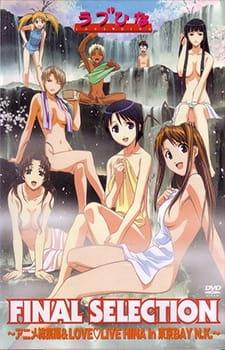
Love Hina
ラブひな
- Comedy
- Ecchi
- Romance
- Harem
- Episodes
- 24
- Duration
- 23 min per ep
- Aired
- Apr 19, 2000 to Sep 27, 2000
- Status
- Finished Airing
Synopsis
As a child, Keitarou Urashima promised a girl he would get into Tokyo University so they could be together. Now 20 and having failed the entrance exam twice, he’s discouraged and uncertain about what comes next—until a call from his grandmother, who runs an inn, convinces him that moving out might finally give him the quiet he needs to study.
Keitarou’s fresh start takes an awkward turn when he arrives to find the inn has become an all-girls dorm. The residents—Naru Narusegawa, a sharp student aiming for Tokyo U; Mitsune Konno, a laid-back freelance writer with a mischievous streak; Kaolla Su, an energetic inventor; Shinobu Maehara, a shy girl searching for her place; and Motoko Aoyama, a serious kendo practitioner—each react to his presence in their own way. Though his welcome is anything but smooth, Keitarou ends up managing the dorm, gradually navigating its chaotic daily life while still holding on to his childhood promise.
Otaku Consensus
Love Hina remains a divisive but historically important harem romcom: Yoshiaki Iwasaki’s Xebec adaptation, shaped by Shou Aikawa’s series composition, gives Ken Akamatsu’s dorm-comedy formula brisk sitcom pacing, dense slapstick, and enough exam-era anxiety to make devotees call it genre-defining. Its weakest point is also its signature: the tsundere punishment gags and archetypal harem writing can feel repetitive or mean-spirited, which helps explain the gap between its strong cultural footprint and its modest 7.09 MAL score and 66/100 AniList score.
Why You Should Watch
Watch Love Hina if you want the pre-streaming harem-romcom blueprint in its loudest, most unfiltered form: a 2000 Xebec production where episodes run on cohabitation friction, exam-pressure insecurity, and punchline escalation. It scratches the same ensemble-chaos itch as Konosuba, but replaces fantasy party dysfunction with dorm-room misunderstandings, tsundere impact comedy, and late-90s manga sincerity. Viewers who like romance to move through bickering, jealousy, and physical comedy rather than clean confession scenes will get the most from it; viewers allergic to punishment gags should not force it. Its value today is historical and sensory: you can see the vocabulary that later harem shows copied, softened, or tried to outdo, from the archetypal cast lineup to the tonal swing between sentimental longing and cartoon violence.
Key Characters
- NNaru Narusegawa(VA: Yui Horie)
Naru is the show’s defining tsundere pressure point, loved by fans for her exam-driven intensity and criticized by detractors for turning romantic tension into explosive slapstick.
- MMotoko Aoyama(VA: Yuu Asakawa)
Motoko brings swordplay and martial-discipline rigidity into a sitcom engineered to make composure collapse.
- SShinobu Maehara(VA: Masayo Kurata)
Shinobu gives the ensemble its softest emotional register, functioning as a shy counterweight to the louder, more combative archetypes around her.
- KKaolla Su(VA: Reiko Takagi)
Kaolla Su is the surreal-comedy accelerator, with inventor energy that lets the dorm gags veer into machinery, chaos, and tokusatsu-adjacent nonsense.
What Makes It Stand Out
- 1
The series aired as a 24-episode Xebec TV run from April to September 2000, placing it at the point where late-90s manga romcom sensibilities were being packaged for a new generation of anime viewers.
- 2
AniList’s tag spread is unusually revealing: Female Harem sits at 97%, Cohabitation at 79%, Love Triangle at 79%, and Tsundere at 71%, making the show a clean reference point for the grammar of early-2000s harem comedy.
- 3
The comedy is not quiet slice-of-life romance; the tag profile includes Surreal Comedy at 79%, Slapstick at 60%, and Swordplay at 60%, reflecting how often the show turns romantic embarrassment into impact gags and physical escalation.
- 4
Makoto Uno’s character designs and Shinichi Yamaoka’s costume design make each resident instantly readable as a distinct romcom type, while Eiji Abiko’s prop design supports the gadget-heavy chaos surrounding Kaolla Su.
- 5
Its reception numbers tell a story of reach versus approval: over 140,000 MAL votes and a popularity rank around #1010 show broad exposure, while a MAL rank around #4417 and AniList’s 66/100 indicate lasting disagreement over its craft and humor.
Fun Facts & Trivia
- Fun fact 1
- The anime adapts work by Ken Akamatsu, whose name became closely tied to the harem love-comedy format that Love Hina helped popularize for English-language anime fandom.
- Fun fact 2
- One sharply negative retrospective review singled out the show’s no-cel production context, reflecting how Love Hina is often discussed as part of anime’s transition into early digital-era TV production.
- Fun fact 3
- The user-review spread around the series is extreme: the provided ratings range from 10/10 genre-defining praise to 5/10 not-recommended disappointment, with several reviewers specifically saying their opinion changed after rewatching it years later.
- Fun fact 4
- AniList lists Shrine Maiden and Tokusatsu at only 20% each, which points to how the show occasionally dips into genre flavor and visual parody without making those elements its central identity.
- Fun fact 5
- The core production credits are unusually compartmentalized: Hachidai Takayama handled art direction, Junko Nagasawa handled art design, Yuuko Kanamaru handled color design, and Katsutoshi Hirose served as director of photography.
Studios
- Xebec