No Game, No Life
ノーゲーム・ノーライフ (No Game No Life)
- Comedy
- Ecchi
- Fantasy
- Isekai
- Strategy Game
- Episodes
- 12
- Duration
- 23 min per ep
- Aired
- Apr 9, 2014 to Jun 25, 2014
- Status
- Finished Airing
Synopsis
Disboard is home to sixteen sentient races under the watch of Tet, the One True God, and every dispute is settled through games. At the bottom sits Imanity—humans, a people without magic—leaving them with little leverage in a world where victory decides everything. That balance begins to shift when two unexpected newcomers arrive.
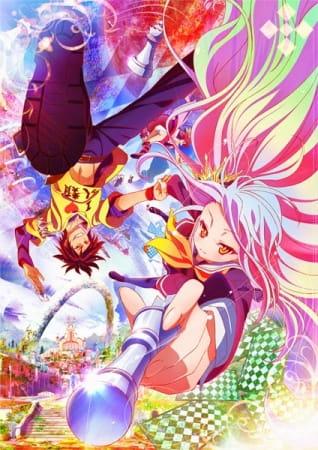
Back on Earth, stepsiblings Sora and Shiro live as reclusive, inseparable gaming prodigies known online as “Blank,” convinced that life itself is just another tedious match. After answering a cryptic message, they’re whisked to Disboard, where Tet lays out the world’s unbreakable rules before leaving them to fend for themselves. Searching for answers and a place to stay, they make their way to Elkia, Imanity’s last remaining kingdom.
In Elkia, Sora and Shiro meet Stephanie Dola, an earnest, emotional young woman struggling to reclaim her father’s throne amid a fight for sovereignty. Moved by her determination, the pair choose to back her and help restore Elkia’s standing—setting their sights on ruling the realm by the only means that matters: winning.
Otaku Consensus
No Game, No Life remains one of the 2010s’ most visible isekai hits—buoyed by Madhouse’s glossy, hyper-saturated presentation and a premise that turns politics and warfare into high-stakes mind games. Fans praise the rapid-fire comedy, “Blank’s” showy strategizing, and the clean, rules-based escalation of each match, reflected in its massive popularity (MAL #21) and strong user scores. The most consistent pushback targets its heavy ecchi/nudity and a style-over-substance feeling for viewers who find the games less clever than the show insists.
Why You Should Watch
Watch No Game, No Life if you want an isekai that treats every conflict like a tournament bracket—where charisma, psychology, and rule-lawyering matter more than sword swings. Madhouse leans into bold color design and punchy comedic timing, making each “game” feel like an event rather than a throwaway obstacle. The appeal is the power-fantasy of competence: Sora and Shiro don’t just win, they perform—baiting opponents, reframing stakes, and turning social dynamics into exploitable mechanics. If you enjoy strategy-game mind games, playful parody of fantasy politics, and a fast, fanservice-forward tone, this is an easy binge with big set-piece energy.
Key Characters
- SSora(VA: Matsuoka, Yoshitsugu)
A shamelessly confident shut-in gaming savant who weaponizes psychology, showmanship, and loopholes to turn every confrontation into a winnable system.
- SShiro(VA: Kayano, Ai)
Sora’s near-silent prodigy partner whose icy focus and absurd processing power make her the perfect counterweight to his theatrical mind games.
- DDola, Stephanie(VA: Hikasa, Youko)
An earnest, emotionally transparent noble fighting to restore her kingdom’s dignity, grounding the duo’s schemes with genuine stakes and heart.
What Makes It Stand Out
- 1
A world built on explicit “game” laws (set by Tet) gives the story a clean ruleset, letting each arc escalate through wagers, constraints, and clever reframing rather than brute force.
- 2
Madhouse’s presentation is deliberately loud: intense color design and stylized visuals sell Disboard as a neon-fantasy playground where every match feels larger than life.
- 3
The series’ hook is competence-as-spectacle—strategy, bluffing, and social engineering are treated like action choreography, with comedy beats landing between turns.
- 4
Genre-mixing that’s unusually direct: isekai power fantasy, parody, and fantasy politics all funnel into the same structure—win the game, rewrite the balance of power.
- 5
Unapologetically ecchi (including nudity), which for some viewers adds to the chaotic, anything-goes tone—and for others is the main barrier to recommending it.
Fun Facts & Trivia
- Fun fact 1
- No Game, No Life is adapted from Yuu Kamiya’s light novel series, with Atsuko Ishizuka directing the 12-episode TV anime at Madhouse.
- Fun fact 2
- Despite being finished airing in 2014 (Apr 9 to Jun 25), it remains a perennial gateway title: MAL Popularity #21 with over 1.6 million user votes and a score around 8.04/10.
- Fun fact 3
- Its genre identity is unusually explicit in major databases: it’s tagged heavily for Isekai, Gambling, and Video Games, reflecting how consistently the show frames conflict through wagers and play.
- Fun fact 4
- Key creative credits include Jukki Hanada on series composition and Kouji Ooya on character design, with a dedicated title logo design credit (Ryou Hiiragi), underscoring the production’s emphasis on bold, branded style.
Studios
- Madhouse