Ace of Diamond: Second Season
ダイヤのA[エース]~Second Season~ (Diamond no Ace: Second Season)
- Sports
- School
- Team Sports
- Episodes
- 51
- Duration
- 24 min per ep
- Aired
- Apr 6, 2015 to Mar 28, 2016
- Status
- Finished Airing
Synopsis
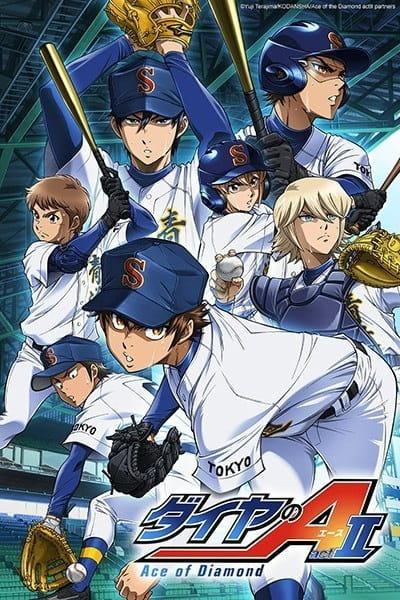
In *Ace of Diamond: Second Season*, Seidou High returns from the National Tournament to face a new stretch of uncertainty as the Fall season draws near. With a new captain at the center of the team, the lineup begins to shift, giving first-time starters a chance to step onto the field. While the veterans carry the weight of past defeats, the entire squad throws itself into relentless practice, knowing the road ahead won’t be easy.
Old rivals and unfamiliar opponents stand between Seidou and another climb toward the top, match by match. As the pressure rises, pitchers Furuya and Eijun are pushed to deliver at their highest level to keep the team moving forward—and to prove who truly deserves to be called the “Ace of Seidou.”
Otaku Consensus
Ace of Diamond: Second Season justifies its strong 8.31 MAL score and 82/100 AniList reception by treating baseball as a grind of roles, habits, and pressure rather than a highlight reel. Mitsuyuki Masuhara’s steady direction, the Madhouse/Production I.G production backbone, and the season-long Fall campaign give the matches weight through preparation and lineup consequences. Its chief weakness is the same thing many fans respect: the inning-by-inning pacing can feel punishingly granular for viewers who prefer sports arcs that move quickly between climaxes.
Why You Should Watch
Watch this if you want the team-room obsession of Haikyuu!! without the instant emotional payoff, or the competitive drive of Kuroko’s Basketball with far less superhuman spectacle. Second Season is built for viewers who enjoy depth charts, practice outcomes, pitcher psychology, and the uncomfortable politics of who deserves to start. Its 51-episode runway lets small adjustments matter: a bullpen session, a catcher’s trust, a coach’s decision, or a player’s response after being benched can echo for multiple games. The appeal is not just winning; it is watching a school club operate like a pressure cooker where talent alone is never enough. If you like sports anime that make process feel as dramatic as the scoreboard, this is one of the genre’s most satisfying long-form seasons.
Key Characters
- EEijun Sawamura
Eijun remains compelling because his growth is framed through control, composure, and trust rather than a simple jump in raw talent.
- SSatoru Furuya
Furuya is the rival teammate fans debate because his obvious pitching gifts constantly collide with the harder question of consistency over a full season.
What Makes It Stand Out
- 1
The season is credited to both Madhouse and Production I.G, a rare pairing of two major studios with strong reputations for polished TV action and disciplined sports layouts.
- 2
Its 51-episode broadcast ran from April 2015 to March 2016, giving the series nearly a full year of weekly continuity rather than compressing its baseball season into a single cour.
- 3
Kenji Konuta handled series composition, and the structure reflects that long-game approach: matches are not isolated set pieces but consequences of practice, roster changes, and accumulated pressure.
- 4
The AniList tag profile is unusually focused: Baseball sits at 93%, with School Club at 66% and Ensemble Cast at 53%, matching a series that prioritizes team systems over a single-star fantasy.
- 5
The season’s title conflict around the “Ace of Seidou” is not treated as a nickname upgrade; it functions as a tactical and psychological evaluation of what a pitcher must provide to the entire roster.
Fun Facts & Trivia
- Fun fact 1
- Yuuji Terajima, the original creator of Ace of Diamond, is credited on this season, anchoring it directly to the manga source rather than positioning it as an anime-original continuation.
- Fun fact 2
- Minoru Ueta is credited with character design, while Satoshi Tasaki served as chief animation director, separating the look of the cast from the role of maintaining animation consistency across the long run.
- Fun fact 3
- Hajime Takakuwa handled sound direction, an especially important role for a baseball anime where bat contact, catcher mitt impact, crowd noise, and dugout reactions shape match tension.
- Fun fact 4
- Natsuki Hanae is listed for theme song performance on ED2 and on ending themes for episodes 2 and 3, connecting the season to a major voice-industry name even outside a listed character role.
- Fun fact 5
- Despite being a sequel with a higher barrier to entry, the season holds a MAL rank of #313 and an AniList favourites count of 958, showing unusually strong retention among viewers who continued past the first series.
Studios
- Madhouse
- Production I.G