Ace of Diamond
ダイヤのA[エース] (Diamond no Ace)
- Sports
- School
- Team Sports
- Episodes
- 75
- Duration
- 24 min per ep
- Aired
- Oct 6, 2013 to Mar 29, 2015
- Status
- Finished Airing
Synopsis
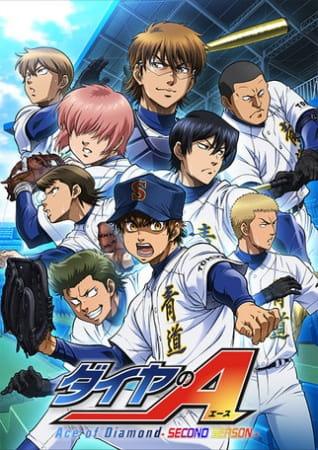
After a wild pitch that costs him his last middle school game, pitcher Eijun Sawamura is left burning with frustration—and a promise he and his teammates make to reach the national tournament in high school. His plans take an unexpected turn when a scout notices the potential in his unconventional throwing style and offers him a chance at Tokyo’s renowned Seidou High. Backed by his friends, Eijun takes the leap, determined to sharpen his abilities in a far tougher baseball environment.
At Seidou, the level of talent is overwhelming, and Eijun has to fight just to prove he belongs. He sets his sights on becoming the team’s ace, but fellow first-year Satoru Furuya, armed with blistering fastballs, quickly earns a prized place in the starting lineup. With new recruits joining an already formidable roster, Seidou pushes toward the top of Japanese high school baseball, meeting powerful opponents along the way.
Otaku Consensus
Ace of Diamond earns its 8.11 MAL and 80/100 AniList reputation by treating baseball as cumulative labor: Mitsuyuki Masuhara's direction and Kenji Konuta's long-series composition let games, practices, and roster politics build over 75 episodes, with Madhouse and Production I.G giving it a cleaner-than-average baseball-anime finish. The common knock is not the sport but the melodrama: repeated flashbacks, Sawamura's early loudness, and a tendency to make every play feel like a climax can make the pacing feel inflated.
Why You Should Watch
If you want Haikyu!!'s team-selection anxiety and locker-room pressure translated into baseball, but without Kuroko's Basketball-style superpowers, Ace of Diamond is built for you. Its appeal is the grind: bullpen competition, coaching decisions, batting-order tension, and the slow humiliation of realizing that talent alone does not secure a jersey. The 75-episode length lets rivalries inside the team matter as much as opponents across the diamond, which gives the series a sharper meritocracy edge than many tournament-first sports anime. Viewers who enjoy technical sports drama, male ensemble casts, and school-club hierarchies will get the most from it; viewers who need constant victories or compact pacing may find its flashbacks and heightened reactions deliberately exhausting.
Key Characters
- EEijun Sawamura
Sawamura is compelling because the series treats his loud, messy competitiveness as raw material that must be disciplined rather than as instant shounen destiny.
- SSatoru Furuya
Furuya functions as the pressure gauge for the roster, turning talent evaluation into a daily contest rather than a distant tournament concern.
What Makes It Stand Out
- 1
Madhouse and Production I.G share studio credit, a notable pairing for a long-running sports series; contemporary reviews singled the show out as looking better than most baseball anime while keeping the action readable.
- 2
The first TV run spans 75 episodes from October 2013 to March 2015, giving the series room to make practice, bench competition, and lineup decisions feel consequential instead of rushing straight to match climaxes.
- 3
Its AniList tags point to the show's real structure: Ensemble Cast at 80%, School Club at 82%, and Primarily Male Cast at 93%, meaning the appeal rests heavily on team dynamics rather than a solo-prodigy fantasy.
- 4
The baseball gameplay is one of the clearest critical bright spots; even mixed reviews highlighted the sport itself as strong, with tension coming from pitcher-batter sequences and in-game decision-making.
- 5
The series leans into shounen sports drama without abandoning the school-club framework, so victories and setbacks are filtered through hierarchy, seniority, and roster survival as much as athletic performance.
Fun Facts & Trivia
- Fun fact 1
- Ace of Diamond is adapted from Yuuji Terajima's original manga, with the anime's first major TV installment concluding at 75 episodes.
- Fun fact 2
- Mitsuyuki Masuhara directed the series, while Kenji Konuta handled series composition and Minoru Ueta provided character designs.
- Fun fact 3
- The production credits include Akiko Konno on prop design, a meaningful role for a baseball anime where gloves, bats, uniforms, and field equipment must stay visually consistent across repeated play sequences.
- Fun fact 4
- Its reception is strong across databases: MAL lists it at 8.11 from 124,917 votes, while AniList records an 80/100 score and 2,650 favourites.
- Fun fact 5
- Post-manga-ending discussion has not erased interest in the anime; web commentary still frames the series as worth watching for the journey even when viewers debate the source material's final destination.
Studios
- Madhouse
- Production I.G