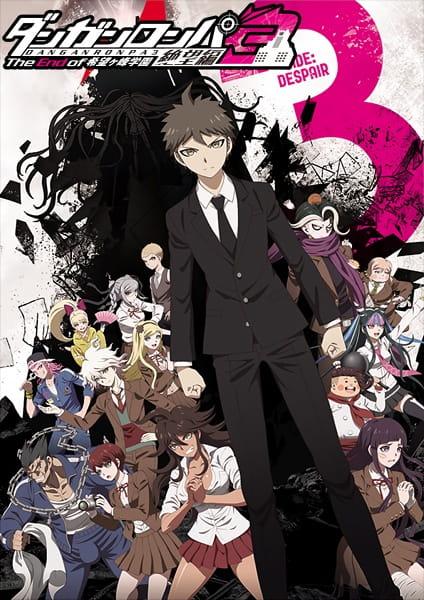
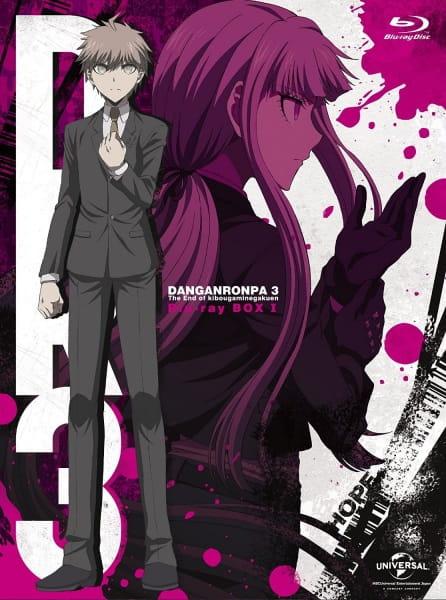
Danganronpa 3: The End of Hope's Peak High School - Future Arc
ダンガンロンパ3 -The End of 希望ヶ峰学園- 未来編 (Danganronpa 3: The End of Kibougamine Gakuen - Mirai-hen)
- Action
- Horror
- Mystery
- Suspense
- High Stakes Game
- Psychological
- Survival
- Episodes
- 12
- Duration
- 24 min per ep
- Aired
- Jul 11, 2016 to Sep 26, 2016
- Status
- Finished Airing
Synopsis
After escaping Hope’s Peak Academy, Makoto Naegi and the other survivors align themselves with the Future Foundation, an organization devoted to stopping despair’s spread. Their fragile peace breaks when Naegi is arrested and put on trial for alleged betrayal after defending the Remnants of Despair, leaving him—alongside Kyouko Kirigiri and Aoi Asahina—at the mercy of the Foundation’s top officials.
The situation spirals when the group’s supposedly unbreakable security is breached by a familiar intruder: Monokuma. With chilling speed, he declares a new killing game, and the appearance of the first body signals that despair has returned.
Known as the Super High School-Level Lucky Student, Naegi is forced to search for the truth once more as allies begin to fall. This time there are no class trials—only 16 trapped participants, a single hidden murderer, and one grim rule: end the killer, and the game ends with them.
Otaku Consensus
Future Arc is received as a sharp, fan-focused capstone to the Hope’s Peak Academy storyline, with Lerche’s tense pacing, Seiji Kishi and Daiki Fukuoka’s claustrophobic direction, and Masafumi Takada’s franchise-defining sound giving the death-game format a colder institutional edge. Its biggest strength is also its main barrier: critics and fans consistently note that it rewards deep familiarity with Danganronpa 1 and especially Danganronpa 2, making it a poor entry point despite its strong character payoffs for invested viewers.
Why You Should Watch
Watch Future Arc if you want a death-game anime built less around puzzle-box spectacle and more around ideology, suspicion, and the psychological exhaustion of people who already survived the impossible. It scratches the same itch as Kaiji’s pressure-cooker mind games and the moral paranoia of Psycho-Pass, but filtered through Danganronpa’s pop-horror theatrics, mascot cruelty, and sudden tonal whiplash. The adult Future Foundation setting gives the series a different texture from the classroom murders of the first game: boardroom authority, factional distrust, and post-apocalyptic stakes replace school-life satire. It is not designed for newcomers; it is for viewers who want the Hope’s Peak saga to stop circling its mythology and finally force its surviving symbols of hope to answer for what their hope costs.
Key Characters
- MMakoto Naegi(VA: Megumi Ogata)
Makoto remains compelling because his optimism is treated not as innocence, but as a dangerous public philosophy that other survivors and authority figures can challenge.
- KKyouko Kirigiri(VA: Youko Hikasa)
Kyouko is the series’ cool analytical center, prized by fans for turning silence, observation, and restraint into a more intimidating presence than most overtly aggressive characters.
- AAoi Asahina(VA: Chiwa Saitou)
Aoi brings the human temperature of the original survivor group, grounding the arc’s institutional paranoia in loyalty, fear, and immediate emotional stakes.
- KKyousuke Munakata(VA: Toshiyuki Morikawa)
Kyousuke stands out as Future Arc’s ideological counterweight, embodying a severe, militarized version of hope that makes him more than a simple antagonist figure.
What Makes It Stand Out
- 1
Future Arc is an anime-original conclusion to the Hope’s Peak Academy storyline rather than a direct adaptation of a single game, making it structurally different from the first Danganronpa TV anime.
- 2
The arc shifts the franchise’s focus to a primarily adult ensemble inside the Future Foundation, a notable tonal change from the student-centered setting that defined Trigger Happy Havoc.
- 3
Lerche returns as the animation studio, preserving the franchise’s sharp character silhouettes and theatrical horror presentation while staging the series around confinement, alarms, and procedural distrust.
- 4
Masafumi Takada’s music ties the anime directly to the games’ identity, using the franchise’s familiar electronic tension and off-kilter menace to make the TV arc feel like part of the same psychological machinery.
- 5
The series removes the class-trial rhythm associated with Danganronpa and replaces it with a faster survival structure, which is a major reason Future Arc feels more like a suspense thriller than a courtroom mystery.
Fun Facts & Trivia
- Fun fact 1
- Kazutaka Kodaka is credited with the original story, while Rui Komatsuzaki provides the original character designs, keeping the anime closely connected to the core creative identity of the games.
- Fun fact 2
- Norimitsu Kaihou handled series composition and also wrote episodes 1-3, 6, 10, and 12, giving the arc a concentrated writing presence across both its opening setup and finale stretch.
- Fun fact 3
- The anime was directed by Daiki Fukuoka with Seiji Kishi supervising, a staff arrangement that links it to the earlier Danganronpa animation while marking this as its own production.
- Fun fact 4
- Contemporary reviews repeatedly warned that Danganronpa 3 assumes knowledge of both Trigger Happy Havoc and Danganronpa 2, with the latter especially important because it had not received a full TV anime adaptation.
- Fun fact 5
- The opening and ending music involved Maon Kurosaki and TRUSTRICK, with TRUSTRICK credited across both opening and ending theme performance roles.
Studios
- Lerche