Magical Girl Raising Project
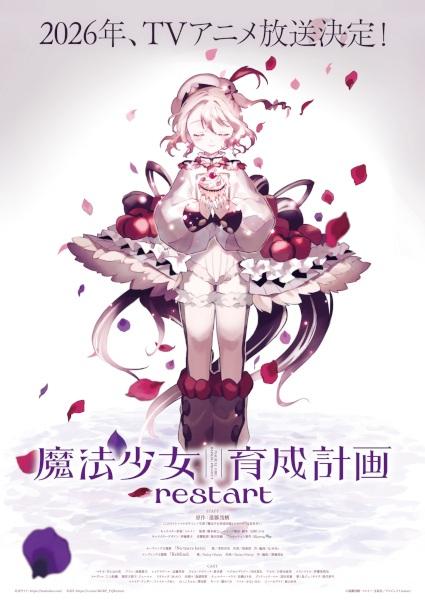
魔法少女育成計画 (Mahou Shoujo Ikusei Keikaku)
- Action
- Suspense
- Gore
- High Stakes Game
- Mahou Shoujo
- Survival
- Episodes
- 12
- Duration
- 24 min per ep
- Aired
- Oct 2, 2016 to Dec 18, 2016
- Status
- Finished Airing
Synopsis
In N-City, the hit social RPG *Magical Girl Raising Project* lets countless girls live out a magical-girl fantasy—at least on a screen. For Koyuki Himekawa, that wish suddenly becomes real when a late-night message announces she’s been chosen to transform into her in-game persona, Snow White, joining a select group of players granted true powers.
Working alongside the other newly made magical girls, Koyuki soon receives another notice: the administrators plan to cut their numbers. Each week becomes a ruthless contest, with Magical Candies earned through magical-girl deeds determining who stays—while the lowest scorer loses her powers. When the first dropout is followed by a real-world tragedy, the stakes are made brutally clear, and as harsher rules are introduced, the “game” reveals itself as a high-risk struggle to stay alive.
Otaku Consensus
Magical Girl Raising Project lands as a divisive but watchable Lerche production: Hiroyuki Hashimoto’s direction keeps the 12-episode survival format moving fast, and critics consistently singled out the cute character designs and bloody action as the show’s cleanest hook. The verdict is harsher on its writing than its craft; the most repeated complaint is that characters are often developed only moments before being removed, making the gore feel more sensational than emotionally cumulative. Its 6.95 MAL score and 66/100 AniList score fit the broader reception: memorable as a compact battle royale, limited as a character tragedy.
Why You Should Watch
Watch Magical Girl Raising Project if you want the magical-girl genre stripped down into a harsh elimination thriller without the slow philosophical build of Puella Magi Madoka Magica. It scratches the same itch as Future Diary or Danganronpa: an ensemble cast, rule changes, alliances, betrayals, and violence that arrives before the viewer can get comfortable. Lerche’s adaptation is best when it weaponizes contrast, placing Maruino’s toy-like magical-girl aesthetics against sudden gore and hard tactical choices. The show is not the pick for viewers who need every contestant fully unpacked, but it is a strong fit for anyone who values pace, combat spectacle, and the uncomfortable thrill of cute iconography being used in a survival-game machine.
Key Characters
- KKoyuki Himekawa(VA: Nao Touyama)
Koyuki anchors the series as the sincere magical-girl idealist, giving the show a moral baseline that makes its harsher survival-game turns hit with sharper contrast.
- KKano Sazanami(VA: Manami Numakura)
Kano functions as the colder-edged counterweight in the main cast, the kind of character viewers often point to when praising the show’s more effective character interactions.
What Makes It Stand Out
- 1
Lerche’s production leans into visual contradiction: rounded magical-girl designs adapted from Maruino’s original concepts are staged inside brutal action and gore-heavy confrontations.
- 2
The anime uses a compressed 12-episode structure, which gives the series a hard survival-thriller rhythm but also fuels the common criticism that character arcs are cut short too quickly.
- 3
The staff list separates character design, prop design, and weapon design, with Yukiko Aikei, Makoto Iino, and Takao Takegami credited in those roles, reflecting how central costume silhouettes and combat tools are to the show’s identity.
- 4
AniList’s tag spread highlights the show’s unusually dense genre mix: super powers, video games, urban fantasy, witch imagery, robots, swordplay, henshin, and a primarily female ensemble all sit inside the same framework.
- 5
The ending received more positive notice than the middle stretch in several viewer discussions, with critics who disliked the rapid eliminations still acknowledging that the finale left the franchise in a workable place.
Fun Facts & Trivia
- Fun fact 1
- The anime is built from Asari Endou’s original story and Maruino’s original character designs, with Yukiko Aikei handling the anime character-design adaptation.
- Fun fact 2
- Magical Girl Raising Project aired as a completed 12-episode TV run from October 2, 2016 to December 18, 2016, placing it in the same late-2010s wave of darker magical-girl genre experiments.
- Fun fact 3
- Its reception remains sharply middle-ground in database terms: 6.95/10 on MyAnimeList from 72,441 votes, rank #5121, popularity #1585, and 66/100 on AniList with 623 favourites.
- Fun fact 4
- The production credited Hirofune Hane as art director, Satoru Hirayanagi for art design, Naoya Imamura for color design, and Tomoyuki Kunii as director of photography, a notable concentration of visual-layout roles for a show praised more for presentation than writing.
- Fun fact 5
- Critical writeups repeatedly frame the show as better suited to battle-royale fans than to viewers looking for a deep dark-magical-girl character study; one review bluntly praised it for viewers who want cute magical girls mutilating each other rather than a meaningful tragedy.
Studios
- Lerche