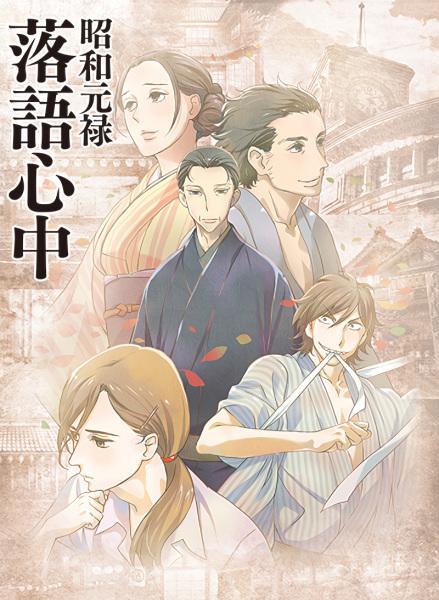
Descending Stories: Showa Genroku Rakugo Shinju
昭和元禄落語心中~助六再び篇~ (Shouwa Genroku Rakugo Shinjuu: Sukeroku Futatabi-hen)
- Drama
- Adult Cast
- Historical
- Love Polygon
- Performing Arts
- Episodes
- 12
- Duration
- 24 min per ep
- Aired
- Jan 7, 2017 to Mar 25, 2017
- Status
- Finished Airing
Synopsis
Even after reaching the coveted shin’uchi rank, Yotarou still can’t shake the feeling that his rakugo lacks a true sense of self. Torn between the lessons of his master Yakumo and the lingering influence of the late Sukeroku’s bold approach, he draws crowds yet struggles to find the ego that would make the art fully his own—especially as rakugo risks fading from the public eye.
Yakumo, long seen as rakugo’s final pillar, faces the strain of age despite performances that remain masterful. As his confidence falters and an old friend draws nearer, the pressure to protect what he’s built only deepens. At the same time, Konatsu raises her son alone, a choice Yotarou refuses to accept; he pushes to marry her and take responsibility for the child himself. *Descending Stories: Showa Genroku Rakugo Shinju* brings these intertwined lives toward a conclusion, as they confront both personal turmoil and the fight to keep a near-obsolete tradition alive.
Otaku Consensus
Critics and committed fans treat Sukeroku Futatabi-hen as the rare sequel that completes rather than merely extends its predecessor: Shinichi Omata's patient direction and Jun Kumagai's tightly shaped 12-episode composition turn rakugo performances into acting duels, while the Yakumo/Sukeroku legacy remains the emotional anchor reviewers repeatedly single out as unusually fresh for anime character drama. Its real barrier is not execution but approachability: multiple reactions note that the rakugo premise and subdued adult pacing make it difficult to sell from a synopsis, so its acclaim has been driven more by word-of-mouth than mass visibility.
Why You Should Watch
Watch this if you want adult melodrama built from craft, regret, pride, and performance instead of battles, school clubs, or easy catharsis. It scratches the same itch as March Comes in Like a Lion's craft-as-emotional-survival focus and Chihayafuru's devotion to traditional Japanese art, but with a harsher adult cast, historical texture, and no tournament scaffolding. Studio Deen's production leans into stillness, posture, breath, and voice-centered acting, making the stage scenes feel like psychological confrontations rather than cutaways to a hobby. Viewers who like slow-burn love polygons, mentor-disciple tension, and stories about an art form surviving beyond the people who define it will find a drama that trusts silence as much as dialogue.
Key Characters
- YYotarou
Yotarou fascinates because his openhearted, crowd-friendly presence clashes with a deeply professional anxiety over whether imitation can ever become authorship.
- YYakumo
Yakumo is the series' austere center of gravity, an elderly master whose elegance onstage makes his private fear of artistic extinction feel sharper rather than softer.
- SSukeroku
Sukeroku remains magnetic even through legacy and memory, representing a freer, riskier idea of rakugo that fans often discuss as the counterweight to Yakumo's control.
- KKonatsu
Konatsu gives the drama its most charged domestic edge, carrying resentment, independence, and inherited artistic history without being reduced to a supporting love interest.
What Makes It Stand Out
- 1
The sequel is a compact 12-episode Studio Deen production that aired from January 7 to March 25, 2017, giving the conclusion the shape of a controlled chamber drama rather than a sprawling legacy sequel.
- 2
Haruko Kumota's original work is adapted with Shinichi Omata as director, Jun Kumagai on series composition, and Mieko Hosoi on character design, a staff configuration that foregrounds performance nuance over spectacle.
- 3
AniList's tag profile is unusually precise: Rakugo is weighted at 100%, Acting at 86%, Elderly Protagonist at 86%, and Primarily Adult Cast at 83%, marking it as a rare TV anime centered on professional performance and aging rather than adolescence.
- 4
The fan-critical reputation is unusually prestige-heavy: it holds an 8.7/10 MAL score from 70,047 votes and a rank of #68, while its MAL popularity sits much lower at #1395, matching the word-of-mouth pattern noted in reviews.
- 5
Reviewers repeatedly point to the Kikuhiko/Yakumo and Sukeroku relationship as the franchise's defining dramatic engine, not because of plot twists but because their opposing philosophies of rakugo reshape how every performance is read.
Fun Facts & Trivia
- Fun fact 1
- The Japanese subtitle Sukeroku Futatabi-hen literally points to the idea of 'Sukeroku once more,' which is fitting for a sequel built around artistic inheritance rather than a simple continuation.
- Fun fact 2
- Masaki Mayuzumi is credited twice, as both Art Director and Art Design, with Hitomi Sano handling Color Design and Asahiko Koshiyama serving as Director of Photography, underscoring how much of the show depends on controlled visual atmosphere.
- Fun fact 3
- Keiichi Sasajima's Prop Design credit is especially meaningful for a rakugo anime, because the art form traditionally depends on minimal physical tools and the performer's ability to transform them through gesture.
- Fun fact 4
- Kousuke Takeda is credited with Design Assistance alongside Mieko Hosoi's character designs, reflecting a production pipeline attentive to subtle period and performance details rather than action-heavy animation set pieces.
- Fun fact 5
- AniList mirrors MAL's strong reception with an 86/100 score and 2,502 favourites, reinforcing the show's status as a critically admired adult drama despite its niche performing-arts subject.
Studios
- Studio Deen