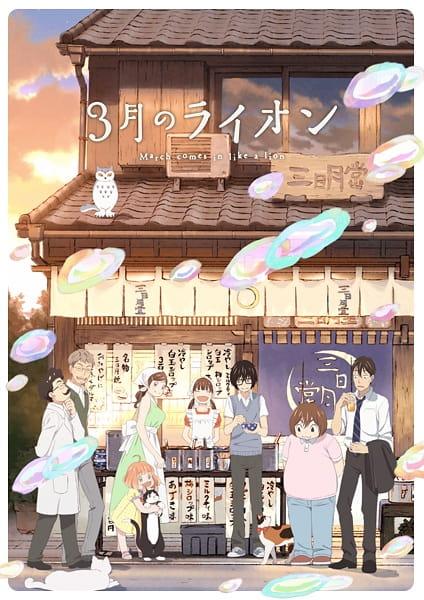
March Comes In Like a Lion
3月のライオン (3-gatsu no Lion)
- Drama
- Strategy Game
- Episodes
- 22
- Duration
- 25 min per ep
- Aired
- Oct 8, 2016 to Mar 18, 2017
- Status
- Finished Airing
Synopsis
Rei Kiriyama became a professional shogi player while still in middle school, placing him among the game’s rare elite. That early success comes with heavy expectations from the shogi world and strain within his adoptive household, pushing the 17-year-old to seek distance by living alone in a small Tokyo apartment. Isolated at school and at the shogi hall, Rei’s withdrawn nature and neglect of his own well-being only deepen his sense of disconnection.
Not long after settling in, Rei crosses paths with the Kawamoto sisters—Akari, Hinata, and Momo—who live with their grandfather above his traditional wagashi shop. Akari’s steady, caring presence offers Rei warmth and structure, while the sisters’ own experience with loss helps form a bond that feels like the family he’s been missing. As Rei continues to navigate the demands of his shogi career, he’s gradually challenged to care for himself, open up to others, and make sense of emotions he’s long kept at arm’s length.
Otaku Consensus
March Comes In Like a Lion earned its reputation by letting Shaft’s expressionistic direction and Chica Umino’s character writing turn shogi into a language for depression, recovery, and fragile belonging. Critics and fans most often praise its emotional precision, visual adaptation choices, and the Kawamoto-family material as the series’ human anchor; the recurring objection is that its patient, interior pacing can feel meandering or dramatically muted for viewers expecting sharper plot propulsion.
Why You Should Watch
Watch March Comes In Like a Lion if you want a character study about recovery without inspirational shortcuts, tournament-anime hype, or easy catharsis. It scratches the same adult-growing-pains itch as Chica Umino’s Honey and Clover, but filtered through Shaft’s more abstract visual grammar: empty rooms, oppressive match spaces, and sudden warmth are treated like emotional evidence. The shogi is not there to teach you opening theory; it gives shape to pressure, pride, dependency, and the strange loneliness of being gifted too early. Viewers who respond to slow-burn seinen drama, found-family intimacy, and anime that makes ordinary meals and small gestures feel morally significant will get the most from it. If you need constant incident, it may feel too quiet; if you want emotional accumulation, it is built for you.
Key Characters
- RRei Kiriyama
Rei is compelling because his silences carry as much tension as his shogi matches, making talent, self-neglect, and rehabilitation feel inseparable rather than neatly solvable.
- AAkari Kawamoto
Akari stands out as a caregiver character written with steadiness instead of sentimentality, giving the series a model of warmth that still feels grounded in fatigue and responsibility.
- HHinata Kawamoto
Hinata brings the series its clearest emotional directness, often cutting through Rei’s withdrawn perspective with a kind of everyday sincerity that fans remember.
- MMomo Kawamoto
Momo’s role is small but tonally vital, softening the show’s heaviest passages by making the Kawamoto home feel lived-in rather than merely symbolic.
What Makes It Stand Out
- 1
Shaft’s adaptation uses the studio’s familiar emphasis on stylized layouts, negative space, and visual metaphor to externalize Rei’s mental state instead of presenting shogi as straightforward sports coverage.
- 2
The production pairs director Akiyuki Shinbou with chief director Kenjirou Okada, while Fuyashi Tou and Shinbou handle series composition, giving the show a tightly supervised dramatic structure across its 22-episode run.
- 3
Chica Umino’s source-material sensibility is central: after Honey and Clover’s focus on young adults facing the future, March Comes In Like a Lion shifts that emotional acuity into a seinen story about work, isolation, and chosen family.
- 4
The series’ structure repeatedly contrasts professional shogi spaces with the Kawamoto household, creating a rhythm where competition, domestic care, and psychological recovery comment on one another rather than occupying separate genres.
- 5
Its reception profile is unusually strong for a slow drama: MAL lists it at 8.37 from over 302,000 votes, while AniList reports an 83/100 score and 8,655 favorites, showing deep audience investment beyond casual popularity.
Fun Facts & Trivia
- Fun fact 1
- The anime aired from October 8, 2016 to March 18, 2017 and ran for 22 episodes, a fuller-than-standard single-season length that gives its emotional beats more room than a typical 12- or 13-episode cour.
- Fun fact 2
- The key visual identity involved specialized design roles beyond character design: Yasuhiro Nakura handled layout design, Etsuko Sumimoto handled accessory design, and Kouhei Nawata handled the title logo design.
- Fun fact 3
- Nobuhiro Sugiyama served as character designer, while Seiki Tamura was art director, placing the show’s soft character expressiveness and carefully controlled environments under distinct creative leads.
- Fun fact 4
- AniList’s highest tags for the series emphasize Coming of Age at 94%, Rehabilitation at 91%, Shogi at 86%, and Found Family at 86%, which accurately signals that the emotional recovery material is as central as the board-game subject.
- Fun fact 5
- English-language review discourse was not uniformly glowing: outlets and bloggers praised its emotional depth and animation, while at least one review framed it as a major disappointment, with pacing and dramatic restraint being the usual fault lines.
Studios
- Shaft