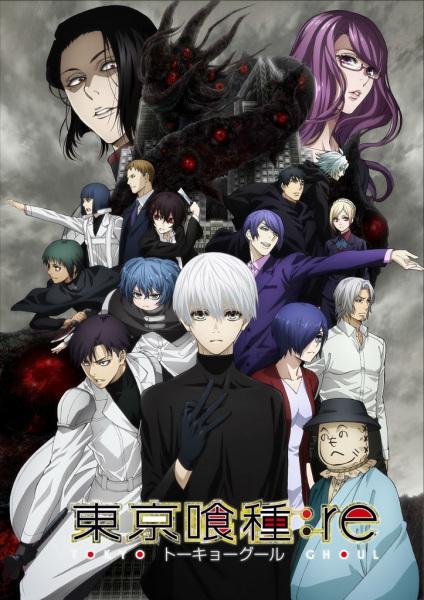
Tokyo Ghoul:re
東京喰種トーキョーグール:re
- Action
- Fantasy
- Horror
- Suspense
- Gore
- Psychological
- Urban Fantasy
- Episodes
- 12
- Duration
- 24 min per ep
- Aired
- Apr 3, 2018 to Jun 19, 2018
- Status
- Finished Airing
Synopsis
Two years after the CCG’s raid on Anteiku, Tokyo sits under a far tighter grip as investigators expand their influence. The pressure hasn’t ended the threat of ghouls—if anything, it’s forced them into greater caution, including Aogiri Tree, the terrorist faction that recognizes how quickly the CCG is closing in.
To gain an edge, the CCG forms the Quinx Squad: humans altered through surgery to wield ghoul-like abilities, deployed on missions to hunt down and eliminate the city’s predators. Their commander, Haise Sasaki, is a rare half-human, half-ghoul trained by renowned special class investigator Kishou Arima. Yet behind his composed leadership, fragments of unfamiliar memories begin to surface, tugging him toward a past he can’t fully recall.
Otaku Consensus
Tokyo Ghoul:re works best when it leans into the CCG-side detective framework, the amnesia-driven identity tension around Haise Sasaki, and the institutional horror of humans weaponizing ghoul biology. The verdict from fans and reviewers is harsh: Studio Pierrot’s 12-episode adaptation is widely criticized for compressed pacing, skipped character development, uneven art, cheap-looking action cuts, and dialogue that often flattens Sui Ishida’s manga character writing. Its popularity remains enormous, but its MAL score of 6.37 and low ranking reflect a sequel that many viewers treat more as franchise obligation than a satisfying adaptation.
Why You Should Watch
Watch Tokyo Ghoul:re if you want the franchise’s urban-fantasy violence filtered through investigators, casework, and unstable identity rather than another straightforward fugitive story. It scratches some of the same itch as Psycho-Pass in its interest in state power and morally compromised policing, while its body-horror angle keeps it closer to Tokyo Ghoul’s gore-soaked roots than a clean sci-fi procedural. The ideal viewer is a Tokyo Ghoul fan who wants to see the CCG’s machinery, the Quinx concept, and Haise Sasaki’s psychological dislocation animated, and who can tolerate a rushed adaptation with visibly inconsistent production values. It is less rewarding for manga readers who prize Sui Ishida’s slow character layering, since many of those connective scenes are exactly what the anime is accused of cutting.
Key Characters
- HHaise Sasaki
Haise is compelling because the series frames him less as a clean protagonist than as a composed CCG officer whose amnesia turns every moment of competence into an identity crisis.
- KKishou Arima
Arima’s reputation as a special class investigator makes him feel less like a mentor figure and more like the embodiment of the CCG’s cold, perfected violence.
What Makes It Stand Out
- 1
The season shifts the franchise’s emphasis toward detective and police procedure, reflected by AniList’s high Detective, Amnesia, and Police tags rather than only action-horror classification.
- 2
The Quinx Squad concept gives the season a specific body-horror hook: the CCG’s answer to ghoul violence is surgical augmentation, not just better weapons or training.
- 3
Studio Pierrot produced the 12-episode season, but the adaptation’s animation and art became one of its defining talking points, with fan reviews repeatedly calling out cheap-looking cuts and inconsistent visual quality.
- 4
Its tonal spread is unusually jagged for a dark urban fantasy: AniList tags include Body Horror, Gore, Crossdressing, Hikikomori, Slapstick, and Unrequited Love alongside Seinen and Primarily Adult Cast.
- 5
The series holds a striking popularity-to-reception contrast: it sits at MAL Popularity #122 with 778,829 votes, yet its 6.37 score and #8794 rank show how divisive this installment became.
Fun Facts & Trivia
- Fun fact 1
- Tokyo Ghoul:re aired from April 3, 2018 to June 19, 2018, finishing as a compact 12-episode TV season.
- Fun fact 2
- Sui Ishida is credited as the original creator, while the anime staff includes director Toshinori Watabe, series composition writer Chuuji Mikasano, and character designer Atsuko Nakajima.
- Fun fact 3
- The production credits separate character work from object and setting detail: Hiroaki Karasu handled sub character design, Yoshinori Iwanaga and Yoshiki Kuga handled prop design, and Manabu Otsuzuki served as art director.
- Fun fact 4
- AniList reception mirrors the split seen on MAL: the show has a 62/100 score but still accumulated 3,911 favourites, indicating a dedicated fanbase despite broad criticism.
- Fun fact 5
- Common review complaints focus on adaptation damage rather than the premise itself, especially skipped character development, subpar art, poor animation, and dialogue described as bland or tone-deaf.
Studios
- Studio Pierrot