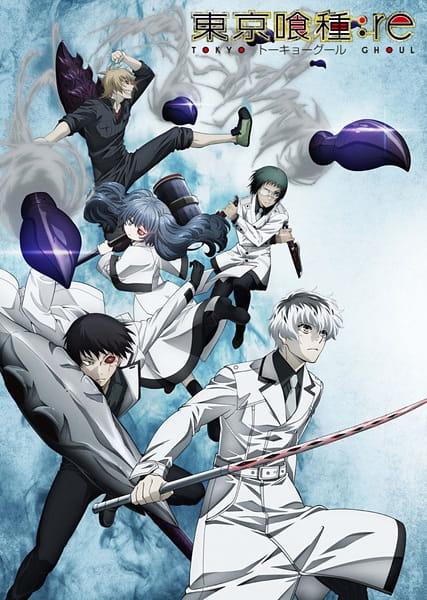
Tokyo Ghoul:re 2nd Season
東京喰種トーキョーグール:re 第2期
- Action
- Fantasy
- Horror
- Suspense
- Gore
- Psychological
- Urban Fantasy
- Episodes
- 12
- Duration
- 24 min per ep
- Aired
- Oct 9, 2018 to Dec 25, 2018
- Status
- Finished Airing
Synopsis
In the wake of the Tsukiyama Family Extermination Operation, the Commission of Counter Ghouls (CCG) has surged in strength and presses forward with its campaign to wipe out ghouls across Japan. Haise Sasaki, now separated from the Quinx Squad, throws himself into increasingly demanding assignments with a detached, almost emotionless composure. Yet beneath that blank exterior, Ken Kaneki’s memories begin to break through, forcing Haise into a growing struggle over who he really is—and his cold shift in demeanor ripples outward to those who once relied on him.
As the Quinx Squad reels from the loss of one of its own without their former mentor’s support, duty leaves little room to grieve. Both Haise and the squad continue carrying out the CCG’s orders, even as unsettling hints emerge: a shadowy presence operating behind the organization, and murmurs of corruption that refuse to fade.
Otaku Consensus
Tokyo Ghoul:re 2nd Season has value as a grim completionist watch: Toshinori Watabe’s season leans into CCG procedural pressure and the Haise/Kaneki identity fracture while Studio Pierrot brings Sui Ishida’s long-running adaptation to its televised endpoint in 12 episodes. The critical and fan verdict is largely unfavorable: the season is widely criticized as a rushed adaptation with dry arcs, skipped character development, and visibly weaker animation than the earlier Tokyo Ghoul seasons.
Why You Should Watch
Watch Tokyo Ghoul:re 2nd Season if you want the accelerated endgame of a bloody urban-fantasy tragedy, not a clean entry point or a prestige adaptation. It works best for viewers already attached to the Tokyo Ghoul mythos who care about identity collapse, institutional rot, ghoul-versus-investigator brutality, and the psychological cost of living as a weapon. Its appeal sits closer to the grim police machinery of Psycho-Pass and the body-horror anxiety of Parasyte than to a conventional battle shounen payoff. The season’s 12-episode format makes it a compact, severe finale, but that compression is also the price: this is for completionists who would rather see the anime’s final destination than stop with the better-regarded earlier seasons.
Key Characters
- HHaise Sasaki
Haise is compelling because his calm, almost administrative exterior turns the series’ usual violence into an identity problem rather than a simple power fantasy.
- KKen Kaneki
Kaneki functions less like a returning hero here than a buried self whose presence gives the season its dissociative, psychological edge.
What Makes It Stand Out
- 1
Studio Pierrot produced this as a 12-episode final broadcast season, airing from October 9 to December 25, 2018, which makes it one of the most compressed stretches of the Tokyo Ghoul anime adaptation.
- 2
AniList’s highest-weighted tags identify the season’s defining structure: Time Skip at 85% and Dissociative Identities at 80%, signaling a story built around fractured continuity and unstable selfhood rather than straightforward escalation.
- 3
The season pushes the franchise further into adult institutional conflict, with AniList tags such as Police at 60% and Primarily Adult Cast at 60%, giving the CCG material more procedural weight than the earlier teen-centered tragedy.
- 4
Its reception is unusually split between visibility and approval: it holds a very high MAL Popularity rank of #196 with 590,607 votes, while its MAL score sits at 6.47 and rank at #8162.
- 5
The horror vocabulary is broader than simple gore: AniList also tags Body Horror at 60% and Dragons at 47%, reflecting the season’s shift toward grotesque, large-scale urban-fantasy imagery.
Fun Facts & Trivia
- Fun fact 1
- Tokyo Ghoul:re 2nd Season marks the end of Studio Pierrot’s four-season anime adaptation of Sui Ishida’s Tokyo Ghoul manga, a point specifically noted in retrospective fan rankings of the series.
- Fun fact 2
- The core production staff includes director Toshinori Watabe, series composition writer Chuuji Mikasano, and character designer Atsuko Nakajima, with Hiroaki Karasu credited for sub character design.
- Fun fact 3
- The design credits are unusually granular: Yoshiki Kuga and Yoshinori Iwanaga are both listed for prop design, while Manabu Otsuzuki handled art direction and Eiko Tsunadou handled art design.
- Fun fact 4
- The season’s final episode aired on December 25, 2018, giving this particularly bleak horror-action finale a Christmas Day endpoint.
- Fun fact 5
- AniList’s numbers mirror the mixed reputation: a 63/100 score but 3,544 favourites, showing that the season retained a committed fanbase despite broad criticism of pacing and animation quality.
Studios
- Studio Pierrot