Kengan Ashura
ケンガンアシュラ
- Action
- Martial Arts
- Episodes
- 12
- Duration
- 24 min per ep
- Aired
- Jul 31, 2019
- Status
- Finished Airing
Synopsis
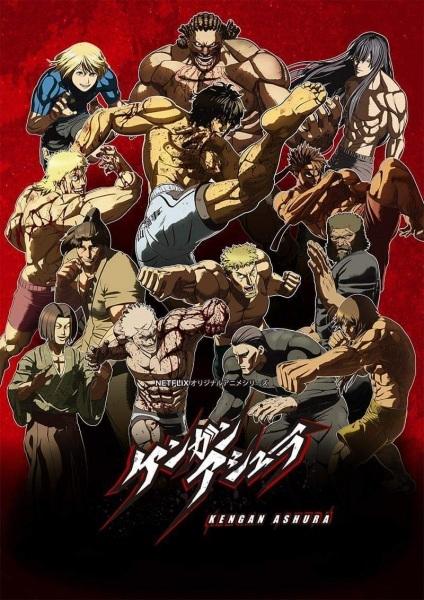
In *Kengan Ashura*, corporate negotiations don’t end at the conference table—they’re decided in the ring. For centuries, influential merchants and companies have settled disputes through sanctioned gladiator matches, a brutal tradition overseen by the Kengan Association and rooted in arenas that trace back to the Edo period.
Ouma Tokita, known as “The Ashura,” enters this world determined to prove he’s the strongest. He’s recruited by Hideki Nogi of the Nogi Group, who assigns the unassuming, middle-aged Kazuo Yamashita as Ouma’s manager. Thrown into a relentless circuit of Kengan bouts, the pair faces a gauntlet of ruthless fighters chasing the same peak.
Otaku Consensus
Kengan Ashura lands as a hard-edged tournament anime whose best asset is momentum: Seiji Kishi’s direction and Makoto Uezu’s series composition keep the 12-episode Netflix part moving from matchup to matchup, while Larx Entertainment’s CG gives throws, grips, and body impacts a readable physicality. Its 7.44 MAL score and 73/100 AniList score reflect the reception pattern: action and sports-anime viewers respond strongly to the fight-first adaptation and the Kengan tournament build, while the recurring criticism is that the full-CGI look can feel less expressive in quieter human moments.
Why You Should Watch
Watch Kengan Ashura if you want Baki-style combat analysis and body-impact spectacle without the surreal detours, or if Hajime no Ippo’s respect for technique appeals to you but you want the pacing of a bracket fighter instead of gym melodrama. The hook is the bout design: fighters are sold through specific gimmicks, physiques, and fighting philosophies, so each match feels like a rules argument being settled with elbows. Larx Entertainment’s full-CGI approach is divisive, but it also lets the camera track clinches, throws, and counters with a clarity that 2D productions often fake through cuts. Yasuharu Takanashi’s score and My First Story’s opening push it toward pay-per-view spectacle. Viewers who skip training arcs to get to the bracket will feel directly targeted.
Key Characters
- OOuma Tokita
Ouma is built less as a relatable hero than as a pressure test for every fighting style the series throws at him, which is why fans tend to discuss him through technique, endurance, and aura.
- KKazuo Yamashita
Kazuo gives the series its strangest texture: a middle-aged corporate everyman whose panic, awe, and bookkeeping instincts make the arena feel like both a deathmatch and a business expense.
- HHideki Nogi
Nogi’s appeal is strategic rather than physical, since he treats fighters as corporate leverage and turns boardroom ambition into a spectator sport.
- JJun Sekibayashi
Jun Sekibayashi stands out because his pro-wrestling showmanship is not a joke layered over combat, but a combat philosophy built around performance, stamina, and crowd psychology.
What Makes It Stand Out
- 1
Larx Entertainment commits to a full-CGI presentation, a choice reflected in AniList’s 86% Full CGI tag. That matters here because the show’s appeal depends on continuous body mechanics: grips, pivots, slams, and counters are often staged as physical sequences rather than single impact poses.
- 2
The first release is a compact 12-episode part that premiered on July 31, 2019, which gives the adaptation a faster tournament-anime rhythm than long-running martial-arts shows. It prioritizes matchups and fighter introductions over extended training-cycle storytelling.
- 3
Seiji Kishi directs with Makoto Uezu on series composition, a pairing that gives the season a clean fight-card structure. The result is easy to navigate even as the cast broadens, matching AniList’s high Ensemble Cast tag at 73%.
- 4
The sound package leans into arena escalation: Yasuharu Takanashi handles the music, while My First Story performs the opening theme. The combination helps frame the series closer to a combat-sports broadcast than a traditional adventure anime.
- 5
The anime adapts Yabako Sandrovich and Daromeon’s manga with Kazuaki Morita translating the original character designs for animation. That production chain is important because the characters’ bodies and silhouettes are central to how the series communicates fighting identity.
Fun Facts & Trivia
- Fun fact 1
- The manga ran on Shogakukan’s Ura Sunday website from April 18, 2012 to August 9, 2018, and was collected in 27 tankōbon volumes. That gives the anime a completed core source to draw from rather than an ongoing first arc.
- Fun fact 2
- The sequel manga, Kengan Omega, began on January 17, 2019, months before the anime’s July 31, 2019 Netflix debut. The franchise was already expanding on the page when the CG adaptation introduced it to a wider streaming audience.
- Fun fact 3
- Yabako Sandrovich is credited for the original story and Daromeon for the original character design, preserving the writer-artist split from the manga in the anime’s core credits.
- Fun fact 4
- Episode-level credits in the production data single out episode 5: Masatsune Noguchi storyboarded it, while Shinichirou Kimura is credited as episode director for episodes 5 and 7.
- Fun fact 5
- The localization data includes Leonardo Santhos as Portuguese ADR Director, a reminder that Kengan Ashura’s Netflix distribution positioned it for international dubbing beyond the Japanese release.
Studios
- Larx Entertainment