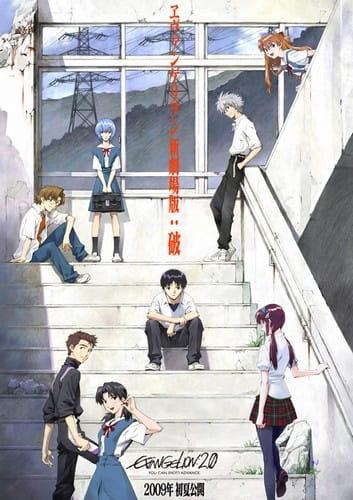
Evangelion: 3.0 You Can (Not) Redo
ヱヴァンゲリヲン新劇場版:Q (Evangelion Movie 3: Q)
- Award Winning
- Drama
- Sci-Fi
- Suspense
- Mecha
- Psychological
- Episodes
- 1
- Duration
- 1 hr 35 min
- Aired
- Nov 17, 2012
- Status
- Finished Airing
Synopsis
Fourteen years after Third Impact, Earth has been reduced to a ravaged wasteland and the remnants of humanity are barely recognizable. Shinji Ikari, still sealed within Evangelion Unit-01, is retrieved from space by Asuka Langley Shikinami and Mari Illustrious Makinami—only to be taken into custody by WILLE, a military force led by his former guardian, Misato Katsuragi. Treated with distrust by the people he once relied on, Shinji is left to face the fallout of what he set in motion.
Rei Ayanami soon pulls him from WILLE’s grasp and brings him back to NERV, where Shinji crosses paths with the mysterious Kaworu Nagisa. Kaworu offers a rare moment of understanding as Shinji learns more about NERV’s ongoing conflict with the Angels, but the calm is short-lived. With loyalties fractured and old bonds turned hostile, Shinji is pushed toward a confrontation where the line between ally and enemy has shifted—and where the world’s future hinges on choices that can’t be taken back.
Otaku Consensus
Evangelion: 3.0 You Can (Not) Redo is the Rebuild film that most aggressively tests its audience: Khara’s visual direction, the hard-reset structure after 2.0, and the Shinji-Kaworu material give it a severe, memorable identity. Its reputation remains split because the same abrupt pacing and withheld exposition that make it feel psychologically ruthless also leave many viewers frustrated by a confusing plot and moments that read as familiar anime melodrama.
Why You Should Watch
Watch Evangelion 3.0 if you want mecha used as emotional interrogation rather than battlefield wish fulfillment. This is the Rebuild entry for viewers who like the alienation of The End of Evangelion and the interpretive unease of Serial Experiments Lain, but filtered through a modern theatrical production from Studio Khara. It is less interested in clean continuity than in making Shinji’s disorientation contagious: alliances, terminology, and even the rules of the setting feel deliberately unstable. The film’s best stretch is its quiet psychological duet between Shinji and Kaworu, a rare pocket of tenderness inside one of Evangelion’s coldest environments. If you want closure without ambiguity, this will fight you; if you want a franchise blockbuster that behaves like a trauma chamber, it is essential viewing.
Key Characters
- SShinji Ikari(VA: Megumi Ogata)
Shinji remains one of anime’s most uncomfortable mecha leads because the film turns his need for reassurance into the engine of its suspense.
- KKaworu Nagisa(VA: Akira Ishida)
Kaworu functions as the film’s emotional pressure valve, and fan discussion often singles out his scenes with Shinji as 3.0’s most affecting material.
- AAsuka Langley Shikinami(VA: Yuko Miyamura)
Asuka’s Shikinami incarnation is compelling here because her familiar aggression now carries the weight of a world that has moved on without Shinji.
- MMari Illustrious Makinami(VA: Maaya Sakamoto)
Mari’s appeal comes from how little she conforms to Evangelion’s usual emotional paralysis, bringing a brash, almost disruptive energy to the bleakest Rebuild film.
What Makes It Stand Out
- 1
Studio Khara makes 3.0 the most severe visual break in the Rebuild series, leaning into ravaged sci-fi spaces, military hardware, and theatrical scale rather than the school-life and urban rhythms that defined much of Evangelion’s earlier identity.
- 2
The film’s most controversial structural choice is its hard reset after Evangelion 2.0, using a fourteen-year gap and withheld context to make the viewer share Shinji’s confusion instead of simply explaining the new status quo.
- 3
The Shinji and Kaworu material has a stronger reputation than the film’s overall reception, with fans frequently pointing to those quieter scenes as the emotional core that survives the movie’s fragmented plotting.
- 4
3.0 is a true theatrical single-entry experience rather than an episodic installment, and its pacing reflects that: it compresses exposition, action, and psychological collapse into one deliberately abrasive feature-length arc.
- 5
Critical reactions consistently separate the film’s imagery and ideas from its narrative clarity, praising its dystopian visual ambition while criticizing the plot for being difficult to follow and occasionally dependent on anime familiarities.
Fun Facts & Trivia
- Fun fact 1
- Evangelion: 3.0 You Can (Not) Redo was released in Japan on November 17, 2012, as a finished single-film entry produced by Studio Khara.
- Fun fact 2
- Among the Rebuild films, 3.0 is widely treated as the most divisive entry because it diverges sharply from the original TV series and from audience expectations set by Evangelion 2.0.
- Fun fact 3
- Its MyAnimeList profile reflects that split reputation: a 7.67 score from 298,536 votes places it at rank #1519 while still keeping it highly visible at popularity rank #534.
- Fun fact 4
- Reviews repeatedly note that the film pushes the dystopian sci-fi visuals further than the original TV framework, even when criticizing the story for confusion or cliché.
- Fun fact 5
- Fan discussion often highlights two specific elements positively despite broader complaints: the ending’s intensity and the exposition scene involving Fuyutsuki.
Studios
- Khara