Evangelion: 3.0+1.0 Thrice Upon a Time
シン・エヴァンゲリオン劇場版𝄇 (Shin Evangelion Movie:||)
- Award Winning
- Drama
- Sci-Fi
- Suspense
- Mecha
- Psychological
- Episodes
- 1
- Duration
- 2 hr 35 min
- Aired
- Mar 8, 2021
- Status
- Finished Airing
Synopsis
In the aftermath of NERV’s failed bid to recover the Spears of Longinus and complete the Human Instrumentality Project, the catastrophe of Fourth Impact has been mostly prevented—yet the world remains fractured. Shinji Ikari, Asuka Langley Shikinami, and Rei Ayanami make their way to Village 3, a settlement of survivors untouched by the planet’s worst devastation. Away from the cockpit, Shinji begins to confront what he’s endured and experiences a life unlike anything he knew as an Evangelion pilot.
Elsewhere, NERV moves to press forward with Instrumentality through a new Impact. When WILLE’s flagship arrives at the village, Shinji chooses to return aboard, convinced he can make a difference by piloting again. With unsettling truths coming to light and open conflict between WILLE and NERV drawing near, the fate of Earth teeters on a knife’s edge.
Otaku Consensus
Khara’s finale lands as the rare legacy ending that feels both authored and corrective, with Hideaki Anno’s chief direction turning the Rebuild films’ divisive detours into an emotional payoff rather than a continuity exercise. Critics and fans most consistently praise the film’s measured early pacing, Shinji’s recovery arc, and the father-son resolution involving Gendo; the recurring complaint is that its late-stage metaphysics and CG-heavy spectacle can become so dense that character clarity briefly fights franchise mythology.
Why You Should Watch
Watch Thrice Upon a Time if you want a mecha finale that treats the cockpit as a psychological burden, not a power fantasy. It scratches the same itch as The End of Evangelion’s apocalyptic psychoanalysis and the cosmic escalation of Gurren Lagann, but its most memorable material is quieter: long pauses, ordinary labor, and characters learning how to exist outside systems that defined them. Viewers frustrated by Rebuild 3.0’s rupture will find a film built to process that disorientation rather than erase it. If you want closure without a neat franchise reset, and emotional catharsis without abandoning the series’ philosophy, this is the Rebuild entry that most directly argues for why Evangelion needed to return at all.
Key Characters
- SShinji Ikari
Shinji is compelling here because the film frames his growth less as heroic resolve and more as the hard work of re-entering ordinary human connection.
- AAsuka Langley Shikinami
Asuka’s appeal remains her abrasive self-possession, but this finale gives her guardedness a sharper emotional context within the Rebuild continuity.
- RRei Ayanami
Rei functions as one of the film’s clearest measures of identity and personhood, especially for viewers interested in Evangelion’s clone and selfhood motifs.
- GGendo Ikari
Gendo stands out because the movie treats him not only as an architect of catastrophe but as the key to one of Evangelion’s most personal unresolved conflicts.
What Makes It Stand Out
- 1
Studio Khara closes the Rebuild tetralogy under Hideaki Anno as chief director, with Katsuichi Nakayama, Kazuya Tsurumaki, and Mahiro Maeda credited as directors, giving the film a visibly hybrid identity between intimate drama and maximalist science-fiction spectacle.
- 2
The movie’s structure is unusually patient for a franchise finale: before escalating into cosmic conflict, it spends substantial time on recovery, routine, and community life, a choice reflected in AniList’s rare Agriculture tag alongside Robots, Philosophy, and Post-Apocalyptic.
- 3
Its reputation rests heavily on character closure rather than continuity mechanics, with reviews repeatedly singling out Shinji, Asuka, Misato, Gendo, and the father-son material as the emotional center of the ending.
- 4
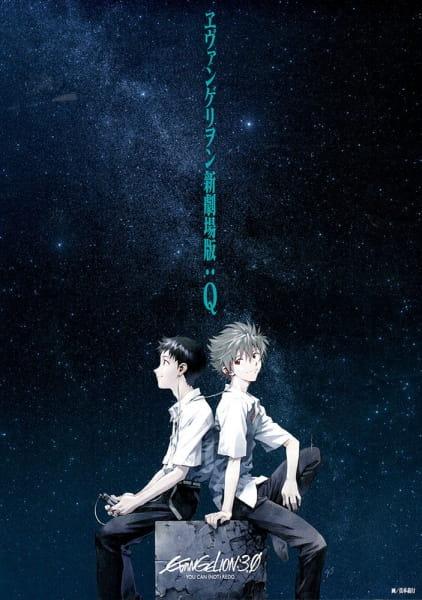
The film directly follows the Rebuild series’ most controversial swerve, Evangelion 3.0, and succeeds by making that disorientation part of the dramatic argument instead of simply returning to the 1995 television template.
- 5
Its tag profile captures the film’s unusual tonal spread: Coming of Age at 94%, Post-Apocalyptic at 93%, Philosophy at 85%, Space at 82%, CGI at 63%, and Ships at 60%, signaling a finale that mixes therapy, war machinery, and mythic scale.
Fun Facts & Trivia
- Fun fact 1
- Thrice Upon a Time aired on March 8, 2021 as a single feature-length entry and is listed as the finished conclusion to the Rebuild of Evangelion film project.
- Fun fact 2
- Hideaki Anno is credited twice in the key staff data: as the original creator and as chief director, reinforcing how closely the film’s reception is tied to his personal authorship of Evangelion.
- Fun fact 3
- The character-design lineage bridges old and new Evangelion: Yoshiyuki Sadamoto, the franchise’s iconic original character designer, is credited alongside Takeshi Honda for original character design.
- Fun fact 4
- The film carries the Award Winning genre label in the database data and holds strong cross-platform reception markers, with an 8.58 MAL score from 195,098 votes and an AniList score of 85/100.
- Fun fact 5
- AniList records 6,996 favourites for the film, a notable figure for a single-episode theatrical release and a sign that its finale status translated into lasting fan attachment.
Studios
- Khara