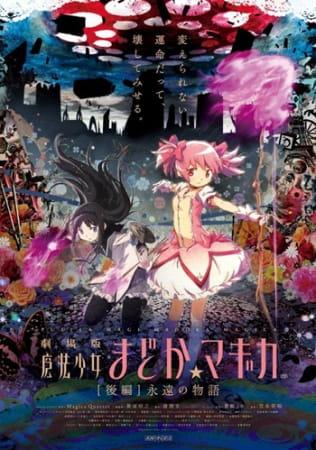
Puella Magi Madoka Magica the Movie: Rebellion
劇場版 魔法少女まどか☆マギカ 叛逆の物語 (Mahou Shoujo Madoka☆Magica Movie 3: Hangyaku no Monogatari)
- Award Winning
- Drama
- Suspense
- Mahou Shoujo
- Psychological
- Episodes
- 1
- Duration
- 1 hr 56 min
- Aired
- Oct 26, 2013
- Status
- Finished Airing
Synopsis
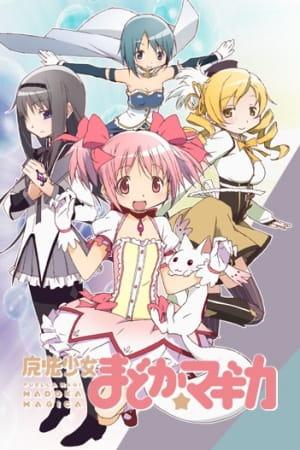
In Mitakihara, Madoka Kaname and the other magical girls settle into an oddly comfortable routine—days spent like any other, interrupted only by occasional battles against evil. The calm feels too perfect, and Homura Akemi can’t shake the sense that something is fundamentally out of place. While everyone else accepts the peace as normal, Homura notices a contradiction she can’t ignore: someone who shouldn’t exist is living alongside them.
*Puella Magi Madoka Magica the Movie: Rebellion* centers on Homura’s search for the truth behind this carefully arranged world. As the mystery tightens, her determination turns increasingly desperate, driven by a love that refuses to fade and the painful consequences that come with uncovering what lies beneath the surface.
Otaku Consensus
Rebellion earns its high critical standing by treating the sequel film format as a formal experiment: Shaft's collage-heavy direction, the eerily sustained first-half pacing, and the widely singled-out Homura-versus-Mami set piece turn a franchise epilogue into a psychological pressure chamber. Its real fault line is necessity: even positive viewers concede it risks reopening a complete ending, and detractors call it visually dazzling but narratively superfluous.
Why You Should Watch
Watch Rebellion if you want a magical-girl film that argues with its own franchise instead of simply extending it. It is best for viewers who loved the original series' moral traps and want the emotional temperature pushed higher without losing Shaft's theatrical weirdness: cutout textures, ritualized transformations, urban-fantasy unease, and fight choreography that feels like stage magic turning hostile. It scratches a similar itch to The End of Evangelion in how it revisits closure as a psychological battleground, while its visual density will click with fans of Shaft's Monogatari work. Come for Homura as an anti-hero study, stay for a feature-length escalation of the series' philosophy, yuri-coded devotion, and suspense mechanics.
Key Characters
- HHomura Akemi(VA: Chiwa Saitou)
Homura is the film's moral stress test, with fans often centering debate on whether her devotion reads as tragic loyalty, anti-heroic obsession, or both.
- MMadoka Kaname(VA: Aoi Yuuki)
Madoka functions less as a standard lead here than as the emotional and philosophical reference point every major choice bends around.
- KKyuubey(VA: Emiri Katou)
Kyuubey remains compelling because the character's calm, utilitarian logic turns cosmic horror into something that speaks in a small, polite voice.
- SSayaka Miki(VA: Eri Kitamura)
Sayaka's presence gives the film one of its sharpest tonal contrasts, mixing brash magical-girl energy with the franchise's habit of making heroism psychologically expensive.
What Makes It Stand Out
- 1
Studio Shaft's visual language is not just polished here; it leans into mixed-media construction, with witch-battle spaces using paper-cutout textures, clashing art styles, and theatrical composition rather than conventional action backgrounds.
- 2
The Homura-versus-Mami sequence has become the film's most cited action showcase, with critics singling out its roughly five-minute gun-and-ribbon choreography as reason enough to watch the movie.
- 3
The film's structure is deliberately destabilizing: its early calm is paced like an eerie stage play, making the viewer question the rules of the setting before the story begins answering them.
- 4
Gen Urobuchi's writing reframes the sequel as a philosophical challenge to the original series' closure, which is exactly why viewers split between calling it essential character work and an unnecessary continuation.
- 5
The soundtrack is repeatedly praised for maintaining a strange, enveloping atmosphere, especially in the first half where the music supports unease more than spectacle.
Fun Facts & Trivia
- Fun fact 1
- Rebellion premiered in Japan on October 26, 2013 as the third Madoka Magica movie, following the franchise's earlier film adaptations of the television series.
- Fun fact 2
- The core creative lineup kept the franchise's signature identity intact: Magica Quartet is credited as original creator, Ume Aoki supplied the original character designs, Akiyuki Shinbou served as chief director, and Yukihiro Miyamoto directed.
- Fun fact 3
- Gen Urobuchi is credited with series composition, which matters because the film's divisive reputation is tied directly to how it extends and contests the original series' ending rather than functioning as a side story.
- Fun fact 4
- The animation credits highlight how much of the film's impact is craft-driven: Takahiro Kishida and Junichirou Taniguchi handled character design, while Kouichi Kikuta and Yuuya Geshi are listed as main animators.
- Fun fact 5
- Its database footprint reflects its unusual fan profile: AniList tags it at 95% Anti-Hero, 80% Philosophy, 81% Yuri, and 79% LGBTQ+ Themes, while MyAnimeList users have kept it at an 8.51 average from more than 253,000 votes.
Studios
- Shaft