Komi Can't Communicate
古見さんは、コミュ症です。 (Komi-san wa, Comyushou desu.)
- Comedy
- School
- Episodes
- 12
- Duration
- 23 min per ep
- Aired
- Oct 7, 2021 to Dec 23, 2021
- Status
- Finished Airing
Synopsis
On his first day of high school, unremarkable Hitohito Tadano hopes to keep his head down and fit in. That plan derails the moment he ends up seated next to Shouko Komi, the class idol whose beauty and poise make her the center of everyone’s attention—along with the target of jealous classmates eager for her spot.
Komi’s calm, untouchable aura hides a harsh reality: overwhelming anxiety and a communication disorder that makes speaking to others nearly impossible. When circumstances leave the two alone, she finally manages to express herself by writing on the classroom blackboard, and Tadano becomes the first to understand what she’s struggling with. Learning that Komi dreams of making 100 friends in high school, he chooses to support her—starting by becoming her very first friend.
Otaku Consensus
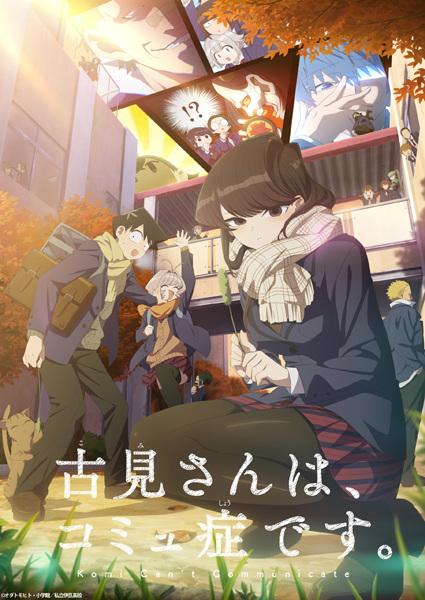
Komi Can't Communicate lands because OLM, chief director Ayumu Watanabe, and director Kazuki Kawagoe treat a school gag manga as a timing exercise: pauses, written text, exaggerated cutaways, and deadpan reactions do as much work as dialogue. Critics and fans broadly read it as a warm, light slice-of-life comedy with strong adaptation instincts and accessible episodic pacing, while the most common pushback is that its low-drama, skit-based structure can feel incomplete or thin for viewers expecting sustained plot momentum.
Why You Should Watch
Watch Komi Can't Communicate if you want a school comedy that treats social anxiety as both a serious barrier and a source of highly formalized visual humor, without turning the show into melodrama. It scratches a similar itch to Hitoribocchi no Marumaru Seikatsu in its anxiety-driven friendship comedy, and to Monthly Girls' Nozaki-kun in the way it builds jokes from classroom archetypes and deadpan misunderstandings rather than plot twists. The 12-episode first season is especially good for viewers who like compact, episodic pacing: each chapter-like segment has a clear comic shape, so the show works in small doses. If your ideal comfort anime has expressive reaction shots, school-culture absurdity, and a gentle emotional baseline without heavy conflict, this is one of the more polished 2021 options.
Key Characters
- SShouko Komi(VA: Aoi Koga)
Shouko Komi became a fan-favorite kuudere because her comedy depends on micro-reactions, posture, and written expression rather than the usual high-energy heroine performance.
- HHitohito Tadano(VA: Gakuto Kajiwara)
Hitohito Tadano works as the series' comic stabilizer: an intentionally ordinary lead whose observational role lets the more extreme school personalities play louder around him.
What Makes It Stand Out
- 1
The anime was produced by OLM, and its visual approach leans into manga-like timing: on-screen writing, abrupt expression shifts, and stylized reaction cuts are central to the comedy rather than decorative extras.
- 2
The season's 12 episodes aired from October 7 to December 23, 2021, giving it a compact fall-season run that matches its chapter-like, episodic structure rather than forcing a long dramatic arc.
- 3
AniList's tag profile captures the show's unusual blend: School at 96%, Kuudere at 92%, Disability at 89%, Episodic at 87%, and Slapstick at 86%, which is a rare combination of social-anxiety framing and broad gag-comedy mechanics.
- 4
The staff structure is notable for pairing Ayumu Watanabe as chief director with Kazuki Kawagoe as director, a setup that helps explain the show's controlled comic rhythm and polished adaptation feel.
- 5
Its reception sits in a strong mainstream sweet spot: a 7.78 MAL score from 544,974 votes, MAL popularity rank #184, AniList score of 76/100, and 8,844 AniList favorites point to broad appeal beyond niche slice-of-life audiences.
Fun Facts & Trivia
- Fun fact 1
- The original creator is Tomohito Oda, with Takenori Ichihara, Yuri Yoshimoto, and Katsumasa Ogura credited for original work assistance in the production data.
- Fun fact 2
- Hitomi Mieno handled series composition, while Atsuko Nakajima served as character designer, giving the adaptation a dedicated split between episodic structure and the distinctive clean-lined character presentation.
- Fun fact 3
- The show is listed as Comedy with a School theme, but AniList users also strongly tag it for Disability, Coming of Age, Meta humor, Yandere elements, and Femboy representation, showing how many subculture lanes the cast comedy touches.
- Fun fact 4
- External reception data is unusually consistent across platforms: IMDb lists it at 7.6, AniList at 76/100, and MAL at 7.78/10, all clustering around a positive but not uncritical consensus.
- Fun fact 5
- Several viewer writeups describe it as wholesome and worthwhile while also calling out its incomplete-feeling first-season shape, which matches the common response to a manga adaptation that prioritizes episodic character accumulation over closure.
Studios
- OLM