Raven of the Inner Palace
後宮の烏 (Koukyuu no Karasu)
- Fantasy
- Mystery
- Historical
- Mythology
- Episodes
- 13
- Duration
- 23 min per ep
- Aired
- Oct 1, 2022 to Dec 24, 2022
- Status
- Finished Airing
Synopsis
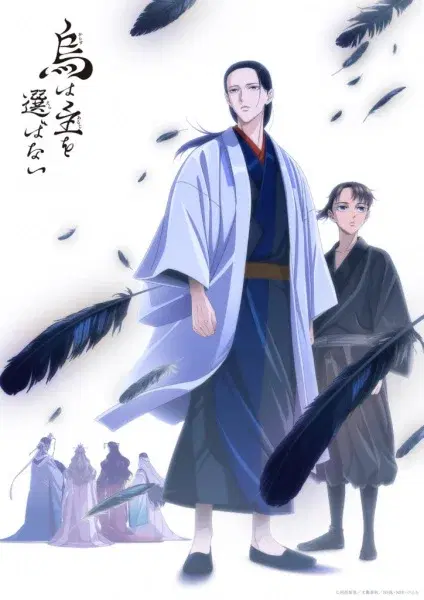
Within the imperial court, few figures inspire as much awe and unease as Ryuu Jusetsu, the Raven Consort. Secluded in a palace of deep black and kept apart from the emperor, she has become the center of whispered tales—some say she wields supernatural power, able to recover what’s been lost or lay curses at a single request. Unmoved by the rumors, Jusetsu keeps to a quiet, solitary life until the young emperor Ka Koushun arrives in person, seeking her help with a puzzling matter.
His visit forces Jusetsu to leave her sanctuary for the first time, and though his repeated appearances test her patience, she finds herself unable to refuse him. Bound by teachings that insist the Raven Consort must remain alone and want for nothing, she nonetheless takes an early step toward connection by choosing the curious court girl Jiujiu as her sole attendant. As requests from within the palace begin to draw them into hidden truths, the attention surrounding the Raven Consort threatens to awaken dangers beyond the court—and stir a past better left untouched.
Otaku Consensus
Raven of the Inner Palace earns its 7.53 MAL score by treating palace fantasy as chamber-piece mystery: Chizuru Miyawaki’s restrained direction, BN Pictures’ subdued visual design, and the adaptation’s mythological case structure give it a texture that feels more curated than flashy. Critics and fans consistently praise the Raven Consort’s striking art, the elegant court atmosphere, and the series’ ability to turn a niche premise into a surprisingly polished 13-episode watch. The recurring complaint is equally consistent: its slow pace and cliffhanger ending make the season feel more like an opening volume than a complete dramatic payoff.
Why You Should Watch
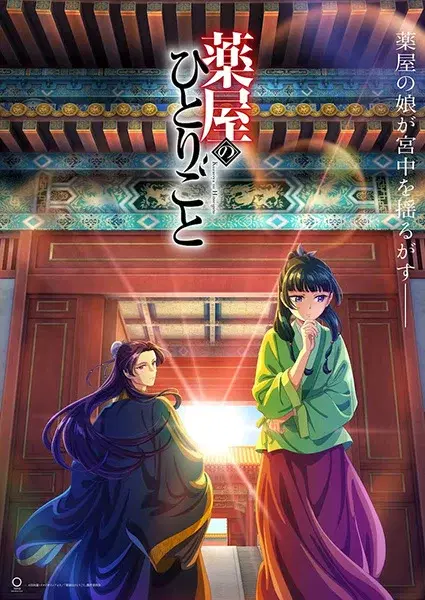
Watch Raven of the Inner Palace if you want imperial-court mystery with ghosts, ritual, and emotional residue instead of swordplay or loud political scheming. It scratches part of the same itch as The Apothecary Diaries in its interest in palace hierarchies and hidden court histories, while its episodic supernatural investigations lean closer to the quiet melancholy of Mushishi than to action fantasy. The appeal is in the texture: black-palace iconography, accessory-heavy character design, necromancy-tinged cases, and a heroine whose isolation is treated as a system to be examined rather than a personality quirk. Viewers who like slow-burn shoujo-adjacent fantasy, adult court casts, and mythology filtered through detective storytelling will get the most from it; viewers needing constant momentum may feel the deliberate tempo immediately.
Key Characters
- KKoushun Ka(VA: Masaaki Mizunaka)
Koushun works as the series’ political pressure point: a young emperor whose repeated visits turn formal court distance into a test of trust, authority, and emotional restraint.
- JJusetsu Ryuu(VA: Saku Mizuno)
Jusetsu is compelling because her kuudere reserve is not just an attitude but an inherited role, making every small social choice feel like a breach in palace doctrine.
What Makes It Stand Out
- 1
Bandai Namco Pictures produced the 13-episode adaptation, giving the series a controlled, subdued look rather than the high-motion spectacle associated with many fantasy titles. Review coverage specifically noted that it lacks dynamic vibrancy but compensates with a pleasing, atmospheric art style.
- 2
The series is built around detective-style supernatural cases, reflected in AniList’s high Detective tag at 88% and Episodic tag at 76%. That structure makes the season feel like a sequence of court hauntings and ritual inquiries rather than a single linear fantasy quest.
- 3
Its visual identity leans heavily on court ornamentation: Shinji Takeuchi handled character design from Ayuko’s original designs, while Yumi Nakamura is credited specifically for accessory design. That production split matters in a show where status, ritual, and presentation are communicated through robes, hairpieces, and formal silhouettes.
- 4
The setting is coded as historical and foreign within anime tag taxonomies, with AniList placing Historical at 90% and Foreign at 95%. Combined with Mythology at 80%, the show distinguishes itself from generic palace fantasy by foregrounding invented court customs and spiritual rules.
- 5
The main cast dynamic is unusually restrained for a fantasy mystery: AniList tags the series with Primarily Adult Cast at 88%, Kuudere at 85%, and Politics at 71%. That combination signals a drama driven less by adolescent escalation and more by etiquette, power boundaries, and withheld information.
Fun Facts & Trivia
- Fun fact 1
- Raven of the Inner Palace began as a Japanese light novel series written by Kōko Shirakawa and illustrated by Ayuko before receiving its 2022 television anime adaptation.
- Fun fact 2
- The anime aired in a single cour from October 1, 2022 to December 24, 2022, finishing with 13 episodes during the Fall 2022 season.
- Fun fact 3
- Chizuru Miyawaki directed the anime, with Satomi Ooshima on series composition, creating a staff structure that paired restrained episode-by-episode mystery writing with a visually formal court presentation.
- Fun fact 4
- The art-side credits are unusually granular for a database listing: Norifumi Nakamura served as art director, Jirou Kouno handled art design, Ritsuko Utagawa handled color design, and Naotaka Watanabe was director of photography.
- Fun fact 5
- Across audience databases, the series sits in the respected-but-niche zone: MAL lists it at 7.53 from 46,197 votes with popularity around #2044, while AniList records a 73/100 score and 907 favourites.
Studios
- Bandai Namco Pictures